

The Stock Exchange of Thailand (SET) is set to introduce eight revised trading measures today, November 16, 2026, covering smaller tick sizes, changes to short-selling rules, tighter oversight of high-frequency trading (HFT) and the removal of certain restrictions. The changes aim to improve trading efficiency, lower transaction costs and strengthen confidence in Thailand’s capital market.
The reforms seek to balance greater liquidity with market stability through more targeted oversight of inappropriate order-submission practices, while easing some trading restrictions to keep pace with market developments and international practices.
Among the key changes, the SET will reduce tick sizes—the minimum price increments for trading—for shares priced from 5 baht to below 50 baht. For shares priced from 5 baht to below 10 baht, the tick size will fall from 0.05 baht to 0.02 baht. For those priced from 10 baht to below 25 baht, it will decline from 0.10 baht to 0.05 baht, while the increment for shares priced from 25 baht to below 50 baht will narrow from 0.25 baht to 0.10 baht.
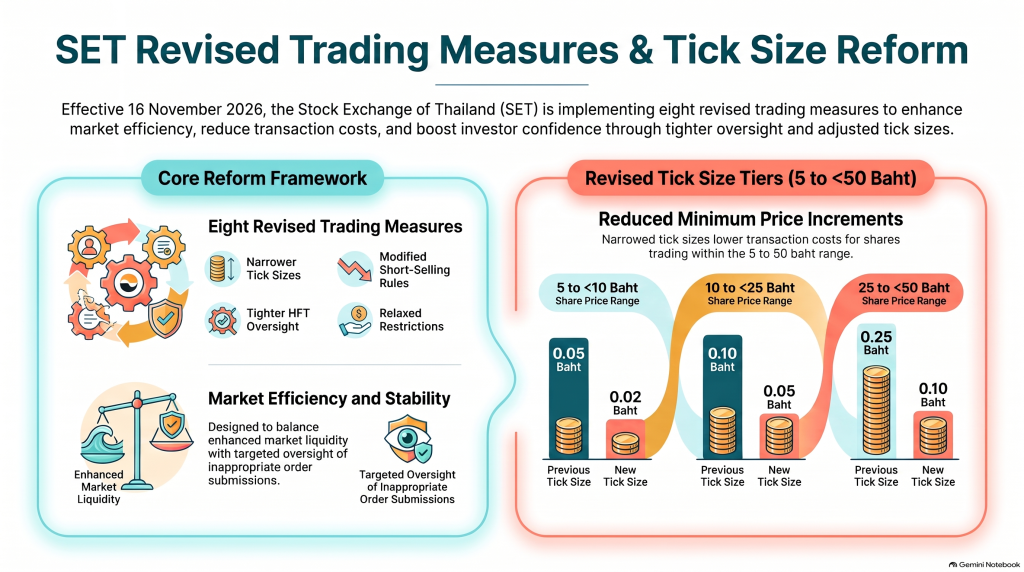
The smaller increments will allow investors to submit more precisely priced bids and offers, narrow bid-ask spreads and increase the likelihood of orders being matched. The changes are expected to lower transaction costs and support liquidity in the Thai stock market.
To strengthen oversight of order submissions, the SET will charge securities firms an additional fee for accounts with an order-to-trade ratio (OTR) above 50 and an average order-submission rate exceeding 50 orders per minute. The fee will apply only to orders exceeding 15,000 per day, at 0.15 baht per order. The measure aims to discourage unnecessary order submissions and reduce the burden on trading-system resources.
For short selling under normal market conditions, the SET will adopt the Zero-Plus Tick rule, allowing short-sale orders at or above the last traded price to provide greater flexibility and ease trading restrictions.
However, if a security closes at least 10% below its previous trading day’s closing price, the Uptick Rule will apply on the following trading day. Short-sale orders will then have to be priced above the last traded price, helping to curb selling pressure during sharp price declines.
The SET will also revise the range of securities eligible for short selling, limiting it to highly liquid instruments: SET100 constituents, shares underlying single-stock futures contracts, depositary receipts (DRs) representing foreign securities, and exchange-traded funds (ETFs). The change aims to reduce the risks associated with short selling less liquid stocks.
For HFT oversight, the exchange will revise registration requirements for investors using dedicated application programming interface (API) order-submission channels or displaying trading patterns classified as HFT. Assessments will consider order frequency and speed, daily trading value and end-of-day securities holdings, allowing more effective monitoring and supervision.
At the same time, the SET will remove restrictions on the types of securities HFT participants may trade. They will be allowed to trade all types of securities on the same basis as other investors, providing greater investment flexibility and equal market access.
Other measures being withdrawn include the Dynamic Price Band (DPB) for individual securities. Its removal is intended to reduce trading obstacles, particularly for small-cap and low-liquidity stocks that may be affected by price-band restrictions.
The exchange will also abolish the Minimum Resting Time (MRT) requirement, which specifies how long an order must remain in the system before it can be amended or cancelled. The change will give investors greater flexibility in managing orders and reduce the system’s burden on securities firms.
Investors with outstanding Good Till Cancelled (GTC) and Good Till Date (GTD) orders should review their existing orders. The exchange will cancel all overnight orders on the SET and the Market for Alternative Investment (mai) before trading opens on November 16, 2026, to accommodate the new tick sizes. Investors should consider resubmitting orders in line with the revised price increments.
The eight measures represent a significant change to Thailand’s stock market trading framework. Their effects on order submissions, trading volume and value, and price volatility will warrant monitoring, particularly for stocks affected by the tick-size adjustments and revised short-selling rules.
Separately, the SET and the Thailand Futures Exchange (TFEX) will extend morning trading hours for selected products, bringing the start of trading forward to 8 a.m. from November 16, 2026. The move aims to give investors more convenient and efficient access to foreign assets.
On the SET, trading in DRs, derivative warrants (DWs) and ETFs linked to foreign securities will begin at 8 a.m., rather than 10 a.m. The closing time will remain unchanged at 4:30 p.m., while existing night-session hours for eligible DRs will also remain in place.
On TFEX, trading in currency futures and options, precious metal futures and rubber futures will begin at 8 a.m., instead of 9:45 a.m.
Currency futures and options will also trade continuously throughout the daytime session, without a midday break. Existing night-session hours for precious metal futures and currency futures will remain unchanged.
The extended hours are intended to improve access to foreign assets and give investors more opportunities to manage risk and adjust their trading strategies in response to developments and price movements in global markets.