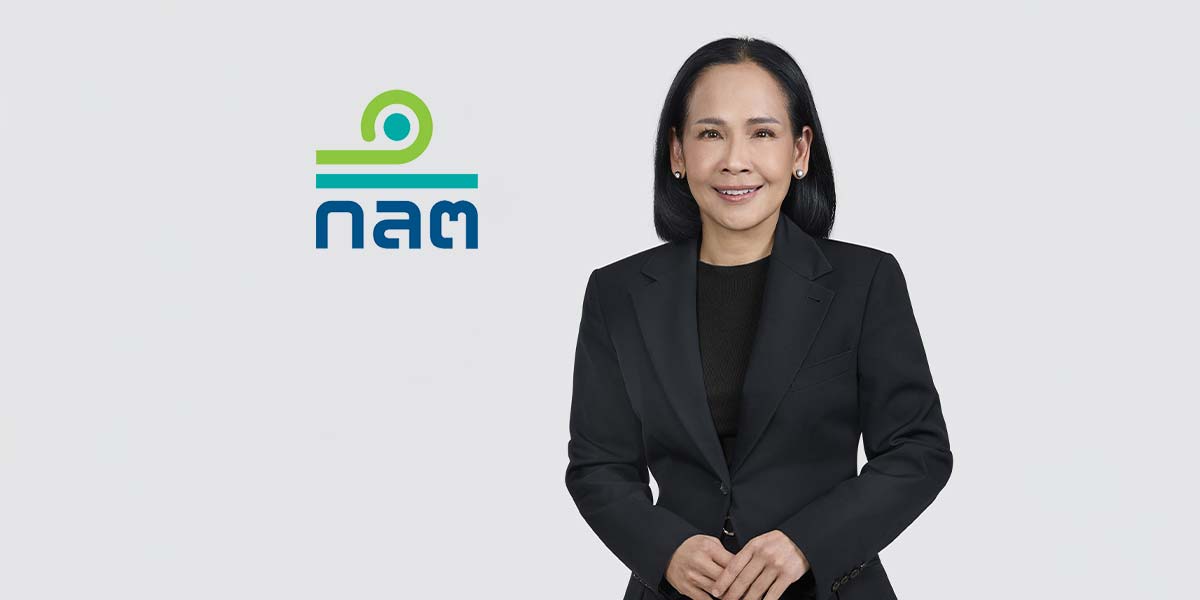
The changing context of the capital market has compelled regulatory agencies like the Securities and Exchange Commission (SEC) to work strenuously in development, improvement, and supervision. Undoubtedly, the “Secretary-General” of the SEC, as the “leader,” bears a significant burden as well.
Especially in this era, where the world and information flow at a rapid pace and the SEC must fulfill the expectations of all participants connected to the capital market amid various issues. Notable cases include Stark Corporation Public Company Limited (STARK)’s financial statement fraud saga exceeding 30 billion baht, and JKN Global Group Public Company Limited (JKN), which defaulted on bond payments and faced delisting from the Stock Exchange in 2025. There are also issues of grey capital, where the Anti-Money Laundering Office (AMLO) has indicated the Thai stock market is used for money laundering, as well as investment scam cases.
“Kaohoon” had the opportunity to speak with Mrs. Pornanong Budsaratragoon, who has sat as the Secretary-General of the SEC for over two years, tackling demanding tasks from her very first day.
“When I started, the market was not doing well—it was about the economy and various other factors. I came in to supervise the enforcement of regulations and answer many questions, whether about STARK or other matters. Once things began to settle, I focused more on policy, but then confronted issues like short selling and others. We must answer these based on empirical evidence, criteria, or standards, and address each issue case by case.
At that time, issues in the bond market affected the real estate sector, a major issuer of bonds, which also links to the construction sector. We had to ensure confidence.”
The Secretary-General of the SEC is confident that the agency properly enforces laws stringently and has improved response time for various cases compared to the past, with particular attention to grey capital and investment scams.
“We are quite confident regarding law enforcement. The process has significantly improved—not that there are fewer cases, but the handling time is better, with improved systems.
Regarding grey capital, initially, scammers were focused on fraudulent schemes, which became widespread. We discussed platforms and providers as the regulator. Social media usage in our country is among the highest, and when linked to grey capital, we proactively address it. Some issues, like money laundering, fall under the jurisdiction of AMLO, but we continuously investigate and monitor.”
For Initial Public Offerings (IPOs), the focus is on quality rather than quantity. Consultations are ongoing with the Federation of Thai Capital Market Organizations (FETCO) and its members in considering necessary adjustments.
“Structural problems in the Thai capital market are significant. There are proposals to loosen regulations, but we maintain that IPOs must have quality. We are also considering attracting BOI-promoted companies to list in the Thai stock market, seeking new sectors. Any obstacles are discussed, as many relate to SET criteria.”
The Thai capital market still requires investors who emphasize automatic, high-speed trading or HFT (High-Frequency Trading) and Short Sale. Their removal could lead to the outflow of foreign funds (Fund Flow).
“When traveling abroad, some funds or global investors ask when we will abolish Uptick or restrict or ban Short Sale—something that has been much discussed over the past two years. Abolishing it is easy, but if done, Fund Flow will rapidly exit, and it will be hard to get it back—South Korea’s stock market is an example. HFT investment adds liquidity. We are not abolishing these. There is no right or wrong, but we continuously monitor as fairness and neutrality are core to our regulation,” Mrs. Pornanong added.