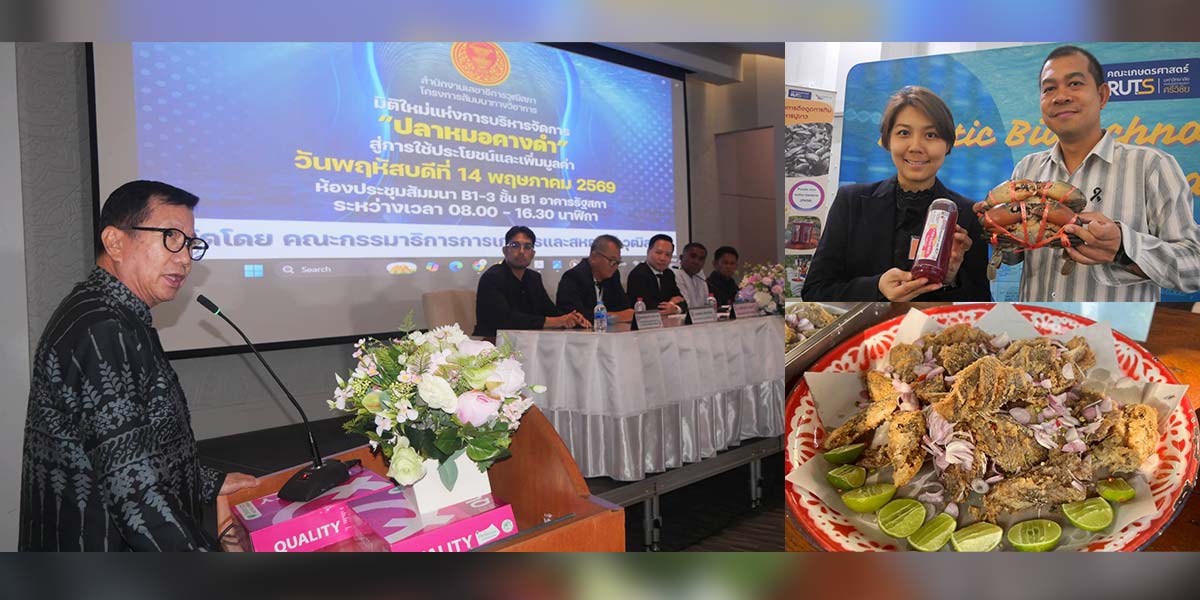
Thailand’s Senate Committee on Agriculture and Cooperatives is proposing a new approach to managing Blackchin tilapia, shifting the focus from eradication alone to systematic utilization and value-added processing as a way to reduce ecological impacts while creating income opportunities for farmers, fishers and local communities.
The proposal was discussed at an academic seminar titled “A New Dimension in Blackchin Tilapia Management: Utilization and Value Creation,” held at the Parliament Building on May 14, 2026. The event was presided over by General Kriangkrai Srirak, First Vice President of the Senate, and organized by the Senate Committee on Agriculture and Cooperatives, chaired by Thawat Suraban.
The seminar brought together policymakers, academics, farmers, community enterprises and relevant agencies to explore practical ways to manage the large population of alien species now found in natural water sources, while transforming the issue into an economic opportunity. Backed by research highlighting the fish’s high nutritional value, the committee aims to promote policy measures supporting procurement and value-added processing to create sustainable income opportunities for farmers and local communities.
Mr. Thawat said Thailand must recognize the practical reality that complete eradication of Blackchin tilapia is unlikely. The more urgent question, he said, is how to manage the species responsibly and convert the existing population into useful raw material.
He said Blakchin tilapia could become an upstream raw material for several value-added products if supported by proper procurement systems, processing standards and risk-control measures. Potential applications include fermented fish products, chili paste, fish sauce, bio-fermented products, animal feed, bio-fertilizer and other processed goods that can support women’s groups, community enterprises and small-scale fishers.
In some provinces, blackchin tilapia is already being used as feed for crabs and seabass, helping farmers reduce feed costs while converting the invasive fish into a useful resource. Thai researchers have also succeeded in extracting calcium and other valuable compounds from the fish, further expanding its potential for value-added applications.
Policy Support and Controlled Movement
Mr. Thawat also called for a review of existing regulations to allow inspected and controlled blackchin tilapia, which no longer poses a risk of further spread, to be transported outside restricted areas for industrial use, including fishmeal production.
He said such measures would help create a more practical management system by combining ecological control with economic value creation.
“It depends on perspective and value creation,” he said.
Research Points to Value-Added Potential
Research presented at the seminar indicated that Blackchin tilapia has potential for further development in several areas, including animal feed production, bio-fertilizer, collagen extraction and food processing.
Preliminary studies also found that the bones of Blackchin tilapia contain significant nutrients, with some qualities comparable to certain commercial marine fish species. This opens up potential opportunities for use in food, health and agricultural industries, provided that safety standards and proper processing controls are applied.
Toward a Circular Economy Model
The Senate Committee plans to compile recommendations from the seminar into a policy report for submission to the government and relevant agencies.
The report is expected to propose measures such as continuous procurement mechanisms, local processing centers, community-level value-added production and regulatory adjustments to support safe utilization of blackchin tilapia.
The committee said the goal is to build a circular economy model that turns blackchin tilapia from burden into a commercially viable raw material — helping reduce pressure on natural ecosystems while generating economic circulation in local communities.