

FWD Life Insurance Public Company Limited (FWD Life Insurance) has launched the Thailand Longevity Readiness Index, the first index of its kind in Thailand to measure how ready Thais are for the Longevity era. NielsenIQ conducted the study and co-developed its framework and research methodology. The index covers three pillars – Healthier (health), Wealthier (finances) and Happier (emotional wellbeing and lifestyle) – assessed across 10 dimensions.
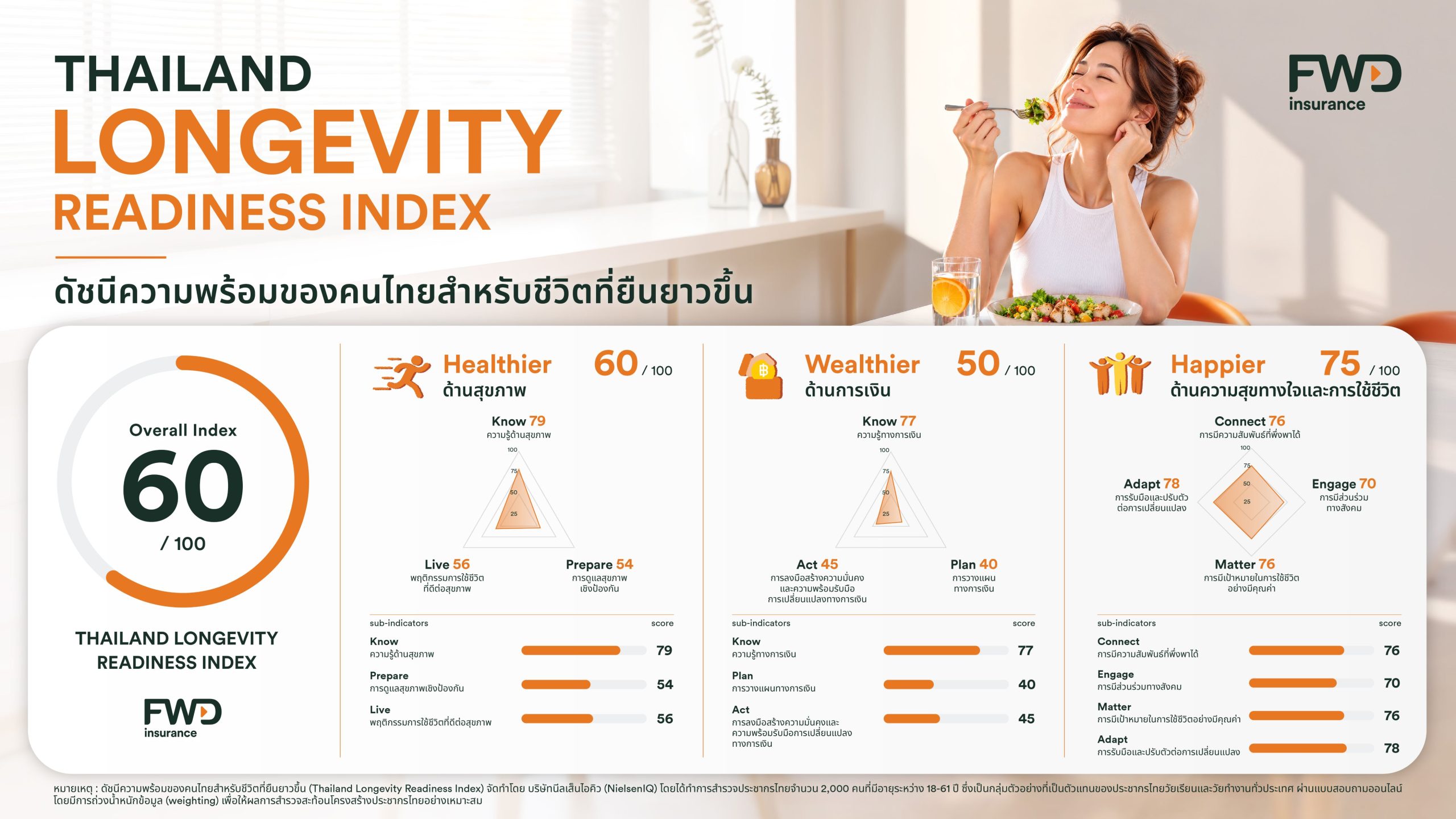
The first-year results show an overall readiness score of 60 out of 100. While 79% of respondents have planned their lives up to the age of 70 or beyond, only 31% rate themselves as well or very well prepared for a longer life, revealing a gap between the expectation of living longer and actual preparation. The findings underline the importance of encouraging Thais to turn their knowledge of health, finances, and emotional wellbeing and lifestyle into action, so that they are ready to enjoy a longer life with quality.
Mr. Knattapisit Krutkrongchai, Chief Executive Officer of FWD Life Insurance Public Company Limited, said: “A longer life is not simply about having more time; it is about being ready to make the most of that time – in health, in finances, and in emotional wellbeing and lifestyle. That is why FWD Life Insurance initiated the Thailand Longevity Readiness Index, with NielsenIQ conducting the study as our research expert, to understand how ready Thais are in each area and which issues deserve greater attention. Our aim is to make preparing for a longer life in the Longevity era something everyone can start today.”
The Thailand Longevity Readiness Index surveyed 2,000 Thai students and working adults aged 18–61 nationwide through an online panel covering Gen X, Gen Y and Gen Z. Results were weighted to reflect Thailand’s 2025 population structure, based on data from the National Statistical Office. The index assesses readiness across three pillars – Healthier (health), Wealthier (finances) and Happier (emotional wellbeing and lifestyle) – through 10 dimensions and 34 questions. It draws on established frameworks, including the WHO’s Healthy Ageing and ICOPE, OECD/INFE and the CFPB, as well as the OECD/JRC handbook on constructing composite indicators, to provide a holistic assessment of readiness for a longer life.
Each response was converted into a score from 0 to 100 to assess each respondent’s readiness in each dimension, before being aggregated into pillar scores and an overall index score. Pillar scores were combined using a geometric mean – the same principle used in the UNDP’s Human Development Index (HDI) – adapted to suit this framework. As this is the first year of the study, there is no previous-year baseline for comparison. This year’s results therefore focus on comparing dimensions within the same framework to identify strengths and areas for further development.
The first-year results show an overall readiness score of 60 out of 100. Happier scored highest at 75 points, followed by Healthier at 60 and Wealthier at 50. This indicates that respondents’ readiness in emotional wellbeing and lifestyle stands out from the other two pillars, while finances scored lowest. Some 79% of respondents have planned their lives up to the age of 70 or beyond, yet only 31% say they are well or very well prepared, making this a key issue in promoting readiness for a longer life.
In the Healthier pillar, Health Literacy scored highest at 79 points, followed by Healthy Lifestyle at 56 and Preventative Care at 54. The study also found that 40% of respondents have never had a health check-up or wait until they fall ill before getting one. This suggests that health knowledge alone may not be enough unless it translates into consistent self-care.
In the Wealthier pillar, Financial Literacy scored highest at 77 points, followed by Financial Resilience – taking action to build financial security and the ability to cope with financial change – at 45, and Financial Planning at 40. This shows that Thais understand how their finances will be affected by a longer life, but have yet to turn that knowledge into retirement plans, savings and financial safeguards for a life that may last longer than they expect.
In the Happier pillar, Resilience & Adaptability scored highest at 78 points, followed by Social Support and Purpose & Contribution, both at 76, and Social Participation at 70. This shows that Thai students and working adults have a solid foundation of emotional wellbeing and lifestyle for a longer life. However, the 25-point gap between the Happier and Wealthier scores suggests that while Thais’ ‘hearts’ are ready for a longer life, their ‘wallets’ have yet to catch up.
“The Thailand Longevity Readiness Index aims to measure readiness to live well in the Longevity era. It is not designed to predict life expectancy or to measure financial status. The study found that Thais are strong in emotional wellbeing and lifestyle, while in health and finances, helping people turn knowledge into action remains important. We hope these insights will help Thais see longevity as something close to home, recognise its connection to their own life planning and start taking action today. We also want to help make preparing for a longer life a shared priority for society, so that Thais can live life to the full and cope with long-term change,” Mr Knattapisit concluded.
The findings released today present the framework and national-level headline results of the Thailand Longevity Readiness Index. In-depth findings and the full report will be published officially on the FWD Life Insurance website in January 2027. FWD Life Insurance will track the index every year as a benchmark of Thais’ readiness for a longer life.