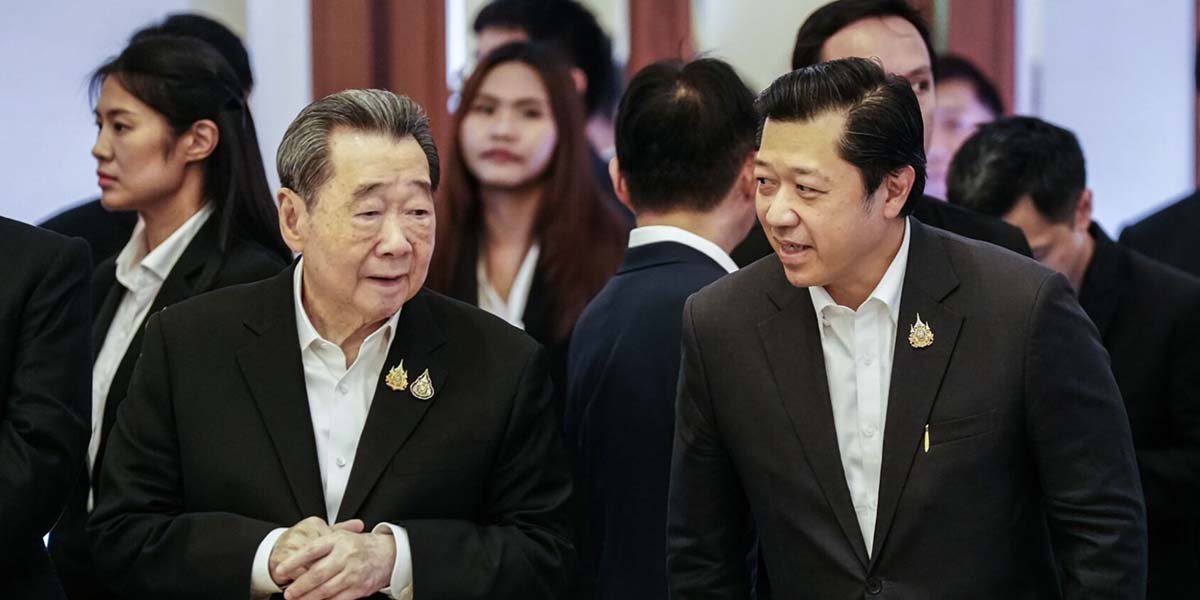
The government has opened the forum “Entrepreneurs Speak, Government Listens” to gather business sector’s vision in driving Thailand’s new era economy. Mr. Suphachai Chearavanont, one of the private sector representatives from CP Group and Arise Ventures Group, proposed five agendas to transform the country’s future—highlighting the world’s first AI Government, building a Startup Ecosystem, attracting global talent, positioning Thailand as a Regional Tech Hub, and accelerating a new economy driven by clean energy and a Green Economy.
In the discussion between government and private sector under the event “The Listening Forum: Voices to the PM—Entrepreneurs Speak, Government Listens” held at Government House to provide a platform for business leaders to present proposals for enhancing the country’s competitiveness, Mr. Suphachai Chearavanont, Senior Vice Chairman of Charoen Pokphand Group and Chairman and CEO of Arise Ventures Group, delivered his multi-dimensional vision to the government. He stated that “Thailand is at a crucial turning point” and must urgently build a new economic structure driven by technology, innovation, and human development so the nation can remain competitive in the era of AI and new geopolitics.
Mr. Suphachai suggested that the most critical starting point is “building a Startup Ecosystem and developing human resources.” He said that Thailand should support Seed Funds and allow the younger generation to experiment with new ideas, thereby creating the country’s future small, medium, and large businesses. He also called for a major overhaul of Thai education by including basic courses in AI, Computing Science, and Digital Technology from early education levels, combined with ingrained AI governance and responsible technology use.
“Today, Thailand has more than 2 million university students and over 9 million students in basic education. If we can enhance AI and technology skills among the youth, Thailand will make a significant leap in human resource quality,” Mr. Suphachai said.
Furthermore, he proposed that Thailand should quickly develop a Cloud Platform and Digital Infrastructure capable of filtering inappropriate content and supporting creative content, so that children and young people can access the internet, computers, and technology learning equally. He also called for raising the standard of vocational education to align with the digital economy of the future.
Another crucial point Mr. Suphachai raised was attracting quality talent from around the world. He sees high potential for Thailand to become a “Global Talent Destination,” drawing the professionals that Thailand currently lacks. This is to strengthen the country, bring in new technologies, expertise in needed fields, or future-centric businesses to create jobs and a new economy, provided that appropriate incentives in terms of tax, quality of life, innovation ecosystem, and job opportunities are put in place.
“Thailand’s strengths in food, tourism, culture, and quality of life are admired globally. If we establish a proper support system, Thailand can attract top global talent on a large scale in the long run,” Mr. Suphachai said, adding that drawing high-level knowledge and skills into the country will become a key mechanism for building the new economy and raising Thailand’s competitiveness.
On technology, Mr. Suphachai noted that the world is moving from “Digital Government” to “AI Government,” which will rapidly transform public administration. He cited Estonia as an example—a country with only about 1.37 million people that established world-class Digital ID and innovation ecosystems. If Thailand succeeds, it will be the first country in the world to have an AI Government instead of an E-Government.
Mr. Suphachai suggested Thailand should capitalize on the global trend of investment in Data Centers and AI Infrastructure by requiring Hyperscaler companies investing in Thailand to establish Research and Development Centers linked with leading Thai universities and jointly develop advanced technology industries—from AI to semiconductors.
He also proposed the government support tax incentives, researcher salaries, and employment of Thai personnel in high-tech fields, similar to Singapore’s approach, to attract both global technology companies, research work, and talent to Thailand and push the country toward becoming a center for education, research, and technology in the region.
Additionally, Mr. Suphachai stated that Thailand has significant “geopolitical advantages,” as it is centrally located, connecting China, the Indian Ocean, Malaysia, and Singapore, a region with an enormous combined economy. If Thailand can upgrade its logistics, trade, and digital connectivity infrastructure, it will be able to become a Regional Hub for trade, finance, and the digital economy in the future.
At the same time, he proposed that in a highly volatile era of geopolitics, Thailand must maintain stability and balance between global powers to turn “crises” into “opportunities,” particularly by accelerating development in Energy Independence, Clean Energy, and a Green Economy, which will become the new engine of Thailand’s economy and a vital opportunity to enhance Thailand’s competitiveness in the long term.
“The world is changing rapidly. Countries that can develop people, technology, and ecosystems that attract innovation first will be advantaged in the future,” Mr. Suphachai concluded, reaffirming that Thailand has the potential to become the economic, technology, and innovation hub of the region, provided all sectors work together with determination and continuity.