
Beyond Platform Fees: Addressing the Causes, Not Just the Symptoms
Regulating Platform Fees May Offer Immediate Relief—but Could It Create New Competition Risks Elsewhere?
Digital platforms have become indispensable gateways connecting businesses with consumers. Online marketplaces, food-delivery platforms, app stores, Online travel Agent-booking services and other multi-sided platforms allow businesses to reach customers on an unprecedented scale. In return, platforms commonly charge commissions, payment-processing fees, advertising fees, logistics charges, subscription fees and other service-related payments.
As businesses become increasingly dependent on these platforms, concerns over the level, complexity and transparency of platform fees have intensified. Calls for regulatory intervention are therefore understandable. A reduction or cap on platform commissions may appear to provide immediate relief to merchants, developers or other business users.
However, the more difficult policy question is not simply whether platform fees are too high. It is whether regulating a particular fee would address the underlying source of the problem—or merely suppress one manifestation of a broader competitive concern.
Platform Fees: The Problem or a Symptom of the Problem?
A platform fee is not inherently anticompetitive. Platforms incur substantial costs in developing and maintaining technology, processing payments, preventing fraud, providing customer support, attracting users, operating logistics networks and creating the infrastructure through which transactions take place.
Fees may therefore constitute legitimate consideration for services that generate genuine commercial value.
The competition concern arises when the level or structure of those fees reflects insufficient competitive constraint rather than the value or cost of the service supplied. This may occur where a platform benefits from substantial network effects, control over data, high switching costs, user lock-in, limited multi-homing or a lack of credible alternative distribution channels.
In those circumstances, high fees may be better understood as:
a manifestation of market power rather than the source of market power itself.
This distinction matters. A measure that reduces a visible commission rate may temporarily relieve pressure on businesses, but it may leave untouched the conditions that enabled the platform to impose that rate in the first place.
The central analytical question should therefore not be limited to:
Is the platform fee excessive?
It should also ask:
What market conditions allow the platform to impose that fee, and what alternatives are realistically available to its business users?
The Appeal—and Limits—of Direct Fee Regulation
Direct regulation can be attractive because it is visible, understandable and capable of producing relatively rapid results. A fee ceiling or prohibition may reduce a particular cost immediately and respond to clear political or commercial concerns.
Regulating one component does not eliminate the commercial incentive to recover revenue. It may instead redirect that incentive towards another part of the ecosystem.
For example, if a commission is capped, a platform might respond by increasing payment or logistics fees, reducing merchant subsidies, introducing new service charges or making commercial visibility more dependent on paid advertising. It might also revise non-price conditions by changing ranking systems, restricting data access, narrowing interoperability or offering differentiated levels of service.
The result could be a lower headline commission but no meaningful reduction in the business user’s total effective cost of participation.
This gives rise to what may be described as strategic substitution or fee shifting: the replacement of a constrained commercial practice with an alternative mechanism that produces a similar economic outcome.
Commercial incentives rarely disappear. They evolve.
Potential Regulatory Side Effects direct fee intervention may generate several unintended consequences;
Migration to less transparent fees, Increased dependence on paid visibility, Bundling of platform services, Reduction in subsidies or service quality or Strategic changes to platform governance.
Different Jurisdictions, Different Regulatory Philosophies
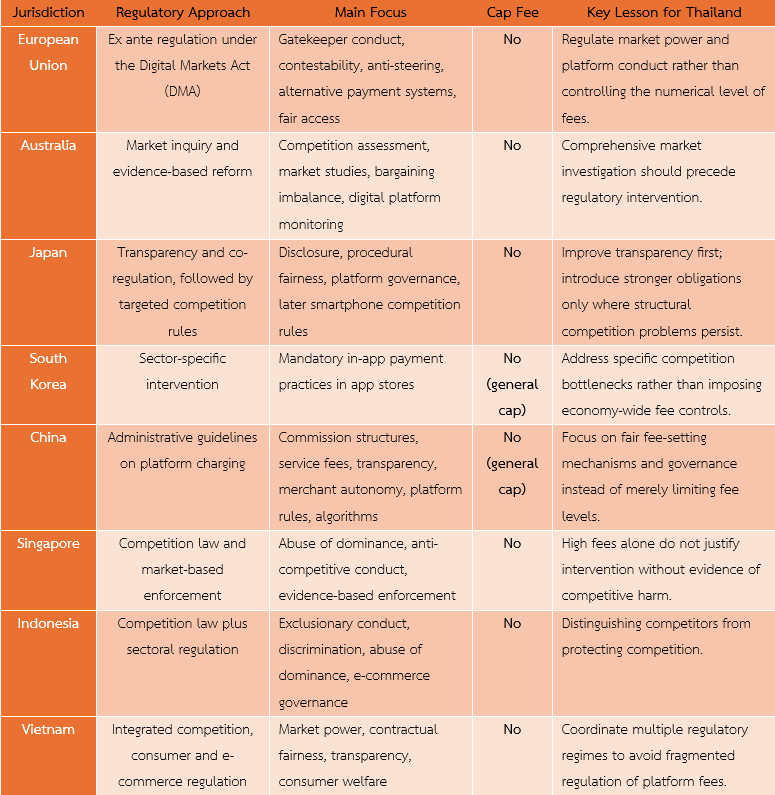
There is no single international model for regulating platform fees. Different jurisdictions have chosen different instruments depending on their legal frameworks, market structures and policy objectives.
The relevant comparison is therefore not simply which country has regulated fees. It is why each jurisdiction selected a particular tool and what aspect of platform power that tool seeks to address.
Towards a More Complete Regulatory Toolkit
It should nevertheless form part of a broader toolkit that may include:
- transparent disclosure of all fees and their calculation methods;
- advance notice and consultation before material fee changes;
- accessible dispute-resolution mechanisms;
- prohibitions on compulsory ancillary services;
- protection against discriminatory treatment;
- interoperability and data-portability measures;
- freedom to use alternative sales or payment channels;
- scrutiny of ranking and recommendation systems;
- periodic market reviews; and
- targeted competition enforcement where market power is abused.
This combination is more likely to address both the visible charge and the ecosystem conditions that sustain it.
Regulating the visible fee alone may treat the symptom rather than the disease.
Where the underlying source of concern is dependency, lock-in, network effects, data control or the absence of viable alternatives, a fee cap may provide temporary relief without restoring competition. Worse, it may redirect commercial incentives towards other charges or less transparent forms of platform control.
The experience of the European Union, Australia, Japan, South Korea, China and Southeast Asian jurisdictions demonstrates that there is no universal regulatory model. Some systems focus on gatekeeper conduct, others on transparency, market inquiries, payment choice, unfair trading practices or the reasonableness of the fee-setting process.
Effective competition policy must look beyond the headline commission. It must examine the architecture of the platform, the incentives created by regulation and the full range of ways in which market power may be exercised.
Key Takeaway
Constraining one platform fee does not eliminate the underlying economic incentive.
Unless regulation addresses the competitive conditions that give rise to the fee, the cost may simply reappear elsewhere—in another charge, another contractual condition or another layer of the platform’s governance system.