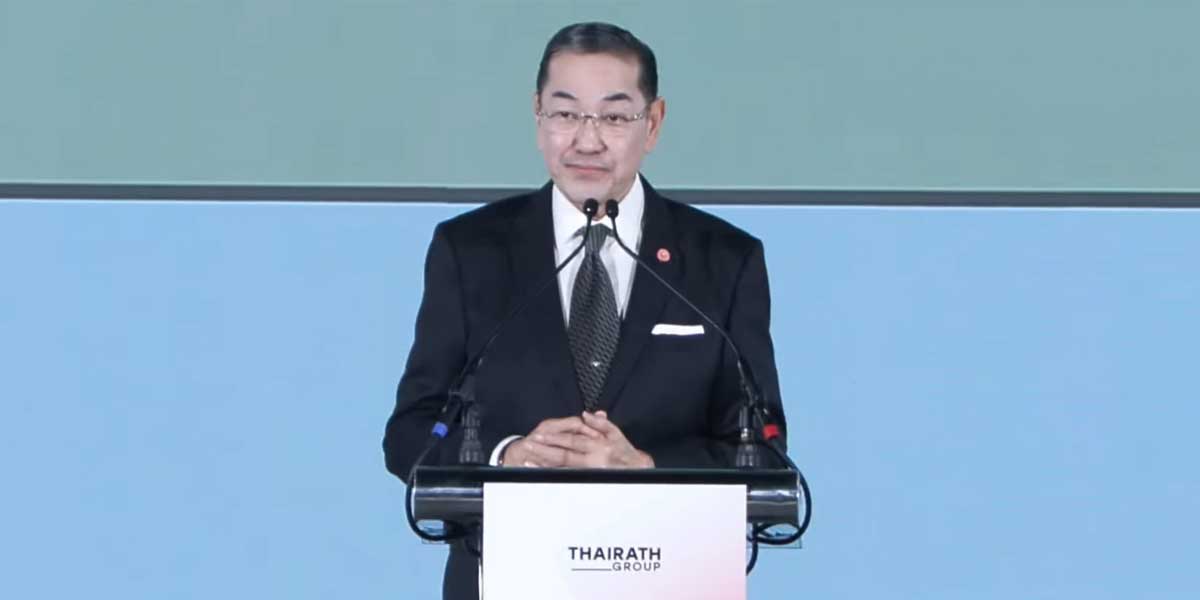
Former Deputy Prime Minister Surakiart Sathirathai has urged Thailand to reposition itself as a resilient regional hub as the global economy enters an era of prolonged uncertainty, proposing seven principles for reducing vulnerabilities and four new growth engines to drive the country’s next phase of development.
Speaking at the THAIRATH FORUM 2026: “THAILAND IN THE NEW GLOBAL ORDER” on Aug. 31, Surakiart, who is also chairman of the Council of Chulalongkorn University, said the world is moving into a period of chronic crises that could become the new normal.
He described the current global environment as one of “no major war, but no peace,” noting that even when individual industrial or armed conflicts subside, their structural economic and geopolitical effects could persist for years.
The changing environment is also forcing a fundamental shift in the global economic order, from an “Efficiency First” and “Just-In-Time” model focused on minimizing costs toward a “Security First” and “Just-In-Case” approach that places greater emphasis on security, resilience and preparedness.
“In an uncertain environment, the cost of shortages of goods and raw materials is higher than the cost of holding inventories,” Surakiart said. “Economic, food and energy security have effectively become one issue.”
He said governments and businesses worldwide therefore need to change their mindset toward “Diversified Globalization” by spreading risks and strengthening resilience rather than relying excessively on a single source of supply, market or strategic partner.
Thailand as a Resilient Regional Hub
For Thailand, Surakiart proposed establishing a new strategic position as a “Resilient Regional Hub,” building on the country’s ability to maintain relationships with multiple sides and act as a “Trust Connector” and “Bridge Builder” between major powers and regional economies.
Thailand, he said, can leverage its relationships with the United States, China, Europe, Russia and ASEAN to strengthen its position amid the fragmentation of the global order.
At the same time, improving competitiveness will require Thailand to focus on producing goods and services at an “Acceptable Cost,” while developing human resources with skills that match rapidly changing labor-market requirements and the evolving global economy.
Surakiart outlined seven principles for leaders preparing for the transition:
- Identify Dependence — Assess excessive reliance on external factors to identify vulnerabilities facing the country and individual organizations.
- Diversify — Spread risks across supply chains, sources of raw materials and markets to avoid excessive dependence on any single source.
- Strategic Reserves — Maintain adequate reserves of essential production inputs and resources to withstand volatility and unexpected disruptions.
- Committed to Transition — Commit to moving organizations and the country into the new global environment without delaying necessary adjustments.
- Strengthen Regional Cooperation — Deepen regional cooperation to enhance bargaining power and build greater economic resilience.
- Preserve Openness — Keep Thailand open and connected to the global community under a “Secure & Open” approach that balances security with economic connectivity.
- Leadership for Change and Reform — Accelerate meaningful reforms and drive change so the country and its organizations can respond to the new environment in time.
Surakiart also warned against complacency, which he described as one of the major enemies of success, particularly when economic and geopolitical conditions are changing rapidly. Thailand, he said, needs to prepare before crises emerge rather than waiting for disruptions to force a response.
Four New Engines of Growth
Beyond resilience, Surakiart identified several areas that could become new engines of economic growth for Thailand. The first is the Longevity & Care Economy, where Thailand can build on its existing strengths in wellness and care services to serve the rapidly aging global population. The sector could create new economic opportunities through healthcare, wellness and quality-of-life services.
The second is Green Transition & Infrastructure. Thailand should accelerate investment in clean energy and related infrastructure, particularly electric vehicles, solar power and wind power.
He also emphasized the importance of “Financing of Transition” — developing financial mechanisms that allow businesses to invest in and adapt to the transition toward a greener economy.
The third opportunity is New Thinking on Tourism. Thailand needs to reshape its tourism model around a broader concept of safety, covering not only conventional risks but also natural disasters, crime and scams.
At the same time, the country should improve infrastructure in secondary cities and destinations to spread the economic benefits of tourism beyond the major tourist hubs.
The fourth is Human Capital Transformation, which requires education reform centered on integrated and interdisciplinary learning.
Thailand needs to develop a “new breed of human resources” capable of working effectively alongside technology and artificial intelligence while possessing skills aligned with the country’s future industrial direction.
Ultimately, Surakiart said Thailand’s challenge is no longer simply to preserve its competitiveness. The country must build resilience, diversify its dependencies, remain open to the world and capitalize on its ability to connect different countries and economic blocs.
By doing so, Thailand can turn the uncertainty created by the changing global order into an opportunity for a new phase of economic growth.