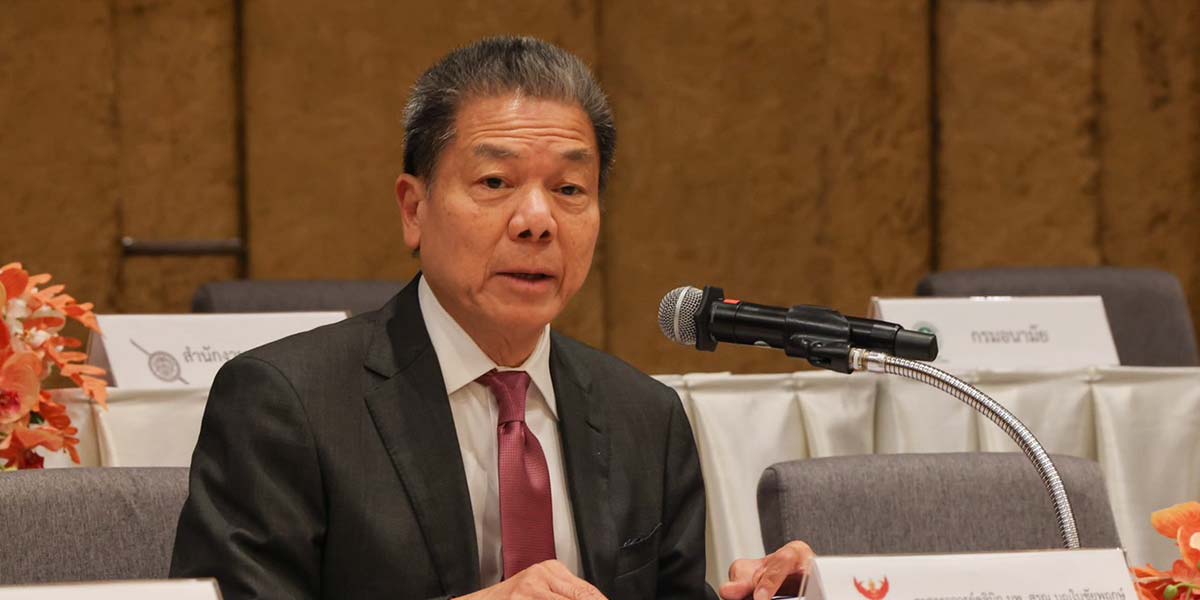
Thailand’s Supreme Administrative Court has overturned a lower court order that dismissed a lawsuit filed by Clinical Professor Dr. Sarana Boonbaichaiyapruck, directing the Administrative Court of First Instance to accept the case for consideration. The lawsuit came after the country’s telecommunication board attempted to remove him from the leading position, citing prohibited characteristics.
On September 2, 2026, the Central Administrative Court scheduled a session to read the Supreme Administrative Court’s Order No. 952/2569. Although the plaintiff had been duly notified, he did not attend court. As a result, the Court did not read the order in person and instead notified him through the Electronic Litigation System.
The lawsuit was filed by Dr. Sarana against the Selection Committee of the National Broadcasting and Telecommunications Commission (NBTC), seeking revocation of the committee’s decision dated July 21, 2026. The committee had ruled that Dr. Sarana possessed prohibited characteristics under Section 8 (2) of the Act on Organization to Assign Radio Frequency and to Regulate the Broadcasting, Television, and Telecommunications Businesses, B.E. 2553 (2010) or NBTC Act, and deemed that he had waived his right to assume the position of NBTC Commissioner.
The committee’s ruling was based on its finding that Dr. Sarana continued to serve as an hourly-compensated physician at the Faculty of Medicine, Ramathibodi Hospital, Mahidol University, from January 8, 2022, to April 12, 2022. The committee considered this status to constitute being an employee of a government agency.
The dispute followed the Senate’s resolution on December 20, 2021, approving Dr. Sarana to hold the position of NBTC Commissioner. The President of the Senate later announced that the approved individual must resign or cease practicing any prohibited profession or occupation by January 11, 2022. Dr. Sarana submitted a resignation letter and supporting documents certifying that he had resigned or ceased such work.
The Prime Minister subsequently submitted a letter dated February 14, 2022, petitioning for a Royal Command to appoint Dr. Sarana. The Prime Minister’s Office later issued an announcement dated April 13, 2022, stating that a Royal Command had appointed him as Chairman of the NBTC, effective from April 13, 2022.
After Dr. Sarana assumed office, the committee investigated complaints and ruled that his continued work as an hourly-compensated physician before the Royal Command amounted to a prohibited characteristic. It further ruled that, under Section 18 of the Act, failure to resign or cease a prohibited profession within the deadline set by the President of the Senate was deemed a waiver of rights by operation of law.
The Supreme Administrative Court found that the case is an administrative dispute concerning an alleged unlawful act by a state official under Section 9, paragraph one (1) of the Act on Establishment of Administrative Courts and Administrative Court Procedure, B.E. 2542 (1999).
The Court also found that the committee’s ruling affected Dr. Sarana’s legal status, rights, or duties, as it could serve as a ground for vacating office under Section 20, paragraph one (5) of the relevant Act. Therefore, Dr. Sarana was considered a person who had suffered, or may inevitably suffer, trouble or damage from the committee’s action and was entitled to file a lawsuit in the Administrative Court under Section 42, paragraph one.
The Supreme Administrative Court therefore reversed the Administrative Court of First Instance’s dismissal order and directed it to accept Dr. Sarana’s lawsuit for consideration.