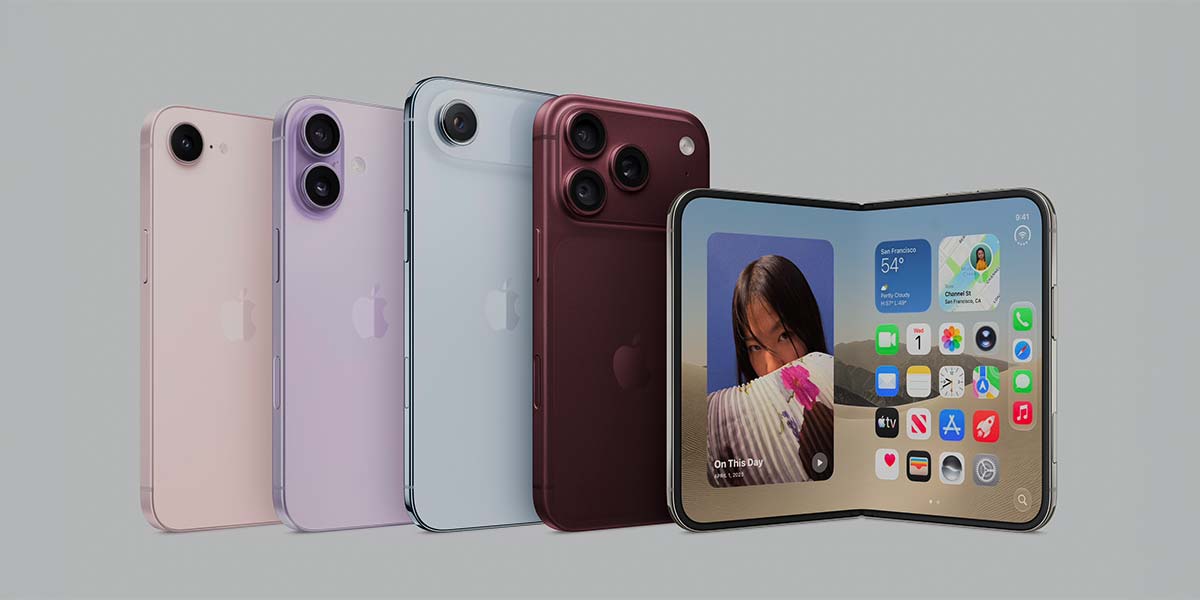
Apple’s first foldable phone, the iPhone Duo, will start at $1,999, placing it above every previous iPhone in price. The company also raised prices for its flagship Pro lineup at Wednesday’s launch, the first product keynote led by chief executive John Ternus.
The presentation at Apple’s headquarters in Cupertino, California, included the iPhone 18 Pro, iPhone 18 Pro Max, Apple Watch Series 12, Apple Watch Ultra 4 and AirPods 5. The Duo headlined the event, opening into a 7.6-inch screen designed to deliver an experience more like an iPad.
Ternus became CEO on September 1, succeeding Tim Cook after serving as senior vice president of hardware engineering. He had supervised work on several of the products presented and described the new iPhone generation as the strongest device for artificial intelligence. In Apple’s announcement, he characterized the Duo as the biggest change to the phone since its debut, emphasizing its combination of a large screen and pocket-sized design.
The Duo’s $1,999 starting price covers 256GB of storage. Buyers can also choose 512GB, 1TB or 2TB, with star white and night sky finishes offered on a mirror-polished enclosure made from grade 5 titanium. Before the unveiling, market sources had pointed to iPhone Ultra as a possible internal codename or Fold as a potential retail name.
Opening the handset like a book reveals its 7.6-inch inner display; when closed, users have a 5.4-inch external screen. Both use Super Retina XDR technology and matching aspect ratios, allowing content to retain its proportions when moving between displays. The open screen provides 50% more display area than the iPhone 18 Pro Max. Folded shut, the Duo preserves 90% of the screen area available on the iPhone 18 Pro.
Apple is emphasizing materials and construction as it enters a foldable market where Samsung and Huawei already have substantial positions, particularly in the United States and China. More than 100 parts make up the hinge, which manages the folding motion while supporting the display at its center.
A nano-textured layer covering the inner panel is intended to cut glare and make the fold less noticeable. Outside, Ceramic Shield 2 delivers three times the scratch resistance of its predecessor. The handset also has an IP68 rating.
At 254 grams, the Duo is 11.3 millimeters thick when folded and 5.2 millimeters when open. Achieving that slim design involved compromises in authentication and photography. Rather than Face ID, it uses a fingerprint reader integrated into the side button for Touch ID. Its rear cameras comprise a 48-megapixel Fusion Main sensor and a 48-megapixel Fusion Ultra Wide. A 12-megapixel, optical-quality 2x telephoto option draws on the main sensor instead of using a separate telephoto lens.
Software is also tailored to the folding format. The Duo uses iOS 27.1, not iPadOS, but gains iPad-style interface elements and the ability to run apps next to one another.
The iPhone 18 Pro and Pro Max retain much of the appearance of the models they replace. Exterior changes include three new colors and a reduced Dynamic Island, while the main hardware additions are the A20 Pro processor, bigger batteries and variable-aperture main cameras.
Manufactured using a 2-nanometer process, the A20 Pro adds a CPU core, a GPU core and a second neural engine relative to the A19 Pro. Its six-core CPU includes two super cores that Apple describes as comparable to desktop-class processing.
Apple says the seven-core GPU improves graphics processing speed by 40% over the A19 Pro. The chip also includes revised neural accelerators, two Neural Engines with 32 cores and a claimed 50% increase in memory bandwidth.
Both Pro models continue to use three 48-megapixel rear cameras. The change is in the main camera’s variable aperture, which gives users manual adjustment up to f/4.0 alongside control over shutter speed. That camera can admit as much as 50% more light in low-light conditions and supports cinematic effects in video. Additional photographic styles introduce controls for texture and grain.
Apple offered little detailed battery information, but said the eSIM-only Pro Max provides the longest battery endurance of any iPhone, with video playback reaching 45 hours. The corresponding claim for the eSIM Pro is 36 hours. Faster charging allows the phones to reach 50% charge in 15 minutes.
The Pro models come with iOS 27, incorporating the new Siri AI and Apple Intelligence capabilities. Compatibility extends to a broad range of third-party apps, while a standalone Siri app stores conversation history and synchronizes it among a user’s Apple devices.
Apple did not present a standard iPhone 18 alongside the premium devices. According to reports, that model, the iPhone 18 Air and the iPhone 18e are now expected in spring 2027. The iPhone 17 will remain on sale until then.
The split schedule leaves the Pro phones and Duo as the only new iPhone releases for the holiday shopping period, directing customers toward more expensive models. Separately, support for Apple Pencil through USB-C is scheduled to reach the Duo later this year.
Apple has also increased starting prices by $100 across its iPhone range, including older models that received no update at the latest launch. The new Pro lineup begins at $1,199 for an iPhone 18 Pro with 256GB of storage and reaches $2,499 for the 2TB iPhone 18 Pro Max.
Higher-capacity configurations carry steeper increases than the entry-level versions. For iPhone 18 Pro Max customers, moving to the 2TB storage option costs an additional $599.
The adjustments also extend to the existing iPhone 17 and iPhone 17e. Their starting prices are now $899 and $699, respectively, bringing the increases beyond the newly introduced premium phones.
With the older models now also carrying higher prices, the expectation is that Apple will avoid another increase when the iPhone 18 and iPhone 18e arrive next spring.