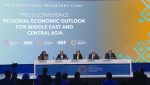
The International Monetary Fund has cautioned that while global economic growth appears superficially steady at a projected 3.1 percent for 2026, the world economy is standing precariously on “one leg” driven overwhelmingly by artificial intelligence enthusiasm while broader fundamentals weaken.
Speaking at the IMF-World Bank Annual Meetings in Bangkok, IMF Managing Director Kristalina Georgieva warned that mounting public debt, stubborn inflation, and growing global divergence threaten to undermine this fragile stability unless nations take immediate action to rebuild fiscal buffers and reduce debt.
According to Georgieva, the IMF’s steady headline projection hides a dramatic shift in underlying economic composition. Upward growth revisions are heavily concentrated within a tight cluster of seven economies integrated into the AI value chain—including the United States, China, India, South Korea, and Thailand—while fuel-importing states and conflict-affected nations face downgrades. This sharp divergence is further complicated by stubborn inflation driven by elevated energy, food, and climate disruptions, forcing central banks to maintain tight monetary stances at a time when ballooning public debt and deficits are driving up debt-servicing costs across both advanced and developing economies.
Georgieva highlighted that overreliance on short-term AI sentiment poses systemic financial risks, referencing Amara’s Law—the tendency to overestimate technological benefits in the short term while underestimating them over the long run. She cautioned that any sudden disappointment in AI adoption could spark market pullbacks and financial volatility. Meanwhile, an out-of-control AI could bring financial stability to the world.
Beyond technological risks, the IMF chief flagged expanding global imbalances, noting that the United States continues to overconsume and run high deficits, China maintains high export volumes paired with weak domestic demand, and European economies suffer from chronically sluggish productivity and underinvestment. To fortify against future external shocks, Georgieva urged world leaders to prioritize fiscal discipline, cut deficits, and put their economic houses in order before the next crisis hits.