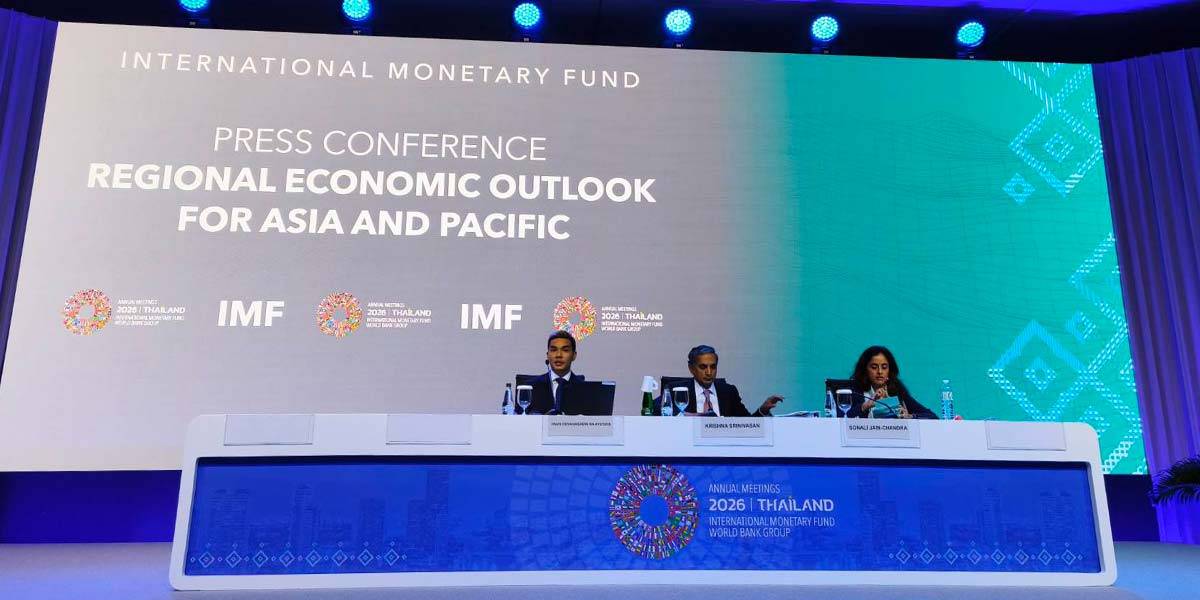
Asia remains the primary engine of the global economy, projected to generate 68% of global growth despite facing a volatile backdrop of energy price shocks, tariff frictions, and high debt levels. Speaking at the IMF-World Bank Annual Meetings in Bangkok during the release of the regional outlook, Krishna Srinivasan, Director of the IMF’s Asia and Pacific Department, outlined an economy shaped by three powerful forces: an energy shock stemming from Middle East tensions, a massive artificial intelligence tech boom, and ongoing global trade realignments.
While regional growth is forecasted to ease gradually from 5.0% in 2025 to 4.8% in 2026 and 4.4% in 2027, economic performance across Asian nations remains higher than western countries. Additionally, global growth is expected to drop from 3.5% in 2025 to 3.1% in 2026 before bouncing back to 3.4% in 2027.
The accelerating demand for artificial intelligence hardware has sparked a surge in semiconductor exports, data center construction, and tech investment across the region. However, this boom unfolds alongside substantial vulnerabilities, particularly Asia’s heavy reliance on imported energy, where energy consumption averages 4% of GDP. While major economies have managed to cushion early price spikes by drawing down energy inventories and expanding renewable capacity, IMF officials warned that inventory buffers have physical limits.
Meanwhile, global trade has shown surprising durability amid earlier tariff increases, supported by market diversification, deeper trade agreements, and expanding intra-regional trade. Analytical work by the IMF suggests that eliminating regional non-tariff barriers could boost Asia’s economic output by roughly 2%, an expansion equivalent to adding an economy the size of Thailand.
Addressing the policy framework required to navigate these headwinds, Srinivasan stressed that central banks must keep monetary policy focused on price stability while preserving central bank independence. On the fiscal front, elevated public debt following consecutive global shocks calls for growth-friendly consolidation.
IMF guidance emphasizes that governments should “protect people, not prices” by shifting away from broad price subsidies toward targeted social transfers delivered through digital platforms and social registries, all backed by clear medium-term fiscal frameworks.
On the labor market, fresh empirical findings from the IMF reveal that while job postings in AI-exposed sectors initially fell by 10%, hiring demand has since stabilized as employers seek workers with specialized AI skills, indicating that technology is reshaping and appreciating work rather than simply replacing it.
For host nation Thailand, structural vulnerabilities are particularly pronounced due to its high energy intensity—standing at roughly 7% of GDP—and a heavy household debt burden that continues to restrain private consumption and broader economic growth. IMF officials advised Thai policymakers to rebuild depleted fiscal buffers through structured consolidation while leveraging digital social registries to shield vulnerable households from ongoing cost-of-living pressures.
Across East Asia, the impact of the tech wave varies markedly. While Japan benefits from the AI boom through memory chip exports, the net contribution to its current account remains moderate because tech hardware constitutes a smaller share of its total export basket.
By contrast, South Korea stands out as a central beneficiary of the global AI cycle, driven by dominant market positions in advanced memory and logic chips. Sonali Jain-Chandra, Deputy Director of the Asia and Pacific Department, detailed how strong semiconductor demand has generated robust corporate earnings, buoyant equity markets, and significant windfall tax revenues for Seoul. However, Jain-Chandra cautioned that this high sector concentration exposes South Korea to downside risks if global AI demand or tech asset valuations undergo a sharp correction.