
Salaries in Thailand increased by 4.5 percent in 2025, lower than Thailand’s historical average of 5 percent, according to Deloitte Thailand’s latest survey findings on salary trends, compensation, and human resources challenges, conducted in early October. The reduction to 4.5 percent reflects cost pressures and an economy that has not fully recovered, requiring organizations to manage their salary budgets with greater caution.
In 2025, the energy and utilities sector maintained an average projected salary increase rate of 5 percent, while the retail and technology sectors showed average increases of only 4 percent, representing the lowest rates among industries.
The survey gathered insights from 176 leading companies in Thailand and reveals that Thai organizations are facing dual pressures from an economy recovering more slowly than expected and rapid technological transformation driven by artificial intelligence (AI). Many organizations are placing significant emphasis on integrating AI skills and technology into their operations, which is noticeably influencing compensation structures and workforce management strategies.
AI and technology integration ranks as the most important skill in human resources management, which is changing the job-based compensation equation to one focused on skill-based rewards. Leading organizations implementing AI are linking compensation to employees’ capabilities instead of relying solely on job levels or tenure.

Mr. Ariya Phukfon, Thailand Technology & Transformation Leader, Deloitte Thailand, said, “This year, many organizations face rising costs, but cannot postpone investing in people, especially in technology and AI-related skills, which have become central to future competitiveness. Hence, AI is not replacing people but is changing the value of skills in the labor market. Organizations that understand how to use technology while simultaneously investing in people development will gain advantages in both efficiency and the ability to retain high-potential personnel.”
Trends in salary increases, bonuses, and employee mobility
The salary increase rate for 2025 stands at approximately 4.5 percent, which is lower than Thailand’s historical average of around 5 percent.
Regarding variable bonuses, the survey shows that the overall payment trend for 2025 remains stable compared to 2024, averaging approximately two months. The industries with the highest projected bonus payments for 2025 are chemicals, energy, and oil and gas, which pay approximately three months, while industries with lower bonus levels include technology and retail, with bonus payments of around 1.5 months. Additionally, approximately 28 percent of Thai organizations still provide an additional fixed bonus of one month.

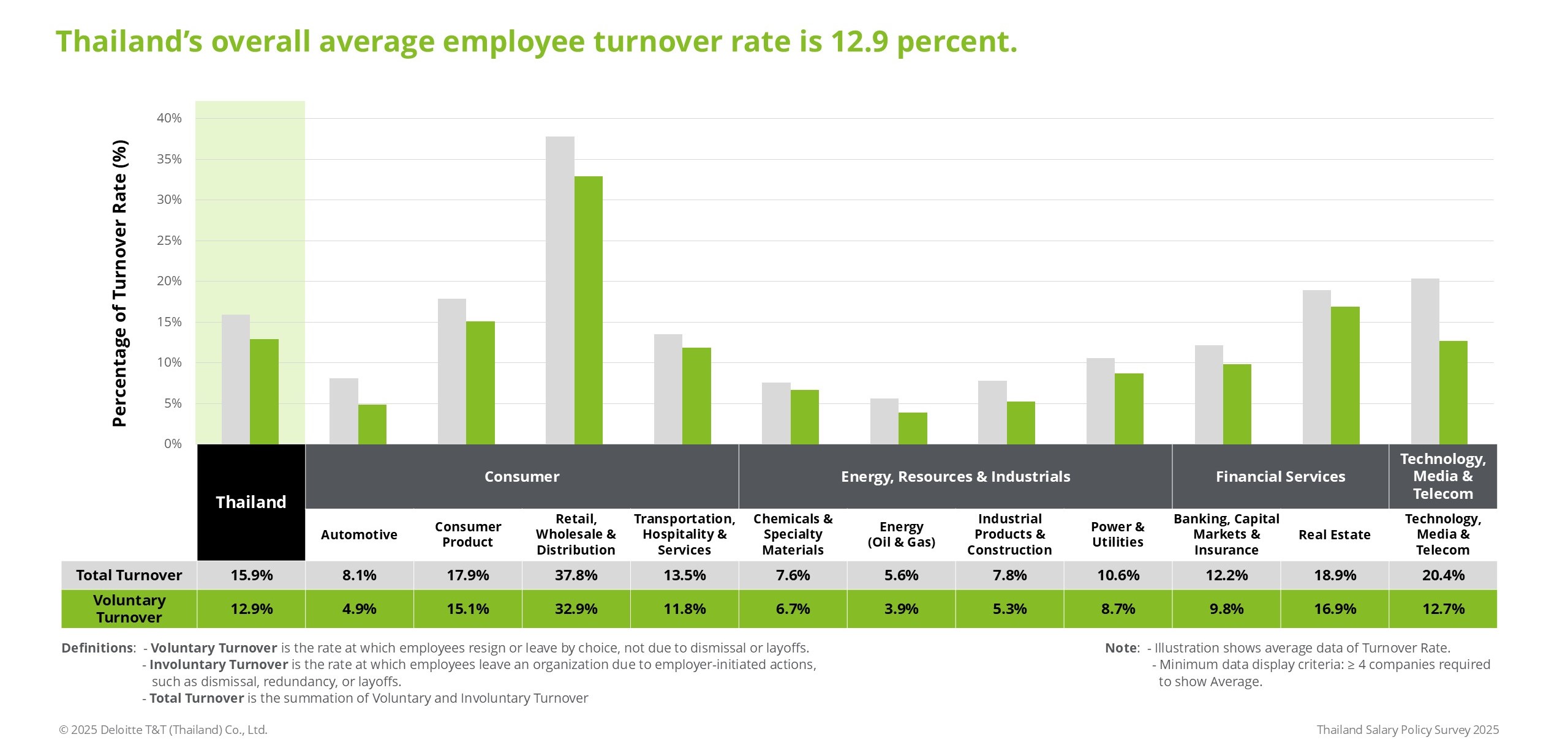
The survey found that Thailand’s overall average voluntary resignation rate is 12.9 percent, with variations across industry groups. Industries with the highest turnover rates include retail at 32.9 percent, real estate at 16.9 percent, and consumer goods at 15.1 percent. Conversely, the lowest turnover rates were found in energy, oil and gas at 3.9 percent; automotive at 4.9 percent; and industrial sectors at 5.3 percent.
Organizations are investing in critical roles despite moderate growth
Despite Thailand’s recent challenging economic conditions, the survey found that most organizations are managing to maintain stability. 44 percent reported moderate growth, and 52 percent achieved their performance targets. However, 35 percent indicated that their growth fell below expectations, highlighting a state of “cautious management” that Thai organizations must navigate carefully during this period of economic slowdown.
Amid the business slowdown, organizations are adapting their compensation strategies to suit economic conditions. The survey found that 57 percent of organizations have reduced or plan to reduce their overall compensation and benefits budgets. Simultaneously, over 55 percent of organizations choose to offer above-market compensation for positions with high business impact while paying below market rates for general positions, reflecting prioritization and targeted investment.
Despite budget constraints, organizations continue to emphasize engagement and retention, with 61 percent using career development opportunities as the primary tool for retaining employees. Among high-potential employees and top performers, 65 percent of organizations consider special promotions alongside career advancement development to strengthen motivation and retain talented individuals for the long term.
Amid the continuing economic slowdown, organizations must prepare themselves to manage people in alignment with the changing economic context, both in terms of transparency in communicating about wages and compensation, and in how AI will support organizational development to align with the modern work environment and create long-term competitive advantages.
For more information, view the full report at this link: https://www.deloitte.com/southeast-asia/en/services/consulting/perspectives/th-salary-policies-survey-2025.html