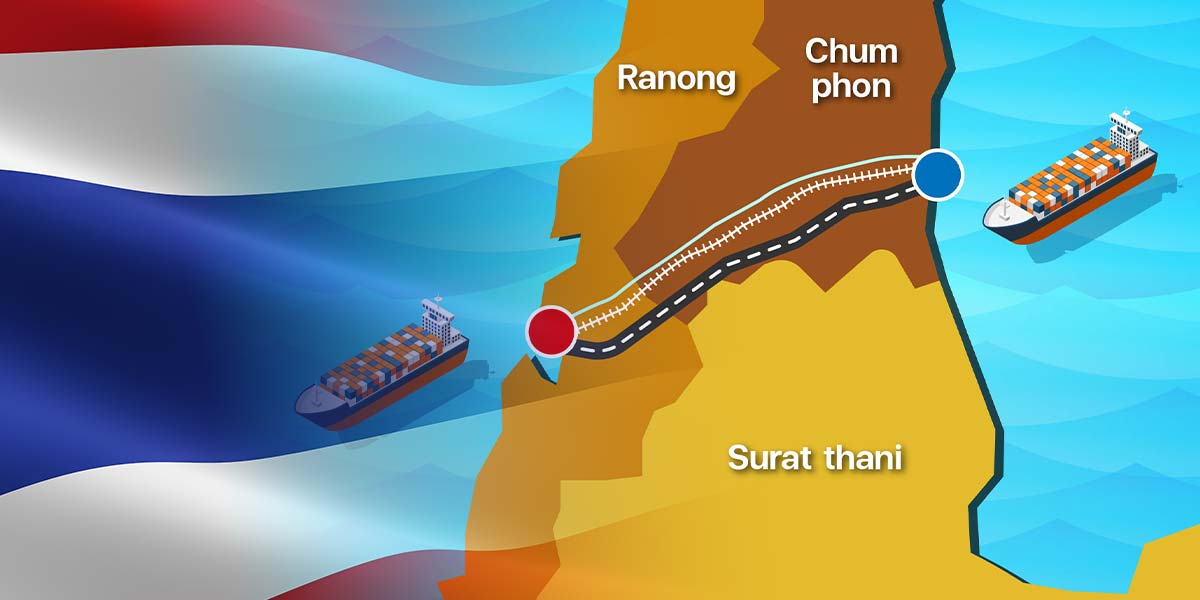
As the world watches the escalating tensions in the Strait of Hormuz, Thailand finds itself at a critical crossroads that could redefine its economic future. The government, led by Prime Minister Anutin Charnvirakul, is aggressively pushing forward with the Land Bridge project, a mega-infrastructure initiative valued at approximately 1 trillion baht. This is not merely a construction project; it is a bold bid to position Thailand as the premier logistics and trade hub of Southeast Asia.
The strategic advantages are compelling. By connecting the Indian and Pacific Oceans through deep-sea ports on both sides of the southern peninsula—linked by dual-track railways, motorways, and pipelines—Thailand offers a viable alternative to the congested Malacca Strait. Currently, the Malacca Strait handles roughly 40% of global trade, including the majority of oil shipments to China, Japan, and South Korea. The Land Bridge promises to reduce shipping times by an average of four days and cut transportation costs by approximately 15%. In an era where global supply chain resilience is paramount, such efficiency is a powerful draw for international investors.
Furthermore, the project serves as a much-needed “new engine” for the Thai economy. Projections suggest the creation of roughly 200,000 new jobs, providing a significant boost to local employment and stimulating regional development. The international community has already taken notice, with entities from the United Arab Emirates, Hong Kong’s DP World, and New World Development expressing keen interest in the 50-year PPP (Public-Private Partnership) concession.
However, this ambitious vision is not without its detractors. Several groups and organizations have voiced strong opposition, questioning the project’s economic feasibility and its potential environmental impact. Critics argue that the investment is too high relative to the projected returns and fear it may follow the path of previous underutilised port projects like Pak Bara. Concerns regarding the destruction of coastal ecosystems, wetlands, and the displacement of local fishing communities remain at the forefront of the debate. Additionally, the lack of a comprehensive public hearing process has led to calls for greater transparency regarding the Environmental and Health Impact Assessment (EHIA) reports.
While these concerns warrant serious consideration and rigorous study, the strategic necessity of the Land Bridge cannot be ignored. In a world of increasing geopolitical instability, controlling a major transit route provides Thailand with a significant strategic edge. As the government prepares to open bidding in 2026, the challenge will be to balance these massive economic ambitions with environmental stewardship and social responsibility. If executed correctly, the Land Bridge could indeed be the transformative force that propels Thailand into a new era of global relevance.