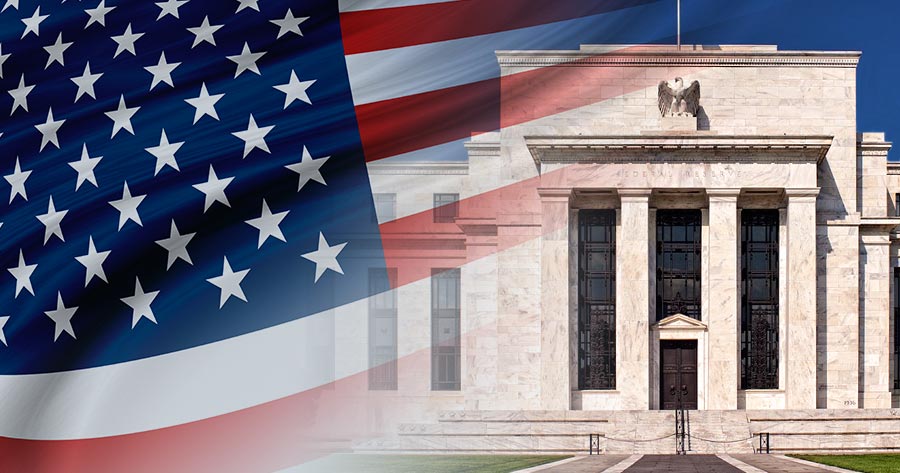
The Federal Reserve opted to leave interest rates unchanged on Wednesday, marking the first policy decision under the leadership of Chairman Kevin Warsh. While the benchmark rate remains in a range of 3.5% to 3.75%, internal projections suggest a growing inclination among officials to resume tightening later this year to combat persistent price pressures. Although the Federal Open Market Committee (FOMC) was unanimous in its decision to pause, the latest “dot plot” revealed a notable divide among policymakers.
This hawkish outlook triggered an immediate reaction in fixed-income markets, where short-term Treasury yields climbed as investors adjusted for the possibility of higher borrowing costs.
The two-year Treasury note, which is particularly sensitive to monetary policy shifts, rose by 11 basis points to reach 4.16%. Current market pricing reflects a significant probability of a rate hike by September, with a full quarter-point move anticipated by the end of December. Additionally, the spread between two-year and 10-year yields narrowed to its tightest level in over a year, a flattening of the curve that signals investor concerns about the impact of tighter policy on future economic expansion.
Nine of the 18 officials who participated in the forecast now anticipate at least one rate increase before the conclusion of 2026, while six foresee two or more hikes. This represents a significant pivot from earlier market assumptions that the central bank might begin cutting rates following the change in leadership. Chairman Warsh, who has been a vocal critic of the Fed’s traditional communication methods and forward guidance, notably declined to provide his own interest rate projection for the quarterly report.
The central bank’s cautious stance comes as inflation reached a three-year peak, with consumer prices climbing past 4% in May. These price increases have been largely attributed to energy market volatility caused by the conflict in the Middle East and the subsequent closure of the Strait of Hormuz.
While a recently brokered diplomatic agreement between the United States and Iran has led to a recent dip in crude oil prices, the Fed noted that inflation remains significantly above its long-term 2% target. Chairman Warsh reaffirmed the committee’s focus on price stability, acknowledging that high costs continue to strain household budgets.Under Warsh, the Fed has moved toward a more concise communication style, drastically reducing the word count of its policy statement to focus on objective data.
The Chairman also announced the creation of five internal task forces to review the central bank’s operational framework, including its inflation management strategies and the size of its balance sheet. These changes occur against a backdrop of administrative shifts, as former Chair Jerome Powell remains on the Board of Governors while a probe into the costs of agency facility renovations continues.
President Donald Trump, who selected Warsh for the role, expressed continued support for the Chairman’s independence, even as he described the prospect of future rate hikes as a move that could potentially restrain the country’s growth.