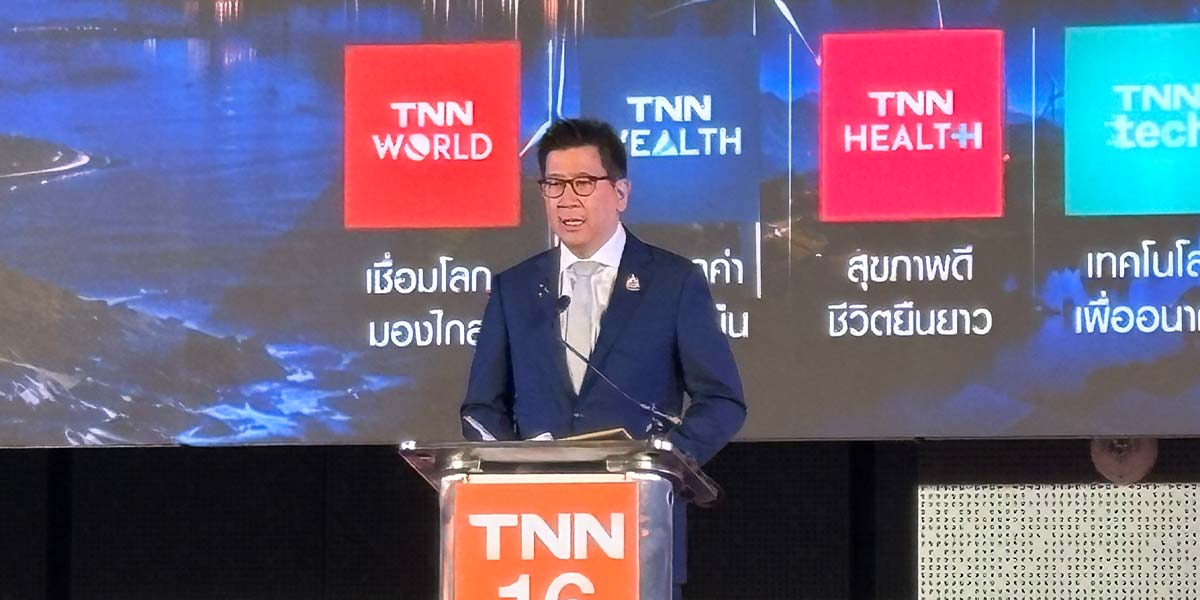
Deputy Prime Minister and Finance Minister Ekniti Nitithanprapas has laid out a two-track plan to fix Thailand’s chronically slow growth and prevent the country from falling into the same crisis cycle again, warning that without decisive action the economy risks splitting further into “haves” and “have-nots.”
Speaking at the TNN Future Forum 2026: “Thailand Beyond Tomorrow” seminar, Ekniti said Thailand is currently grappling with a long-term growth problem. Before 1997, GDP growth ran as high as 6–7%; today it has slipped below 3%. He attributed much of the slowdown to years of underinvestment in large-scale infrastructure projects, which has left the economy performing below its potential, squeezed household incomes, and fueled a persistent rise in household debt.
Layered on top of that structural weakness, he said, have been a series of external shocks — the global financial crisis, the COVID-19 pandemic, and, most recently, the energy crisis — each hitting low-income households and small businesses first, since many SMEs still lack access to formal financing. Government intervention to cushion these blows has, in turn, pushed public debt higher. Ekniti said that today, it is not about talking about the problem, but to actually fix it
Ekniti argued that repairing and building have to happen side by side. As the world grows more fragmented and multipolar, he said, global investors are actively searching for safe, neutral places to put their capital — and Thailand, with its neutrality, stability, and ability to trade with all sides, is well positioned to capture that shift.
“Thailand is carrying a lot of old baggage: low growth, high household and public debt, low savings, and SMEs that can’t access capital,” he said. “We have to repair and build at the same time. If we only repair, the same vicious cycle comes back — another storm hits, another shock lands, the most vulnerable people fall back into debt, and the government has to step in and bail them out again. So this isn’t just about repair anymore. We have to build future opportunities to break that cycle for good.”
He pointed to artificial intelligence as one such opportunity: if small businesses and SMEs can ride the AI wave effectively, it could deliver major benefits. But he stressed that Thailand needs to build out AI infrastructure and shift from being merely a user of AI to a producer — including turning its data center ambitions into an efficient investment base rather than just a consumption market. He also flagged the global push toward environmental trade rules, the country’s aging population — which he framed as an opportunity for Thailand’s healthcare strengths to drive the Health & Wellness industry rather than a burden — as trends the country needs to adapt to quickly.
On longer-term growth, he said Thailand needs to build the infrastructure to support AI and shift from being a consumer of the technology to a producer — by attracting investment into data centers and processing chips, and courting global photonics companies to set up manufacturing bases in the country, leveraging Thailand’s existing strength in clean energy.
Ekniti closed the session by saying that a high-speed train is passing through Thailand right now, and the government’s job is to make sure everyone gets on board. As things stand, the economy is K-shaped — those who can get on the train ride the upward arm of the K, while those left behind on the platform are pulled down the lower arm.
“We don’t want that,” he said. “That’s why we need to repair and build at the same time — to create opportunity and not let this train of the future pass us by. If we do nothing, Thailand’s economy won’t stay K-shaped — it’ll become an ‘A’ shape, sloping down on both sides. What we want is to turn that K into a V, by getting the majority of the country onto this train of the future that’s running through Thailand right now.”