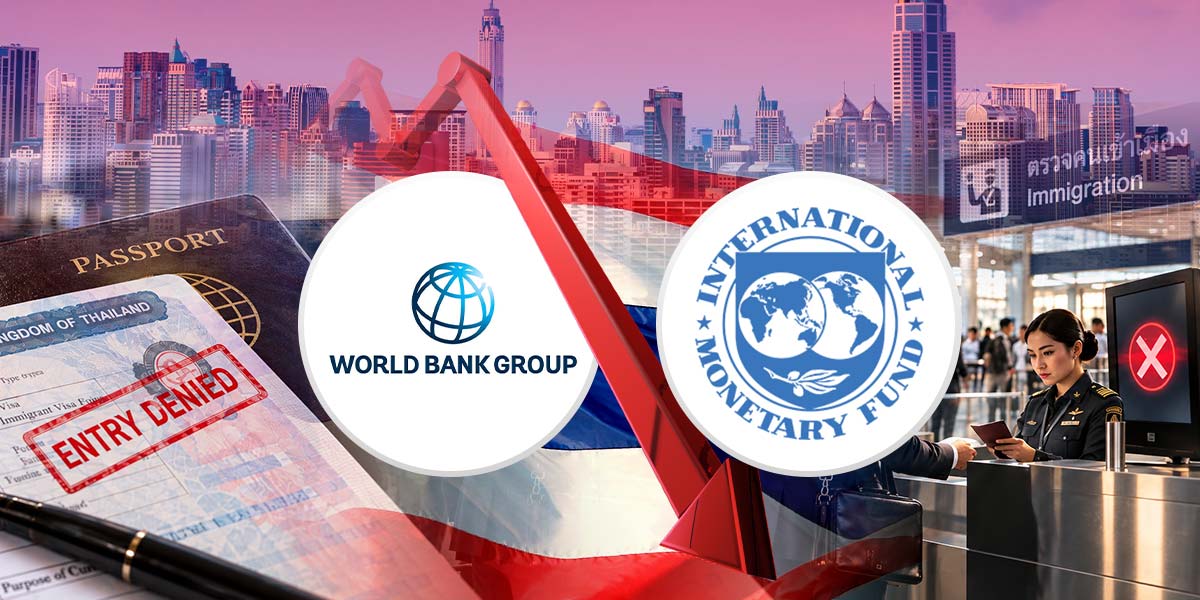
A difference in the wording of Thailand’s visa-exemption notifications published in the Royal Gazette has raised questions about entry requirements for business visitors ahead of the 2026 IMF–World Bank Annual Meetings in Bangkok, highlighting the need for timely clarification before international participants depart.
The issue centers on the permitted purpose of entry. While the July 2024 notification expressly refers to tourism, work and short-term business contact, the notification published in August 2026 refers only to tourism.
For executives and other participants traveling to attend meetings, seminars and related business discussions, the practical question is whether they can continue to rely on visa-exempt entry—or need to make other arrangements before traveling.
What the documents say
The Ministry of Interior notification published in the Royal Gazette on July 15, 2024, established a special visa-exemption framework permitting eligible passport holders to stay for up to 60 days.
Its title explicitly encompasses tourism, work and short-term business contact. Clause 3 in the announcement provides for visa-exempt entry for work or short-term business activities covered by a Department of Employment notification concerning necessary, urgent or specific work.
The Ministry of Interior notification published on August 31, 2026, uses narrower language, describing entry for tourism and allowing eligible passport holders to stay for up to 30 days. It does not include the same express reference to work or short-term business contact.
However, an important regal distinction prevents a definitive conclusion that business-related visa exemptions have been removed: the repeal clause in the supplied 2026 notification identifies two earlier notifications, but does not expressly identify the July 15, 2024 exemption.
The documents therefore leave a question about how the two frameworks interact. They do not, on their own, establish that every business visitor who previously qualified for visa-exempt entry must now obtain a visa.
Clarity needed for conference participants
For those attending the Annual Meetings, the immediate concern is how authorities classify conference attendance and related business discussions under the applicable entry rules.
A traveler’s status as a business executive does not itself determine whether a visa is required; the purpose and activities of the visit matter. Equally, participants should not have to assume that attending a professional meeting falls within a tourism-only exemption.
Official guidance could establish whether the July 2024 provisions remain applicable, what conditions participants must meet, and whether any separate arrangements cover accredited attendees.
Without that explanation, uncertainty could arise when travelers state “business meeting” or “conference attendance” as their purpose in arrival information or during immigration questioning.
Immigration officers assess admission under the applicable rules. Clearly communicated guidance would help ensure that travelers, consular officials, airlines and frontline officers share the same understanding, reducing the risk of additional questioning or avoidable delays.
Economic stakes go beyond the meetings
The upcoming Annual Meetings are expected to bring tens of thousands of high-level international participants to Thailand, including finance ministers, central bank governors, senior financial executives and global CEOs.
The event is also expected to provide a significant short-term economic boost. Preliminary estimates put the amount of money circulating through and injected into the economy at around THB5 billion–THB10 billion, particularly through higher hotel occupancy, restaurants, catering, transportation services and convention centers. The benefits are also expected to reach local communities through exhibitions featuring Thai food, products and culture.
Given the economic and international significance of the event, any friction or uncertainty surrounding entry requirements risks going beyond inconvenience for individual travelers. It could affect Thailand’s reputation as a destination capable of hosting high-level international business and financial gatherings.
For Thailand, the Annual Meetings offer an important opportunity to raise Bangkok’s profile on the world stage and reinforce its ambitions as a regional financial and business hub. Ensuring that legitimate international participants can enter the country smoothly should therefore be part of the broader preparation for the event.
International benchmarks point to a possible solution
Major economies hosting large-scale international events typically establish specialized fast-track entry procedures, dedicated visa channels or clear temporary notification frameworks for accredited participants.
Take the French 2024 Olympics for example. France created a dedicated France-Visas solution for members of the Olympic family to facilitate their arrival for the 2024 Olympic and Paralympic Games. France’s Interior Ministry explicitly says the dedicated solution was deployed to facilitate their arrival.
Thailand could consider a similar approach, including a streamlined digital notification system or dedicated event-visa framework, allowing authorities to maintain immigration controls while providing verified participants with a clear and predictable entry process.
Such a mechanism could also help distinguish legitimate international conference participants from the types of business activities that broader visa reforms are intended to address.
Departure deadlines add urgency
As of October 5, participants preparing to travel have limited time to resolve any unexpected documentation requirements.
If a visa is needed in an individual case, obtaining confirmation shortly before departure could leave a narrow application window. This is particularly relevant for visitors traveling from Europe or North America, whose long-haul itineraries may require them to depart well before their first scheduled meeting.
These are potential difficulties, rather than evidence that participants will be denied entry. Nevertheless, resolving the question before travelers reach an airline check-in counter or immigration checkpoint would be preferable to addressing it case by case upon arrival.
Clear guidance needed before participants depart
Kaohoon International has contacted a senior officer in Thailand’s Ministry of Foreign Affairs to seek clarification. The ministry acknowledged the urgency and is currently circulating guidance to Thai embassies and consulates allowing a registration confirmation letter from the Annual Meetings to be considered in place of an invitation letter from a company in Thailand, which could be required for visa application.
The next step should be clear and standardized guidance for all parties involved in the entry process.
Relevant Thai authorities, including the Ministry of Interior and Immigration Bureau, could issue a formal clarification or standard operating procedure to international airlines, Thai missions overseas and frontline immigration officers. The guidance should clearly establish how terms such as “business meeting,” “conference attendance” and related professional activities are to be treated under the applicable exemption rules.
A unified interpretation would reduce the risk of different practices at airlines, consulates and immigration checkpoints and help prevent avoidable travel disruptions.
For Thailand, the priority is not to presume that business visitors should receive unrestricted access, but to ensure that legitimate participants understand which rules apply and have sufficient time to comply with them.
The Annual Meetings offer Thailand a rare opportunity to demonstrate its capabilities as a host for the international financial community. Prompt and consistent guidance would help ensure that uncertainty over entry requirements does not overshadow that opportunity.