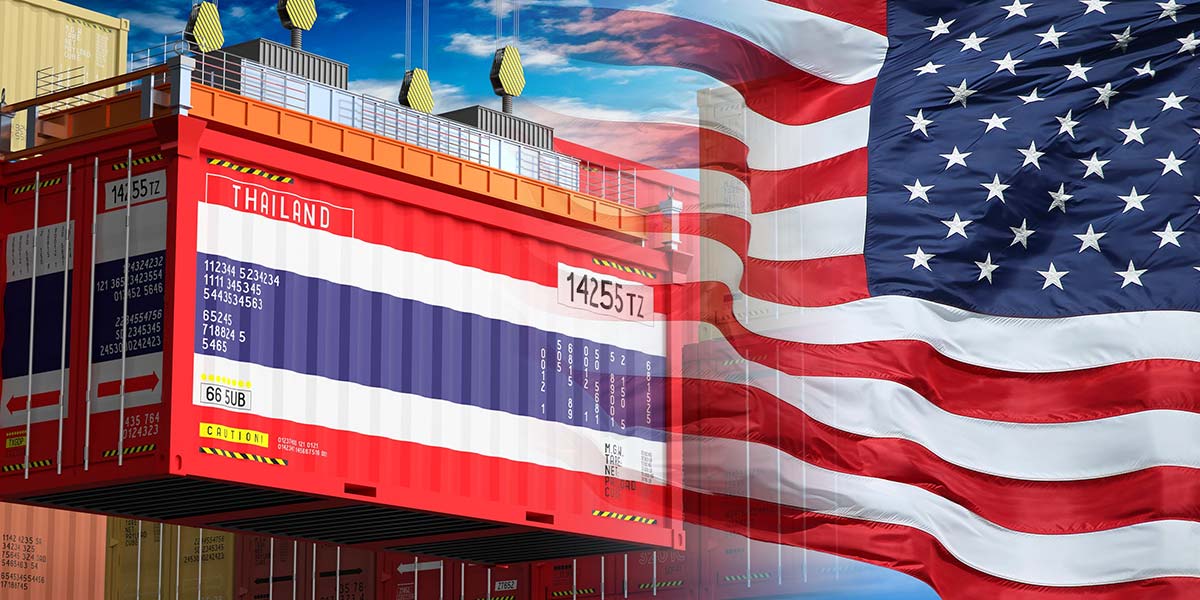
Thailand’s Deputy Prime Minister and Commerce Minister Suphajee Suthumpun said the United States Trade Representative (USTR) has announced preliminary findings of its Section 301 investigation into structural excess capacity on November 25, proposing tariffs on Thai goods at a rate of no more than 18%.
The investigation covers 14 countries and economic areas. Suphajee clarified that the proposed 18% cap includes the existing Section 301 tariff imposed over the absence of measures prohibiting imports of goods produced with forced labor. The proposed rate is therefore a combined tariff rather than an additional 18% levy.
She said the outcome reflected Thailand’s negotiation strategy, particularly the conclusion of the Agreement on Reciprocal Trade (ART) negotiations and the signing of a joint statement between Thailand’s prime minister and the U.S. president on November 17, 2026, during the ASEAN Summit in the Philippines.
According to Suphajee, the move placed Thailand in the same group as ASEAN countries that have already signed ART, including Malaysia, Indonesia and Cambodia, which also received proposed tariff rates of no more than 18%.
The preliminary findings state that the U.S. may consider tariffs of up to 25% if consultations or compliance with commitments are deemed unsatisfactory. Suphajee said that without a concluded negotiation, Thailand could have faced tariffs 7 percentage points higher than neighboring countries.
She added that countries in the region that have not yet concluded ART agreements, such as Vietnam and Singapore, were proposed higher rates of 35% and 20%, respectively. The draft also states that rates may be reduced if those countries reach agreements with the U.S., showing that the conclusion of agreements is an important factor in the U.S. tariff decision.
Suphajee said the proposed tariff rate would help maintain the competitiveness of Thai goods in the U.S., Thailand’s largest export market. Thai exports to the U.S. were valued at THB 2.37 trillion in 2025, accounting for around 25% of total exports, and are expected to reach THB 3 trillion in 2026.
She said the rate would also help protect the competitiveness of agricultural exports worth THB 170 billion, excluding rubber and related products worth at least another THB 160 billion, as well as more than 1.25 million jobs.
At this stage, the preliminary findings has not yet taken effect. Thai exports will continue to be subject to the existing tariff rate of 12.5% until the final result is announced.
The USTR will accept written comments until January 5, 2027, and will hold a public hearing on January 25, 2027, before announcing the final result. Thailand plans to use this process to clarify facts and seek the lowest possible final tariff rate, while accelerating the signing of the ART agreement.
Thailand and the U.S. will next conduct a legal review of the ART before it is submitted to the Thai cabinet for approval. Public and stakeholder consultations will follow, alongside the preparation of measures to support affected groups. The agreement will then be submitted to parliament for approval, after which Thailand will amend the relevant legislation before proceeding with ratification to bring the agreement into force.