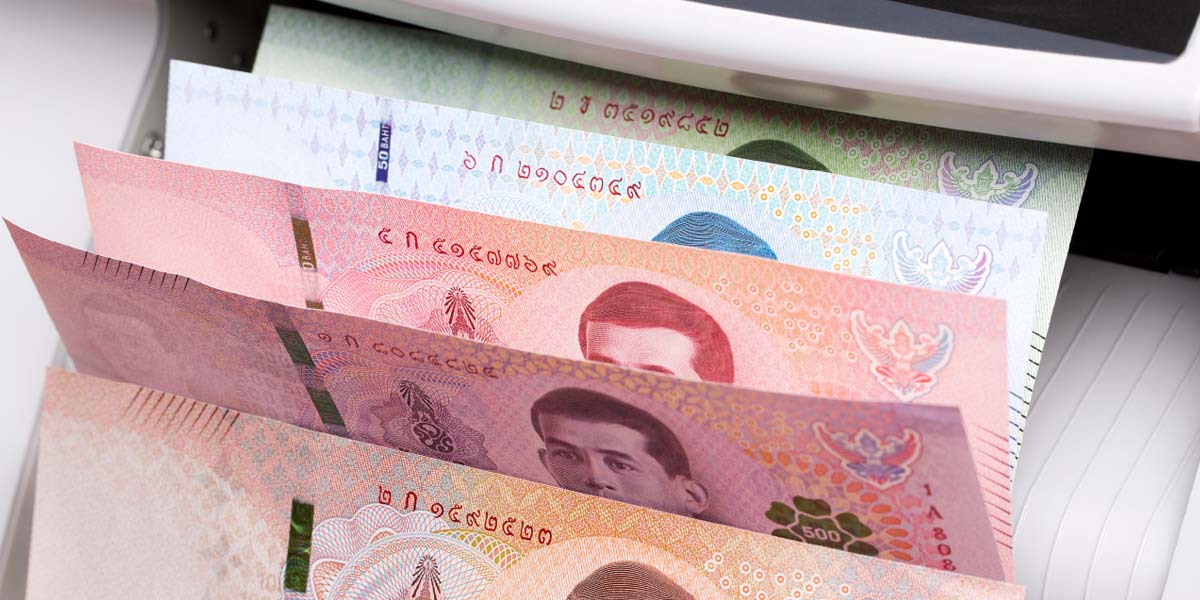
The Thai baht continued its downward trajectory on Monday, depreciating more than 2% against the U.S. dollar in a single day to reach 31.6 baht per dollar. Despite this short-term slip, the currency still shows an appreciation of nearly 8% compared to the beginning of 2025.
The recent 2% decline in the Thai baht is an exceptionally rare occurrence for currency markets. Such sharp depreciations have historically been triggered by major shocks. The last comparable event was on November 6, 2024, following the formal announcement of Donald Trump’s victory in the U.S. presidential election. That outcome prompted a swift exodus by foreign investors from Thai equities and gold holdings, driving demand for U.S. dollars and pushing the baht sharply lower.
Instances of this scale are typically reserved for periods of heightened financial turmoil. During the global financial crisis, the baht plummeted 5% in a single day on February 29, 2008. Market participants witnessed extreme volatility that year, with intraday swings occasionally exceeding 10%, though most sessions still ended with the currency settling within a modest band of ±1%. Prior episodes of such pronounced instability can be traced back to the 1997 Asian Financial Crisis, commonly referred to as the Tom Yum Goong Crisis.
Analysts at Krungthai Global Markets maintain their outlook that the baht (USDTHB) will remain in a strengthening trend throughout the first quarter of 2026. This comes even as the recent rally has lost significant momentum in the past two days, with the baht experiencing a sharp and rapid decline, in line with a substantial correction in gold prices. The firm noted this persistent relationship between gold prices and the baht, emphasizing that movements in gold continue to play a key role in driving volatility and directional swings for the local currency.
Krungthai cautioned that gold price movements warrant close attention from market participants until there is clear evidence that the Bank of Thailand’s efforts to mitigate gold’s impact on the baht—measures previously announced—are having a material effect. The institution noted that the correlation and beta between the baht and gold, although expected to decrease, currently remain elevated and in line with the one-year average.
BOT Tighten Flows
This price action follows the Bank of Thailand’s decision to impose stricter regulations on foreign currency transactions. According to Governor Vitai Ratanakorn, starting 29 December 2025, entities will be required to disclose the source of any inflows exceeding $200,000. The central bank said, as reported by the source, that these steps aim to rein in baht volatility and address currency pressures associated with large-scale international capital movements.
Under these tightened rules, authorised legal entities must strictly verify documentation for spot transactions—the immediate purchase or deposit of foreign currency—for any resident-led transaction of $200,000 or the equivalent. While financial institutions may continue to use a Know Your Business (KYB) process for trusted, long-term clients with established Know Your Customer (KYC) and Customer Due Diligence (CDD) profiles, the central bank has designated several high-risk categories where this “shortcut” is explicitly prohibited.
Investors in Thai real estate and digital assets face the most significant hurdles under the new regime. For digital asset transactions, the BOT now requires additional documentation verifying either the source of the digital assets or the funds used to acquire them. Furthermore, the KYB exemption is unavailable for capital flows that fall outside of traditional securities, intra-group loans, or standard trade in goods and services.
The regulations also zero in on gold and physical cash. Any transaction involving gold—regardless of the amount—requires proof of a foreign sale on the trade date. For physical foreign banknotes, the disclosure threshold is significantly lower, set at $15,000 or equivalent, requiring evidence that the currency was brought into the country. For forward transactions, the BOT will maintain existing standards from 2004, though the ban on using KYB processes still applies to the aforementioned high-risk investment categories.
This regulatory shift signals the BOT’s intent to monitor the “quality” of capital entering the country. By requiring immediate, transaction-level evidence, the central bank aims to separate legitimate commercial activities from speculative “hot money” that can destabilize the local economy.