The gold market witnessed a historic display of volatility during Thursday’s trading session, as the precious metal vaulted to an unprecedented intraday high of $5,586 per ounce in early Asian trading hours before succumbing to a massive pullback. By 22:00 local time in Bangkok, spot gold had retreated sharply, hovering between the $5,100 and $5,200 levels, leaving investors to parse whether this is a healthy correction or a definitive cooling of the “gold fever” that has gripped 2026.
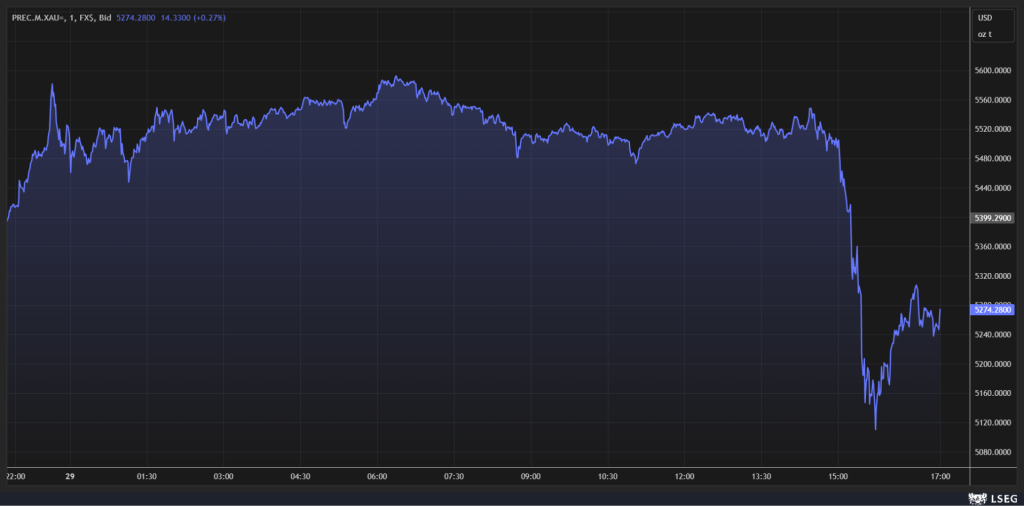
The primary catalyst for the selloff appears to be a recalibration of interest rate expectations following the Federal Reserve’s January 28 policy meeting. While the Fed maintained its benchmark rate as expected, the accompanying statement delivered a sobering message: the central bank signaled its intent to hold rates at current levels until at least June.
Beyond monetary policy, the sheer magnitude of gold’s ascent made it a prime target for profit-taking. Gold surged an astonishing 65% in 2025 and has added another 28% year-to-date in 2026. Having fully priced in a litany of geopolitical “black swans”—ranging from the diplomatic fallout of the US-Greenland acquisition proposal to escalating tensions in the Middle East and Eastern Europe—the metal found itself in deeply overbought territory.
Institutional players seem to be taking the hint. Just last week, Goldman Sachs notably raised its 2026 price target to $5,400. With the spot price overshooting that benchmark by nearly $200 in a single morning, many funds likely hit their “sell” triggers simultaneously.
While the long-term structural case for gold remains supported by central bank diversification and fiscal concerns, the technical outlook suggests a “hard climb” from here. After rising so fast, the market now faces the challenge of finding a stable floor.