
Every time an application is downloaded, a smartphone is activated, or a payment is made via mobile phone, who knows who behind the scenes is “setting the rules of competition” under such architecture?
The answer to this question does not lie solely with application developers. Instead, it rests in the hands of a few business operators who control the Digital Market Architecture through operating systems (OS) and app stores.
This role turns operating systems and App Stores into more than just technologies connecting users to digital services. They become the “competition controllers” capable of dictating market access conditions for other operators—ranging from establishing technical standards, authorizing access to system features, and ranking application visibility, to determining commercial terms between platforms and app developers.
When a single business operator controls a Critical Access Point that others must rely upon, the resulting economic power is reflected not merely through market share figures, but through the ability to set the rules of competition across the entire digital market infrastructure.
Under this dynamic of structural market dominance, the author presents the concept of Pyramid Dominance. This concept may serve as a major turning point in the landscape of competition law regulation worldwide—one that digital businesses at every layer must closely monitor.
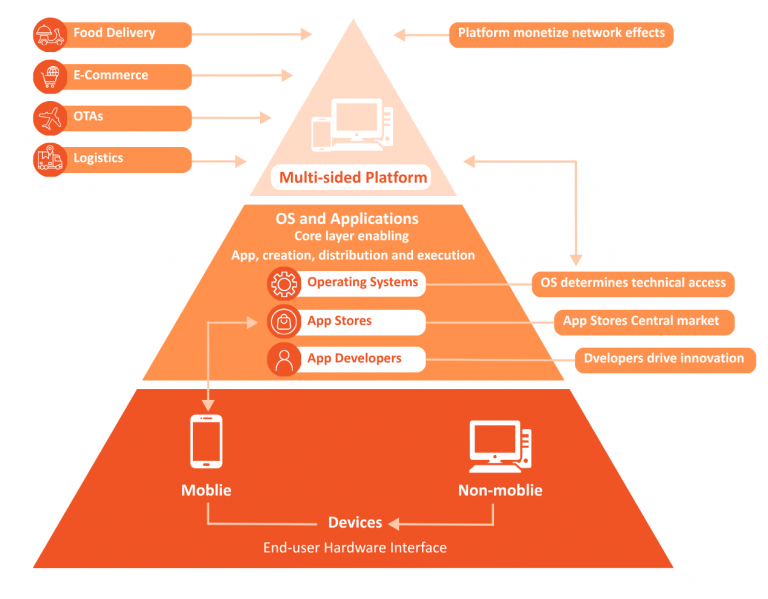
This concept is grounded in the observation that, in the digital market, operators do not possess equal power at every level. Rather, the market resembles a “pyramid”, where operators at certain levels can continuously dictate business conditions for those at subsequent levels. Operators controlling Critical Access Points—such as operating systems, distribution channels, technical standards, or strategic data—may possess the ability to set competitive terms for others, even if they do not hold the highest market share in each market. In other words, OS providers are not merely software developers; they act as infrastructure controllers that other operators—be they App Store providers, app developers, payment service providers, device manufacturers, or other digital service providers—must utilize to enter the market.
Therefore, Pyramid Dominance does not aim to propose a new legal principle or replace traditional market power analysis under competition law. Instead, it serves as an analytical framework to explain structural relationships within the digital ecosystem, making competition assessments more comprehensive by demonstrating that market dominance may stem not from being the largest player in the downstream market, but from controlling the “rules of competition” via key access points in the digital market architecture.
The structure of market power transfer under the Pyramid Dominance concept can be explained through 5 layers of inter-business power transmission:
The transfer of structural Market Power under the Pyramid Dominance framework
What Competition Risks Should Digital Business Monitor? Three Competition Risk Zones
Under the Pyramid Dominance framework, operating-system and platform operators may be more than undertakings with substantial market shares. They may control infrastructure on which other businesses depend to enter, access, or compete in the market. Dominance itself is not unlawful. However, the exercise of power by an infrastructure controller may warrant closer legal and regulatory scrutiny because of its capacity to affect competition across several connected layers.
Recent enforcement and regulatory developments across jurisdictions indicate that competition risk in digital markets may not result from a single isolated practice. It may arise from the combined operation of an ecosystem in which technical, commercial, and data-related rules reinforce one another. Authorities are therefore paying increasing attention to the transfer or leveraging of market power across the digital value chain.
Against that background, the principal competition risks for businesses arise where an upstream infrastructure controller uses its position in a manner capable of materially affecting competition in downstream application or digital-service markets. These risks may be grouped into three competition risk zones, as summarised below.
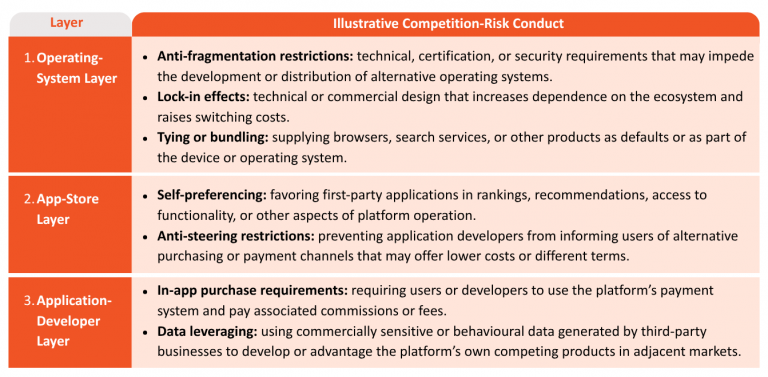
These practices demonstrate that market power need not remain confined to a single layer. It may be exercised vertically or leveraged from an operating-system or app-store layer (upstream markets) into downstream application markets. Depending on the circumstances, such conduct may distort the competitive process, raise rivals’ costs, restrict customer choice, and reduce the incentives or ability of smaller businesses to innovate.
When Competition Law Becomes Part of Business Strategy
The European Union’s Digital Markets Act (DMA), together with the broader regulatory environment that includes the Digital Services Act (DSA), illustrates this shift towards ex ante obligations. The policy direction encourages businesses to design systems, rules, and decision-making processes with competitive effects in mind from the outset—an approach that may be described as Competition by Design.
These developments are not confined to overseas jurisdictions. Thailand’s competition authority has recently received complaints concerning conduct alleged to restrict undertaking choice within e-commerce platforms market. Such developments illustrate that the control of critical access points – the central concern of the Pyramid Dominance framework-is not merely a theoretical construct imported from foreign jurisdictions, but a structural risk that is already materializing within Thailand’s digital markets. Thailand has also considered legislative and enforcement reform addressing digital-platform governance and the effectiveness of competition-law enforcement under the Trade Competition Act B.E.2560 (2017), reinforcing the case for business operating in Thailand to adopt an ex-ante, prevention approach to competition-law compliance. It is increasingly becoming part of corporate governance and enterprise risk management. In practical terms, competition compliance should begin at the business-design stage—not after an authority has opened an investigation.
Practical Recommendations
- Operating-System and App-Store Operators. Businesses that control digital infrastructure should review their internal governance arrangements regularly. They should maintain structured competition-law checklists covering decisions that may affect third-party market access, including:
-
- Criteria for approving, rejecting, suspending, or removing applications;
- Access to application programming interfaces (APIs), system functionality, and other critical technical resources;
- Policies governing default applications and device settings;
- Rules relating to ranking, recommendation, discoverability, and presentation of applications;
- The use of application developers’ data to develop or improve the platform’s own products or services; and
- Fee structures, commercial terms, notice periods, and procedures for changing platform policies.
- Application Developers should monitor changes to platform terms, preserve evidence of the commercial and technical impact of policy changes, and assess whether a measure is applied consistently across comparable businesses or disproportionately affects a particular category of participant. In many cases, complete factual records and a systematic impact assessment may be as important as the legal analysis when explaining how conduct has affected competition.
- Boards and Senior Management. The role of boards and senior executives in the digital economy extends beyond financial performance and conventional risk management. Decisions concerning business strategy, technology investment, algorithmic design, data use, interoperability, and the integration of services within an ecosystem may all have consequences for market competition.
Boards should therefore consider Competition by Design alongside Privacy by Design and Security by Design. This integrated approach helps ensure that products, services, and commercial strategies achieve an appropriate balance between innovation, security, legitimate business objectives, and fair competition. Embedding competition considerations into governance processes at an early stage can reduce legal and operational risk, strengthen stakeholder confidence, and support the sustainable development of digital ecosystems.
Author’s Note
This publication presents Pyramid Dominance as an analytical framework for understanding structural market power within digital market architecture. The framework is intended to support analysis of competitive dynamics in the digital economy. It does not seek to establish a new legal doctrine, replace existing principles for assessing market power, or prescribe a new legal test under competition law.
Disclaimer
This publication is provided for general informational purposes only and does not constitute legal advice in relation to any particular matter. Readers should obtain advice from qualified legal counsel before acting on the matters discussed. For further information regarding competition-law risks, please contact the Antitrust & Competition Practice of Kudun & Partners.