
The Trade Competition Commission of Thailand (the “TCCT”) announced that, during the first half of 2026, the Office of the TCCT had received 16 complaints concerning commercial conduct by digital platform businesses. Seven complaints are currently subject to fact-finding inquiries, while the remaining nine were considered to fall outside the TCCT’s jurisdiction under the Trade Competition Act B.E. 2560 (2017) (the “Trade Competition Act”).
TCCT also stated that it would expedite its consideration of digital platform complaints and had approved the establishment of a dedicated subcommittee to study, develop and propose measures for the supervision and prevention of potentially harmful commercial conduct in digital platform markets.
At first glance, the announcement may appear to be a routine report on complaint statistics. However, when read alongside the entry into force of the TCCT’s guideline concerning unfair trade practices and conduct that may constitute monopolization or the reduction or restriction of competition in multi-sided e-commerce platforms (the “Multi-sided Platform Guideline”), the announcement signals a broader development.
Competition oversight of digital platforms in Thailand appears to be moving beyond the resolution of individual disputes towards a more systematic examination of how platform markets operate.
Competition analysis must address the platform environment (Ecosystem) as a whole
A multi-sided platform differs from a conventional business because it does not transact with only one category of counterparty. Instead, it facilitates interactions among several interdependent user groups.
Within an e-commerce platform ecosystem, participants may include:
- sellers of goods or services;
- purchasers and consumers;
- logistics and delivery providers;
- payment service providers;
- advertising service providers; and
- technology or infrastructure providers supporting digital transactions.
The Multi-sided Platform Guideline defines a multi-sided platform by reference to its intermediary role in connecting two or more distinct user groups so that they may interact directly, exchange value or depend upon one another’s services. It also defines e-commerce broadly to include intermediaries facilitating sales, exchanges or transactions through electronic systems.
Because these relationships are interconnected, a change affecting one side of the platform may produce consequences across several other sides.
For example, requiring sellers to use logistics services selected by the platform may affect not only sellers’ operating costs, but also the ability of competing logistics providers to access customers and the price or quality of services ultimately received by consumers.
Similarly, changes to product-ranking systems may materially affect merchants’ sales even where the platform makes no direct change to prices or fees.
“ This broader analytical perspective aligns with international discussions recognizing that market power in digital ecosystems must therefore consider the market architecture created by the platform not only from market share, but also from the ability to shape the rules governing access, visibility, and participation within the platform environment.”
Definitions
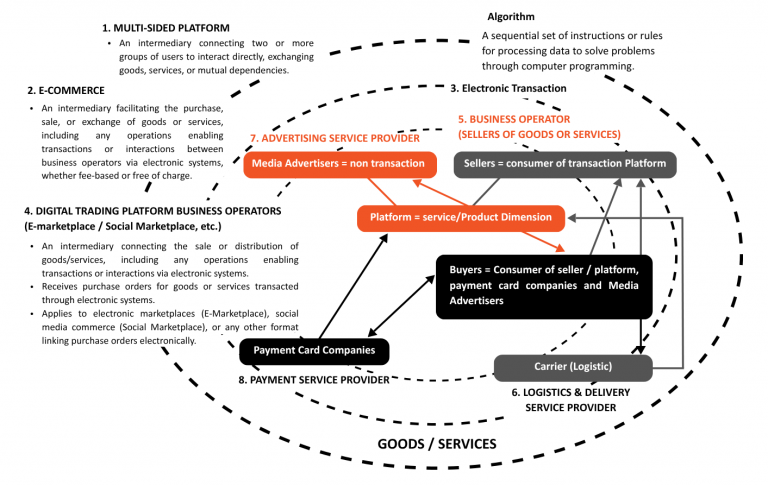
The Multi-sided Platform Guideline is not new legislation, but it matters for enforcement
The Multi-sided Platform Guideline does not establish a new category of infringement separate from the Trade Competition Act. Its purpose is to provide an analytical framework for identifying conduct that may amount to monopolisation, the reduction or restriction of competition, or unfair trade practices. The Guideline links platform conduct to existing provisions of the Trade Competition Act, including Sections 50, 54, 55, 57 and 58.
Conducts are likely to receive greater scrutiny
Based on the Multi-sided Platform Guideline and TCCT’s latest announcement, the conduct likely to attract closer examination may be divided broadly into price-related and non-price practices.
Price-related conduct
Potential areas of scrutiny include:
- requiring sellers to price below cost;
- requiring sellers to offer the same price across all sales channels;
- resale price maintenance;
- introducing new fees, charges or financial benefits without reasonable justification or sufficient prior notice;
- applying different fees without an objective basis; and
- setting or adjusting fees in a manner capable of affecting competition.
The Guideline refers specifically to below-cost pricing requirements, price-parity obligations, resale price maintenance and the imposition of fees or other financial benefits that were not previously charged, without reasonable justification or prior notice.
Non-price conduct
Practices requiring review may include:
- requiring sellers to use logistics services designated by the platform;
- requiring the use of the platform’s payment or advertising services;
- compelling participation in promotional campaigns;
- restricting the visibility of goods or services;
- favoring the platform’s own products or services;
- denying or restricting access to data;
- changing commercial terms without sufficient prior notice; and
- limiting a business user’s freedom to choose commercial partners or sales channels.
The Guideline itself recognizes that commercial conduct should be evaluated together with reasonable and legitimate economic, business or marketing grounds.
The specialized subcommittee signals a more systematic regulatory approach
The subcommittee’s role is not limited to adjudicating individual complaints. Its mandate includes studying, analyzing and collecting information, and preparing proposals concerning guidance, regulatory approaches, criteria, notifications, rules or wider policy measures for consideration by the TCCT.
Five Questions Every Platform Business Should Now Ask
- Are our platform fees objectively justifiable?
- Do our contractual terms unnecessarily restrict business users’ commercial freedom?
- Are our ranking algorithms sufficiently transparent and consistently applied?
- Could our logistics or payment requirements be perceived as exclusionary?
- Are we able to demonstrate legitimate business justifications if our commercial practices are challenged?
How businesses should prepare
TCCT’s announcement that it will expedite complaint handling, combined with the establishment of the specialised subcommittee, means that platform operators should not wait for a complaint before reviewing their internal governance arrangements.
Immediate priorities should include the following.
- Review platform terms and conditions
- Review procedures for changing commercial terms
- Assess the necessity of mandatory ancillary services
- Establish algorithm-governance procedures
- Maintain contemporaneous evidence of commercial justifications
- Develop effective internal complaint mechanisms
- Extend competition compliance beyond the legal department
Key Takeaways
For executives and businesses
- The 16 complaints represent only part of the picture. The more significant development is TCCT’s move towards systematic oversight of digital platform markets.
- The Multi-sided Platform Guideline does not create a new category of infringement, but it indicates the analytical framework likely to be applied under existing competition law.
- Competition risks extend beyond prices and fees to algorithms, ranking, logistics, payments, advertising and contractual governance.
- The practices identified in the Guideline are not automatically unlawful. Businesses should nevertheless be able to demonstrate reasonable, proportionate and evidence-based commercial justifications.
- Platform competition compliance should involve legal, commercial, product, data and technology functions.
This article was co-written by:
Kom Vachiravarakarn Partner
Piyapat Tubin Competition law specialist
Chuenkamol Viriya Associate
Competition Practice – Kudun & Partners