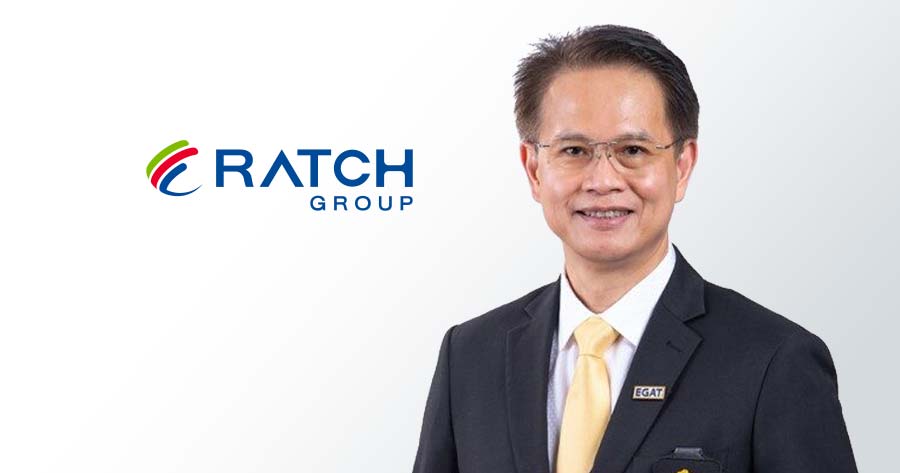
Nitus Voraphonpiput, Chief Executive Officer and President of RATCH Group Public Company Limited (SET: RATCH), revealed that the company’s earnings outlook for the second half of the year is expected to outperform the first half.
This is attributable to new power plants scheduled for commercial operations (COD) in the fourth quarter of 2026 – namely, the NPSI solar power plant in the Philippines with a total installed capacity of 145 MW (with 71.05 MW under RATCH’s equity holding), and the Song Kieng 1 hydropower project in Vietnam, with an equity capacity of 5.5 MW. Furthermore, there may be greater clarity on electricity sales to data center operators as well.
For 2026, the company maintains its EBITDA target at THB 15 billion, after having achieved THB 7.62 billion in the first half. The company anticipates that new projects will continue to support results in the second half, and it targets no less than 15% of its total revenue coming from renewable energy.
Additionally, the company has set an investment budget for 2026 at THB 10 billion, divided into THB 4 billion for projects under construction, THB 3 billion reserved for merger and acquisition (M&A) deals, and another THB 3 billion earmarked for investment in new businesses.
In terms of investments, the company is prepared to invest in new power plant projects according to Thailand’s electricity generation development plan. The focus will be on bidding for renewable projects, including community solar, solar farms, wind power, and biomass power plants. At the same time, the company also has interest in natural gas power plants, which it sees as “transition energy” to maintain stability and security in the national power system. RATCH has been scouting for suitable locations for such projects and reviewing available technology.
Moreover, RATCH sees investment opportunities in Indonesia in line with the country’s electricity development plan (RUPTL). The company is planning to expand the Paiton power plant in East Java, a 1,000 MW thermal power plant, given its readiness in terms of land and connectivity potential with the Java-Bali power grid. The company is also studying the feasibility of expanding gas engine projects (200 MW) and a combined heat and power plant with a cooling system (140 MW) in Batam.
As for value creation at the Ratchaburi power plant—where the PPA contract will expire in April 2027—the company is crafting a new business model to develop the site with three approaches: renewing the PPA contract, supplying electricity to data center businesses, and partially divesting power plant assets. Currently, negotiations are underway with multiple hyperscale data center operators.
In the first half of the year, RATCH entered the digital sector by supplying electricity to data centers via its subsidiaries. Ratchaphat Energy Co., Ltd., in which RATCH holds a 51.67% stake, signed a 60 MW power purchase agreement with a data center customer located in Saha-Phat Industrial Estate, Chonburi. Meanwhile, Nava Nakorn Power Plant, with an installed capacity of 232 MW and 40% RATCH ownership, has agreed to produce and supply 48 MW and 20 MW of electricity to two data center customers in the Nava Nakorn Industrial Promotion Zone.
RATCH has also made progress in negotiations to co-invest in a Sustainable Aviation Fuel (SAF) production project in Turkey, with a production capacity of 100,000 tons per year. Additionally, the company is developing a new business model for the Ratchaburi power plant, with initial focus on basic utility services, circular economy-related businesses, or future new businesses.