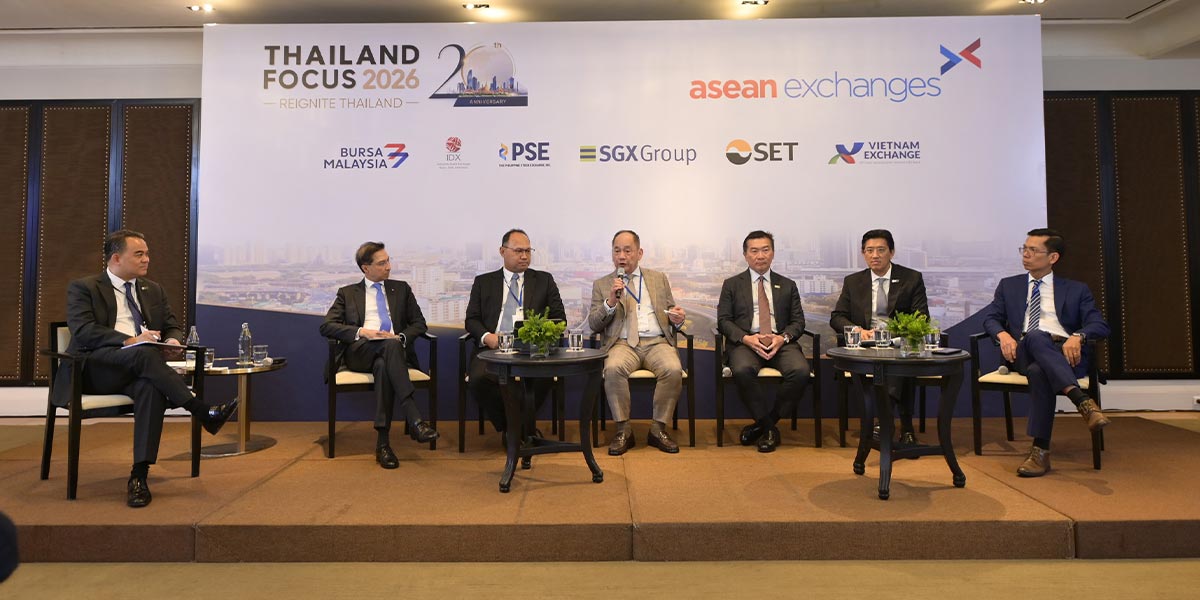
At the “Thailand Focus 2026: Reignite Thailand” forum on 26 August 2026, leaders from Southeast Asia’s top stock exchanges gathered for a high-profile panel titled “Luncheon Talk: ASEAN Growth Opportunities (ASEAN Exchange Session).”
The executive panel collectively highlighted that ASEAN is projected to rise as the world’s fourth-largest economy by 2040. Speakers emphasized that while global capital markets currently remain heavily underweight on ASEAN assets, the region should be viewed as a cohesive network of complementary opportunities rather than competing individual markets.
The discussion highlights how the stock exchanges of Malaysia, Indonesia, the Philippines, Singapore, Thailand, and Vietnam are executing structural reforms, technological upgrades, and regional integrations to connect global capital with regional prosperity.
Bursa Malaysia
Led by Chief Executive Officer Dato’ Fad’l Mohamed, Bursa Malaysia is experiencing strong listing activity. The exchange welcomed 60 IPOs in 2025, raising nearly MYR 6 billion with a total market capitalization of MYR 27.4 billion. This momentum carried into the first half of this year, which recorded 42 IPOs that raised nearly MYR 6 billion.
To sustain this growth, Bursa Malaysia is focusing on:
- High-Value Sectors: Actively recruiting companies from target industries such as semiconductors, technology, healthcare, and advanced manufacturing.
- Mid-Sized and SME Support: Guiding medium enterprises and SMEs to register on the ACE and LEAP Markets.
- Corporate Value Creation: Driving the “My Value Up” program, which targets 88 large-cap companies representing 80% of Malaysia’s total market capitalization. These companies are voluntarily preparing clear value-creation plans with specific KPIs, due by the end of this year, with progress monitoring scheduled for 2027.
- Product Diversification & Dual Listings: Expanding financial offerings via ETFs and Digital Asset ETFs, while signing an MOU with the Hong Kong Stock Exchange (HKEX) and cooperating with the Hong Kong SFC to study dual-listing opportunities.
Malaysia’s core capital market strengths include its highly diversified sectors and a robust domestic institutional investor base capable of injecting over MYR 28 billion of new investment capital. Furthermore, Malaysia is a global leader in Islamic Capital Markets, with Shariah-compliant securities comprising 80% of its capital market. This is backed by solid industrial fundamentals, as Malaysia is the world’s sixth-largest semiconductor exporter, accounting for a 13% global market share in chip assembly and testing.
Indonesia Stock Exchange
Under the leadership of Director of Trading and Membership Mr. Irvan Susandy, the Indonesia Stock Exchange (IDX) is executing a massive structural overhaul in coordination with Indonesia’s Financial Services Authority (OJK) to bolster corporate governance and win foreign investor confidence.
The exchange is implementing an ambitious eight-topic market reform plan, with five key areas already fully enacted and legally enforced:
- Free Float Policy Overhaul: A new rule requires both newly listing and existing listed companies to maintain a minimum free float of 50% (a substantial increase from the previous 7.5% threshold), supported by a three-year transition window.
- Ultimate Beneficial Ownership (UBO): Implementing much stricter disclosure rules regarding the actual, ultimate owners of listed companies.
- Granular Shareholder Tracking: Refining investor classifications into 39 distinct categories, with a mandatory requirement to report any shareholder holding a stake greater than 1% at the beginning of each month.
- Stricter Market Enforcement: Tightening law enforcement and implementing severe penalties for market misconduct and stock price manipulation.
- Governance & Professional Standards: Mandating continuous Good Corporate Governance (GCG) training for board directors and commissioners, while requiring corporate financial statement preparers to hold certified professional accounting credentials.
For the three remaining reform areas, IDX is on track to finalize its demutualization into a public company under a new legal framework by late this year or early next year. Additionally, IDX will upgrade its trading infrastructure this December and recently expanded its product suite by launching five Gold ETFs last month. To align with global benchmarks, the exchange is collaborating with stakeholders on sustainable reforms and harmonizing its indices with S&P and FTSE standards. IDX currently serves over 30 million registered investor accounts, of whom approximately 30% are highly active, regular traders.
Philippine Stock Exchange
Under President and CEO Mr. Ramon S. Monzon, the Philippine Stock Exchange (PSE) is prioritizing short-term structural reforms to address its primary market challenge: liquidity.
To enhance market activity, the PSE is implementing several key strategies:
- Listing Flexibility: Adjusting the Sponsor Model listing criteria and permitting the listing of preferred shares only.
- REIT Rule Relaxation: Expanding Real Estate Investment Trust (REIT) eligibility to cover infrastructure assets such as expressways, data centers, and renewable energy, with the country’s first data center fundraising slated for November.
- New Financial Instruments: Applying for regulatory approval from the SEC to establish Global Derivative Depositary Receipts (GDDR) and finalizing a Derivatives Rule Framework targeted for launch in Q2 of next year. The exchange is also revising rules to develop its exchange-traded funds (ETFs) market, which currently features only a single fund.
- Retail Accessibility: Establishing a Negotiated Trade Board to allow large-block transactions with custom price agreements to bypass normal queuing, restructuring its minimum trading lots to a “One Share, One Board Lot” system, and supporting tax-incentivized Personal Equity and Retirement Accounts (PERA) for employees.
- Major Infrastructure Upgrades: Completely replacing its trading infrastructure with the “Nasdaq Eclipse” system, set to go live in November. This runs alongside upgrades to listed company reporting systems, the Central Securities Depository System, and sub-regulator market surveillance systems.
The Philippine stock market currently trades at a highly attractive price-to-earnings (P/E) ratio of just 9.56x, compared to its historical average of 12–13x and the ASEAN average of 13–17x. Listed companies boast an average profit margin of 14% (ranking third in ASEAN behind Singapore and Indonesia). Driven by a large young population and domestic consumption making up 75% of GDP, the country’s economic growth is projected to return to a normal rate of 6–7% as government reforms take hold.
Singapore Exchange
Led by CEO Mr. Loh Boon Chye, Singapore Exchange (SGX) continues to position itself as a premier, resilient multi-asset exchange focused on sustainable and durable growth.
SGX is currently experiencing extraordinary trading momentum:
- Record Activity: Average daily equity trading values have reached an 18-year high, while retail trading activity has peaked at a 50-year high.
- Small-Cap Expansion: Liquidity has dispersed into small-cap equities, whose trading volume doubled in just one year.
- Healthy IPO Pipeline: Over 50 companies are working with advisors to prepare for IPOs, spanning digital infrastructure, consumer products, healthcare, real estate, and heavy industries.
- Global Board Initiative: SGX has partnered with Nasdaq to establish a Global Listing Board, enabling Asian companies to dual-list and trade seamlessly across both exchanges.
- Liquidity and Funding Backing: Capital flows are actively supported by the Monetary Authority of Singapore (MAS) through a SGD 6.5 billion Equity Market Development Program fund (of which SGD 3.9 billion has already been allocated), complemented by SGX’s own “Value Up Program”.
- Systems Upgrades: SGX is revising large-block transaction size (Block Size) rules and preparing to transition its custody and depository systems in the coming months.
Currently, Southeast Asian and South Asian enterprises represent 20% of the listed companies on SGX’s mainboard, solidifying its role as the region’s capital gateway.
Stock Exchange of Thailand
President Mr. Asadej Kongsiri outlined the Stock Exchange of Thailand’s (SET) vision to serve as “The Trusted Gateway to Inclusive Opportunities” to drive capital mobilization and support stable national economic growth.
The SET is spearheading growth through several key strategies:
- The JUMP+ Programme: Actively strengthening the fundamental growth capabilities of Thai listed companies.
- “New Economy” Rules: Collaborating with the Thai SEC to review and relax listing rules to attract high-potential, technology-driven “New Economy” businesses while maintaining strict disclosure standards and investor protections.
- Digitalization and Tokenization: Studying and preparing infrastructure frameworks to support asset digitalization and asset tokenization, which are fundamentally transforming stock exchange services globally.
- Cross-Border Depositary Receipts (DRs): Expanding regional capital linkages, exemplified by its highly successful DR program with SGX. Thai investors now have access to over 500 DRs trading directly on the Thai stock exchange.
Vietnam Exchange
According to Deputy CEO Mr. Dang Tai An Trang, Vietnam Exchange (VNX) is developing its capital market around four strategic pillars: market accessibility, market quality, investment products, and market credibility.
Key milestones and strategic focus areas for VNX include:
- FTSE Emerging Upgrade: September 2026 will mark a major turning point, as FTSE Russell is scheduled to officially upgrade Vietnam’s status from a Frontier Market to a Secondary Emerging Market. This upgrade is driven primarily by “market accessibility” improvements rather than market size, notably the elimination of pre-funding requirements and easing market access for foreign brokers.
- Post-Upgrade Clearing and Settlement: Developing and transitioning the clearing and settlement process to a Central Counterparty (CCP) system, alongside preparing regulatory frameworks for Securities Lending and Covered Short Sales.
- Product Expansion: Diversifying financial products beyond common equities by developing new ETFs, derivatives, and regional linkage products.
- Sustainability connectivity: VNX signed an agreement with other ASEAN stock exchanges to enter into the ASEAN-Interconnected Sustainability Ecosystem (ASEAN-ISE) initiative during a meeting in Hoi An in June.
- Credibility, IFRS, and ESG: To attract long-term institutional capital, VNX is mandating the transition to International Financial Reporting Standards (IFRS/IAS), promoting sustainability and ESG data reporting in partnership with the ASEAN Sustainable Finance Network, and upgrading corporate governance in line with OECD criteria.
These initiatives successfully reinforce Vietnam’s position as one of Asia’s most dynamic and strategically situated capital markets.