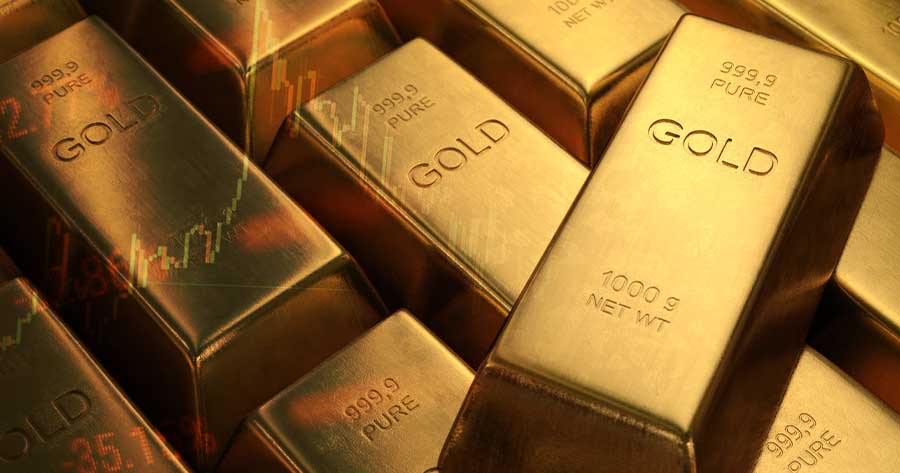
Pawan Nawawattanasub, Chief Executive Officer of YLG Bullion International Co., Ltd. (YLG), stated that gold prices remain in an upward cycle, supported significantly by central bank purchases worldwide.
China, in particular, has continuously added gold to its portfolio, importing over 1,000 metric tons from the start of the year through August—a volume exceeding its total imports for all of 2025. However, gold still accounts for only about 5% of China’s total reserves.
Meanwhile, Poland, which has been accumulating gold since before the COVID-19 pandemic, currently holds around 30% of its reserves in gold and maintains a target to continue buying until its reserves reach 700 metric tons.
Data on the top 20 gold-holding nations globally from the World Gold Council and the International Monetary Fund (IMF) reveals that most major powers maintain high gold reserve ratios, whereas emerging market economies hold less than 10%.
Uzbekistan ranks first with a ratio as high as 86 – 87% (416 metric tons), followed by the United States at 84%, which holds the world’s largest reserve at 8,133.5 metric tons. Germany holds 84% (3,350.3 metric tons), Lebanon 82% (286.8 metric tons), France 81.8% (2,437 metric tons), Italy 81.3% (2,451.8 metric tons), Portugal 79.9% (382.7 metric tons), Kazakhstan 77% (339.9 metric tons), the Netherlands 74.2% (612.5 metric tons), and Greece 64 – 65% (115 metric tons).
Among countries ranked 11th to 20th, Cyprus leads with 62.4% (13.9 metric tons), followed by Turkey at 53.4% (603 metric tons), Russia at 47% (2,317 metric tons), Spain at 33.8% (281.6 metric tons), Poland at 30.1% (582 metric tons), Curaçao and Sint Maarten at 29.9% (13.1 metric tons), Belarus at 28.4% (53.8 metric tons), the European Central Bank at 28.1% (504.8 metric tons), Slovakia at 23.2% (31.7 metric tons), and the United Kingdom at 22.5% (310.3 metric tons).
Thailand holds a 10.5% gold share in its reserves, with total holdings of 234.5 metric tons, ranking 23rd globally and 1st in Southeast Asia, where regional neighbors hold an average of only 5% of their foreign reserves in gold.
However, YLG assesses that central bank accumulation is only one factor, with interest rates and yields on other assets also playing key roles. The recent pullback in gold prices reflects profit-taking triggered by rising U.S. Treasury yields. Nevertheless, the long-term trajectory remains upward, and gold prices are expected to retest their previous peak in the second half of next year.