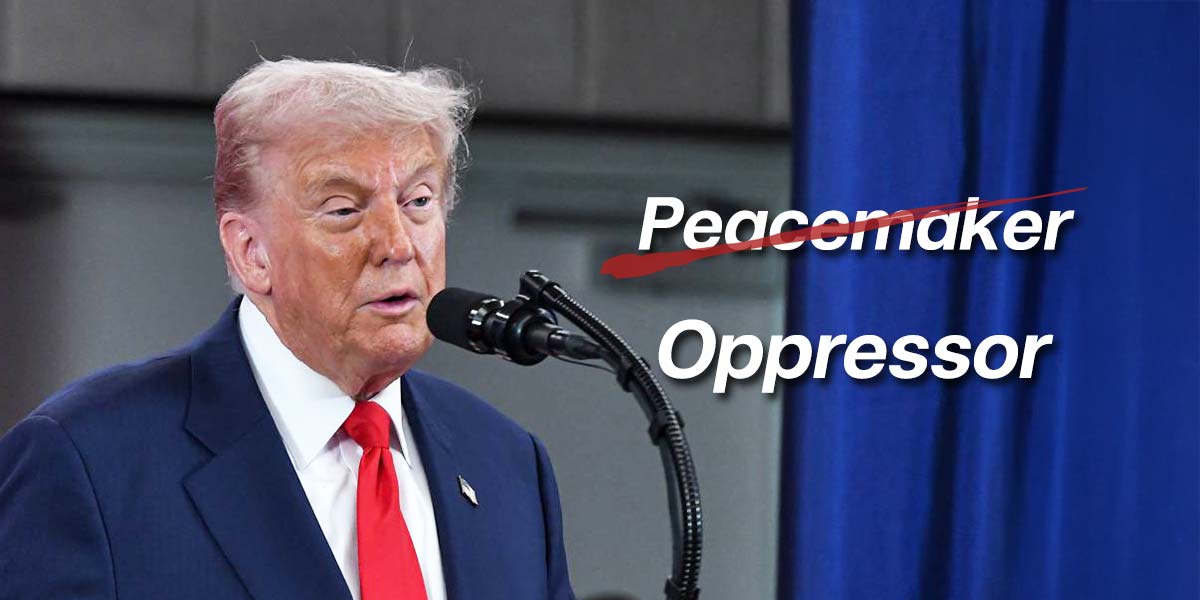
The recent revelation from President Trump’s interview with The Wall Street Journal, where he boasts of using tariff threats to “settle” a border dispute between Thailand and Cambodia, paints a deeply concerning picture of American foreign policy. While the objective of peace is universally laudable, the method employed bears an uncomfortable and striking resemblance to an oppressor ruling by fear, rather than a global superpower fostering genuine, ethical diplomacy.
Trump’s self-proclaimed role as a peacemaker, enforced by the chilling ultimatum – “If you have the war, not only am I going to break the trade deal we have, but I’m going to put tariffs on your country” – positions the United States not as an ally, but as an enforcer. This isn’t the subtle art of negotiation or the patient work of international mediation; it’s a blunt instrument of economic coercion wielded with maximalist intent.
The underlying message delivered to Bangkok and Phnom Penh is unambiguous: play by my rules, or face financial ruin. “Nobody can do that but me,” Trump declared, a statement that rings with the authoritarian confidence of a supreme lord asserting dominion over his territory rather than the sober perspective of a head of state.
This dismissive tone is compounded by the staggering double standard it reveals in the valuation of human life and sacrifice. Just as the Thai government was grieving casualties, President Trump, in his social media post, chose to label the landmine explosion that killed and wounded Thai soldiers as merely an “accident.” This callous trivialization of an ally’s loss stands in sharp contrast to the gravity the White House assigns to its own troops. Around the same time, the administration reportedly vowed swift and strong retaliation for the death of a U.S. serviceman in Syria.
This discrepancy in language and promised action suggests a deeply troubling calculation: that the lives and suffering of a treaty ally’s soldiers are matters of minor, accidental inconvenience, while the death of a U.S. citizen demands immediate, vengeful action. By publicly drawing such a stark line on the value of human life, Trump signals that the U.S. sees Thai sovereignty and casualties as having little to no importance compared to its own citizens, fundamentally degrading the concept of an alliance.
Such tactics strip nations of their sovereignty and undermine the very principles of multilateralism that have historically underpinned global stability. They transform trade agreements, meant to foster mutual prosperity, into bargaining chips in geopolitical power plays, creating a system where weaker nations are forced to make decisions under duress. This approach fosters resentment, not respect. When the world’s leading democracy acts like a mafia, demanding obedience through threats of economic punishment while diminishing the sacrifices of its partners, the fabric of global cooperation begins to unravel, leaving behind a volatile landscape where power, not principle, dictates peace.