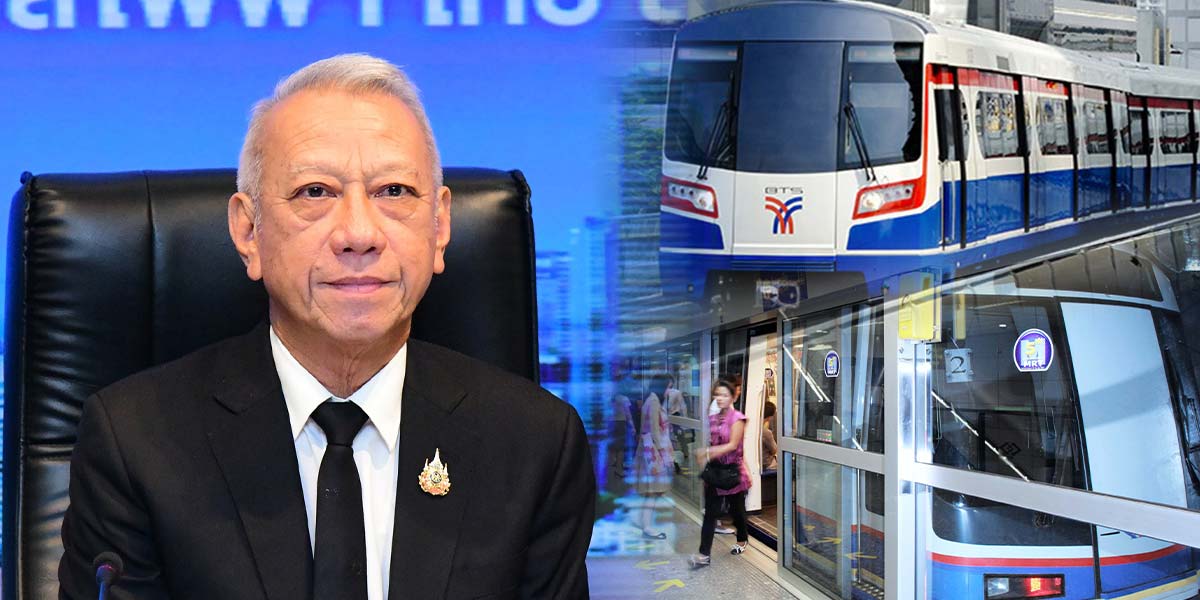
Phiphat Ratchakitprakarn, Deputy Prime Minister and Minister of Transport, disclosed on “Inside Thailand” program regarding the consolidation of all mass transit railway lines into the administration of Mass Rapid Transit Authority of Thailand (MRTA), or the Single Ownership operation, in order to promote joint management of the mass transit system and support the common ticketing policy.
Phiphat stated that this proposal is for the Cabinet to acknowledge the principle. Afterward, the Ministry of Transport will officially begin negotiations for the buyback of the mass transit rail projects.
The Ministry of Transport has proposed two funding approaches for the buyback without utilizing the national budget. The first approach is to raise funds through the Thailand Future Fund, which has already been discussed with the Ministry of Finance. However, this method may take around one to one and a half years to implement, similar to listing the company on the Stock Exchange.
The second approach is, in the pre-funding period, the private sector will still operate as usual, but the operational rights must transfer to the MRTA first. This approach is to ensure that the cost of living reduction measure can be achieved as planned.
Phiphat said that the ministry’s goal is for the public to only pay one fare for the entire journey, even if they change the line during transit. Currently, passengers must pay a new fare each time they change the line.
If the buyback cannot proceed as intended, and the rails are still operated by the private sector, the fare will be set at THB 17 – 45 per trip, not a flat rate for the entire day, and the fare for outgoing and return journeys will be charged separately. This differs from the Purple and Red Lines, which currently provide all-day service at a rate of THB 40.
Phiphat further explained that, at present, there are questions concerning the private concessionaires, namely Bangkok Expressway and Metro Public Company Limited (SET: BEM) and BTS Group Holdings Public Company Limited (SET: BTS), that require consultation. However, while negotiations with the private sector are ongoing, the ministry is considering announcing a temporary fare rate of THB 17 – 45 per trip.
The concessions buyback will require negotiation based on the actual revenue of each mass transit line. For instance, the Green Line, which currently has an average of 1.2 million passengers per day, will need a mechanism for managing the revenue difference should the passengers increase after the new fare rate has been implemented.
Moreover, the Ministry of Transport has also envisioned the establishment of a “clearinghouse,” which could be a bank or financial institution, to manage fare revenues and return any overpayment to the public within three days, after the rights have been transferred to the state and private operators have been hired to manage the system.
Phiphat said that should the negotiation be concluded before the concession expiration, such as the Green Line which has about three years left, the process can be expedited. However, some projects, such as those under BEM’s concession, which have much longer concession terms remaining, may require different negotiation approaches.
Nevertheless, determining the buyback value of the concession must be carried out carefully, as setting an inappropriate price could be perceived as benefiting the private sector. The Ministry of Finance will assist in calculating an appropriate valuation.