
Key takeaways:
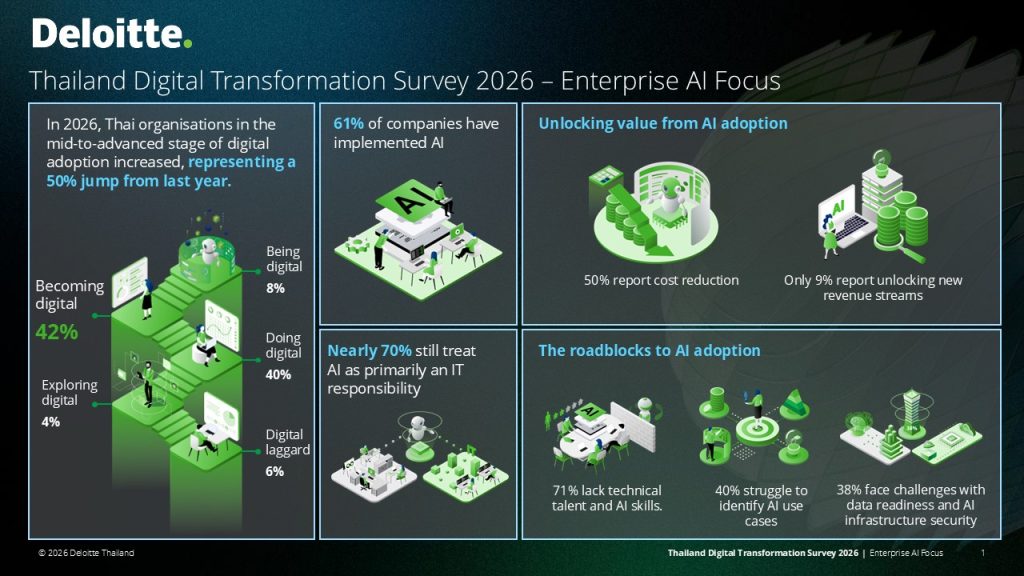
- New Deloitte findings show the share of Thai organisations in the mid-to-advanced stage of digital adoption jumped from 28% to 42%, representing a 50% jump in a single year.
- AI adoption continues to accelerate, with 61% of Thai organisations now implementing AI.
- Half of businesses reported that AI has reduced costs, yet only 9% have unlocked new revenue, with 81% still unable to scale beyond pilots.
- Nearly 70% still treat AI as primarily an IT responsibility rather than a cross-functional business-led priority.
- 71% cite a lack of technical talent and skills as the top barrier, and 40% point to difficulty identifying AI use cases, and 38% are held back by data readiness and security of AI infrastructure— all of which are critical foundations for scaling AI successfully
Thai organisations are progressing through digital transformation faster than ever before, but practical applications of AI have become the point where ambition is outpacing execution, Deloitte research has found.
According to Deloitte’s Thailand Digital Transformation Survey 2026 – Enterprise AI Focus, the proportion of Thai organisations in the “Becoming Digital” stage of maturity rose from 28% to 42% in a single year (a 50% jump), meaning more companies are leveraging digital technologies, becoming less siloed, with more advanced changes to their business.
Thai companies are investing heavily in digital adaptation to advance their business, with 48% allocating budget to operations in 2026, increasing from 39% last year. AI is the greatest focus for Thai organisations, with 61% now reporting AI implementation, up from 47% last year.
Despite increasing adoption of AI, many organisations struggle to translate ambition into real impact. Only 19% of Thai organisations have scaled AI across their operations, while 81% remain in experimentation and pilots. Seven in ten (71%) say they have only partially achieved their planned AI outcomes.
Thai companies not embedding AI into the business
Companies have not yet embedded and integrated AI across the business. The report finds most companies still treat AI as an IT project rather than a business transformation: nearly 70% see AI as primarily an IT responsibility rather than a cross-functional business priority.
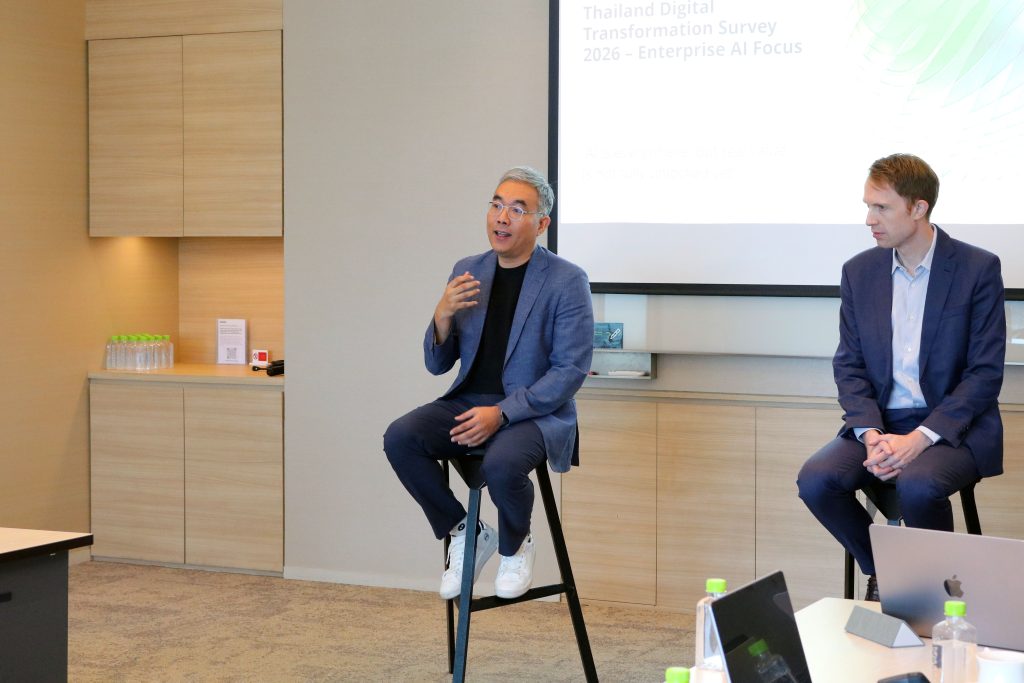
Mr. Robert Gallagher, Technology, Media & Telecommunications Leader, Deloitte Thailand, said: “Thai organisations are increasingly investing in AI to improve operations, but the reason businesses are not seeing transformational results is structural: AI is still being treated as an IT project rather than a business-led priority. Until business leaders take ownership of where and how AI gets applied, while IT focuses on delivery, the disconnect will persist.”
Most organisations (71%) cite a lack of technical talent and skills as a major roadblock to AI adoption, alongside difficulty in identifying use cases (40%). The foundations on which they can build AI solutions also need attention, with 38% saying their data is not ready to maximise AI, and the same number also saying their security of AI infrastructure needs to be addressed.
In order to achieve full adoption, it is critical that AI training is rolled out across all employees in an organisation. According to the survey, majority of Thai organisations had provided AI-related training to fewer than 30% of employees.
Redesigning workflows for greater human-AI collaboration
However, training alone will not unlock AI’s full potential. The more powerful lever lies in redesigning workflows so that humans and AI complement each other’s strengths, enabling people to focus on higher-value work while AI handles routine and repeatable tasks.
Mr. Tawin Tusnajareon, Director, Technology & Transformation, Deloitte Thailand, said, “Upskilling our teams is a vital first step, but it is only part of equation. The market leaders who are capturing real value have stopped treating AI as a mere software upgrade. Instead, they are actively redesigning their operation flows, business models, and customer touchpoints around AI’s strengths. While early adopters are already securing quick wins in operational efficiency and cost reduction, the true frontier for Thai businesses lies in harnessing AI to pioneer entirely new customer experiences and drive exponential market growth.”
Half (50%) of the businesses surveyed said AI adoption had enabled them to reduce costs, 48% said it had improved efficiency and productivity, and another 48% cited ease of adopting new systems or software.
Yet, only 9% said that AI had helped them unlock new revenue, a signal that Thai organisations are capturing AI’s efficiency dividend but have not yet reached the stage where it drives growth.
“Organisations also need the right enablers in place to protect and grow value: reliable and actionable data, redesigned ways of working and a clear governance framework. Companies must establish strong, centralised AI foundations and integrate individual AI initiatives into one cohesive operating model to move beyond isolated experiments to deliver enterprise-wide impact. Organisations can unlock entirely new avenues for revenue generation. The next phase of AI investment will see AI evolve from an efficiency enabler into a strategic capability that reshapes business models, strengthens competitive advantage and unlocks new growth,” added Mr. Gallagher.
The sixth annual Deloitte Thailand Digital Transformation Survey drew on a survey of business leaders across six industries, conducted between January and May 2026, complemented by in-depth interviews with executives.
To complement the latest survey findings, executives from Deloitte Thailand provided deeper insights into the specific industry applications and strategic hurdles facing local enterprises during a detailed discussion.
Industry Leaders and Laggards
While AI adoption is widespread, its impact varies significantly across sectors. Financial Services (Banking and Insurance), Retail (including FMCG), and Telecommunications are currently leading the charge. The most successful use cases in these sectors revolve around hyper-personalization. By capturing customer activity in real-time, AI allows these businesses to deliver the right campaign or product—such as an insurance policy exactly when a customer experiences a life milestone—through the most effective channel at the precise moment of need.
On the other hand, industries with less direct customer interaction, such as B2B businesses, tend to adopt AI more slowly. This is because, in the early stages of AI adoption, they often see fewer clear business use cases than customer-facing industries. By contrast, sectors with frequent customer interaction can more readily use AI to enhance customer experience and improve service efficiency, creating a stronger business case for AI investment and broader adoption.
AI as a Driver for Sustainability
The conversation highlighted that AI’s value extends beyond simple productivity into Environmental, Social, and Governance (ESG) goals. In manufacturing and energy production, AI is being deployed for advanced energy management. Unlike traditional rule-based systems, AI can optimize complex production flows 24/7, reducing waste and energy consumption. Even a marginal efficiency increase of 0.1% to 0.2% can translate into millions of dollars in savings while helping companies meet their sustainability targets.
Overcoming Structural and Security Roadblocks
A significant barrier identified is the tendency for Thai companies to be “Adopters” rather than “Innovators,” relying on technologies developed in the West or China. To scale effectively, organisations must move away from fragmented, “bottom-up” experimentation where different departments use different tools. Instead, a top-down centralized governance model is required to ensure data integration and security.
Security remains a top priority, especially for highly regulated industries like banking. AI is increasingly being used as a defensive tool to monitor network traffic and “self-heal” by automatically detecting and blocking cyber threats. Deloitte executives emphasized that for enterprise-grade AI, data must be “shielded”—meaning internal company data is processed within secure, private environments rather than being exposed to the public internet.
The Path to ROI
For Thai businesses to move beyond the 81% currently stuck in pilot phases, they must balance two factors: identifying clear business use cases and managing the high cost of infrastructure. As global demand for high-performance processing (GPUs) drives up costs, the companies that survive will be those that can demonstrate a clear link between AI investment and measurable business outcomes, such as increased revenue or significant cost reduction.