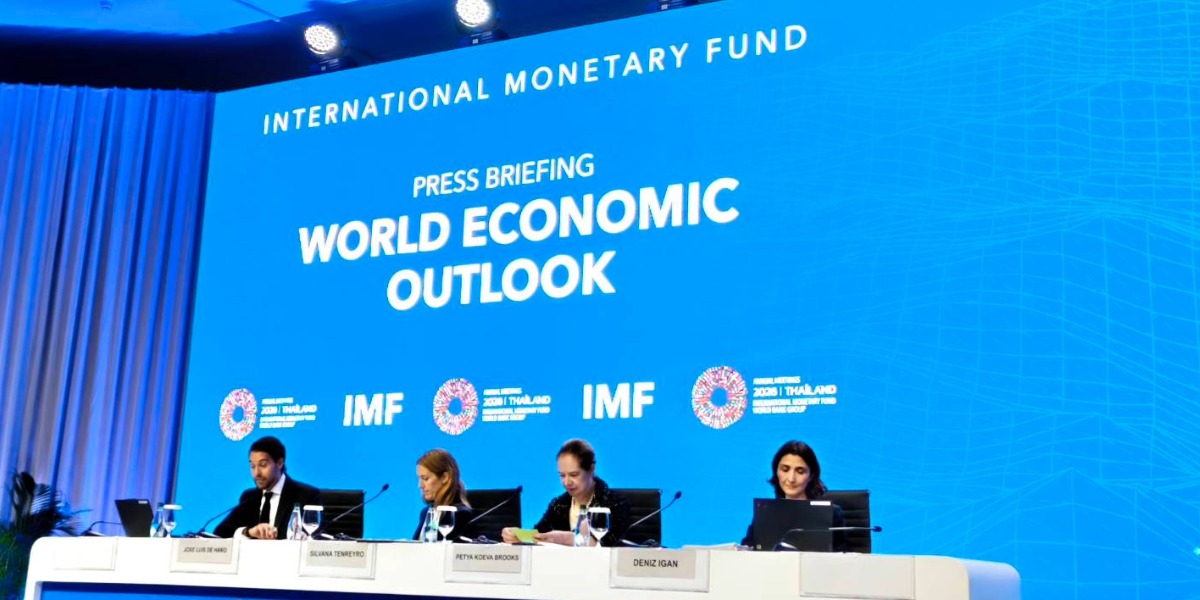
The International Monetary Fund (IMF) presented its latest October edition of the World Economic Outlook titled: “Resilience Under Strain, Urgent Choices,” at the IMF-World Bank Annual Meetings in Bangkok, warning that while global economic activity has demonstrated durability, that resilience is reaching its outer limits under compounding risks.
According to the IMF, global economic activity is projected to grow at 3.1% this year—40 basis points lower than last year—before rising slightly to 3.4% in 2027. The baseline outlook is shaped by two opposing macro forces: a negative global supply shock driven by war-related energy and commodity price surges, and a positive demand shock propelled by the artificial intelligence (AI) technology boom.
While these supply and demand forces pull activity in opposite directions, both exert upward pressure on prices. The IMF projects global headline inflation to reach 4.7% this year before easing to 4.1% in 2027. The pass-through to core inflation is expected to be limited.
The IMF outlined three major vulnerabilities currently testing global economic stability:
Commodity and Geopolitical Shocks: Renewed conflict in the Middle East has driven sharp price increases for crude oil, gas, diesel, and jet fuel. The IMF noted that market adjustment mechanisms—such as supply rerouting, inventory drawdowns, energy efficiency gains, and alternative fuel substitution—cushioned the initial shock. However, these cushioning margins are reaching their limits. In a downside risk scenario where commodity prices remain 40% higher alongside elevated bond term premiums, global growth across advanced and emerging economies could drop by an additional 50 to 60 basis points by 2027. The IMF anticipated that energy prices would remain high for the next six months.
AI Concentration and Market Risks: The AI boom has become a pivotal driver of global trade, with trade in AI-related goods surging 29% between 2023 and 2025 compared to 8.3% overall trade expansion (without AI, global trade growth would have reached only 4.6%). However, the IMF warned that AI supply chains are heavily concentrated in a few countries, sectors, and firms, creating potential choke points. Market valuation corrections or cybersecurity threats could weigh on growth and trigger financial stability risks.
Fiscal Pressures and High Debt: Elevated borrowing costs and public debt levels are increasing interest payment obligations, crowding out critical spending, and eroding fiscal buffers against future shocks.
Policy Imperatives
To address these vulnerabilities, the IMF emphasized that countries must transition from “coping” to rebuilding fiscal space and supply-side resilience.
- Fiscal Policy: The IMF recommended fiscal restraint to contain demand pressures in an inflationary environment. Countries with high debt and deficit levels must implement fiscal consolidation to ensure debt trajectories move downward. Financial support measures, if needed, should remain temporary and strictly targeted to protect vulnerable groups while preserving market price signals.
- Monetary Policy: Central banks were advised to stay firmly focused on price stability, maintaining a sufficiently restrictive policy stance to prevent second-round inflation effects and anchor long-term expectations. The IMF underscored that central bank independence remains vital for achieving inflation targets.
Regional Outlooks
Regional-wise, economic performance remains highly uneven and exposure levels. Asia-Pacific was highlighted as the fastest-growing region globally, as strong AI supply chain integration has offset headwinds from energy import costs. India’s growth is forecast at 7.0% for both this year and next, while China is projected to grow by 4.5% this year and 4.0% in 2027. Economies tightly linked to AI supply chains—including South Korea, Singapore, Vietnam, Malaysia, and Thailand—have seen upward performance. Thailand is expected to exit deflation, with growth and inflation both projected at 2.1% this year, and inflation moderating to 1.7% next year with the same 2.1% economic growth.
The IMF observed that half of major G7 nations are not reducing their fiscal deficits between 2025 and 2031. The United Kingdom, along with India, was cited as an exception for initiating fiscal consolidation, with the IMF urging UK authorities to “stay the course”.