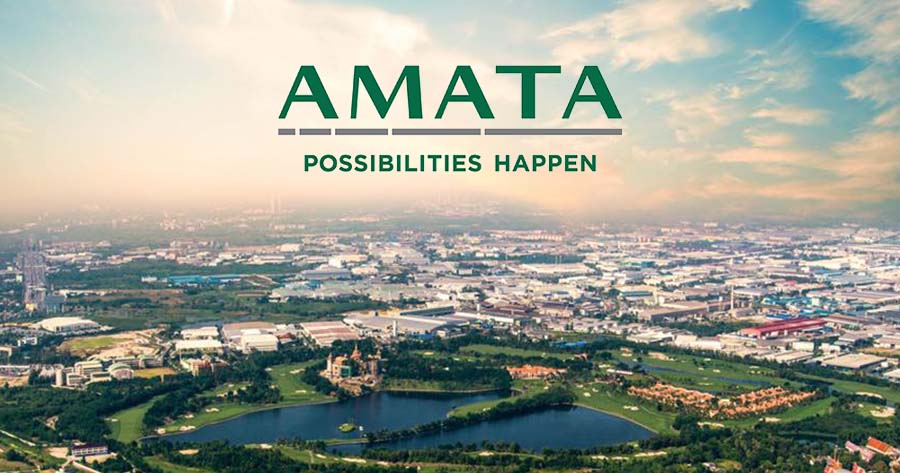
Amata Corporation Public Company Limited (SET: AMATA), under the leadership of Chairman Vikrom Kromadit, has announced a robust investment plan of over THB 10 billion for 2026 to drive the development of industrial estates and accommodate fresh inflows of investment in Southeast Asia. The majority of the budget, around THB 7–8 billion, will be directed to Thailand, with an additional THB 2–3 billion earmarked for Vietnam.
For 2026, AMATA plans to sell a total of 2,800 rai of land, a significant increase from 1,234 rai in the previous year. These land sales target three primary ASEAN countries: Thailand (1,650 rai) with a focus on high-tech industries and Eastern Economic Corridor (EEC) investments; Vietnam (550 rai) to capture manufacturers relocating from China and expanding digital industries; and Laos (600 rai) as a strategic logistics gateway for the region.
AMATA is also transitioning into a holistic “Industrial City” developer—integrating infrastructure, technology, and quality of life—based on its “All Win” philosophy. The aim is to achieve balanced growth for businesses, investors, local communities, and the environment.
As of now, AMATA holds a THB 22.1 billion sales backlog, which will be gradually recognized as revenue and is expected to contribute to further growth in 2026, building on 2025’s total revenue of THB 14,524 million. The company maintains its commitment to a gross profit margin of not less than last year’s 38%.
Environmental sustainability is another key priority. AMATA is intensifying efforts to reduce carbon dioxide emissions across its industrial estate projects, enhancing infrastructure, and embracing green energy. The target is to achieve carbon neutrality by 2040 and reduce greenhouse gas emissions per unit area by 30%.
Vikrom underscored ongoing geopolitical and economic challenges, such as trade wars and Middle East tensions, which are influencing supply chains and operational dynamics worldwide. He pointed out that ASEAN, particularly Thailand, Vietnam, and Laos, is emerging as a strategic manufacturing hub for investors seeking stability and long-term growth.
To support this vision, AMATA is undergoing its first major organizational restructuring in eight years, focusing on agility, improved governance, and scaling up management for new waves of investment—especially in New S-Curve industries and mega-projects.
Thailand’s strategic location, bolstered by upcoming projects like China’s high-speed rail and new highways, further boost its appeal as an investment destination. AMATA recommends that the government capitalize on this opportunity by implementing policy measures to attract more foreign investment.