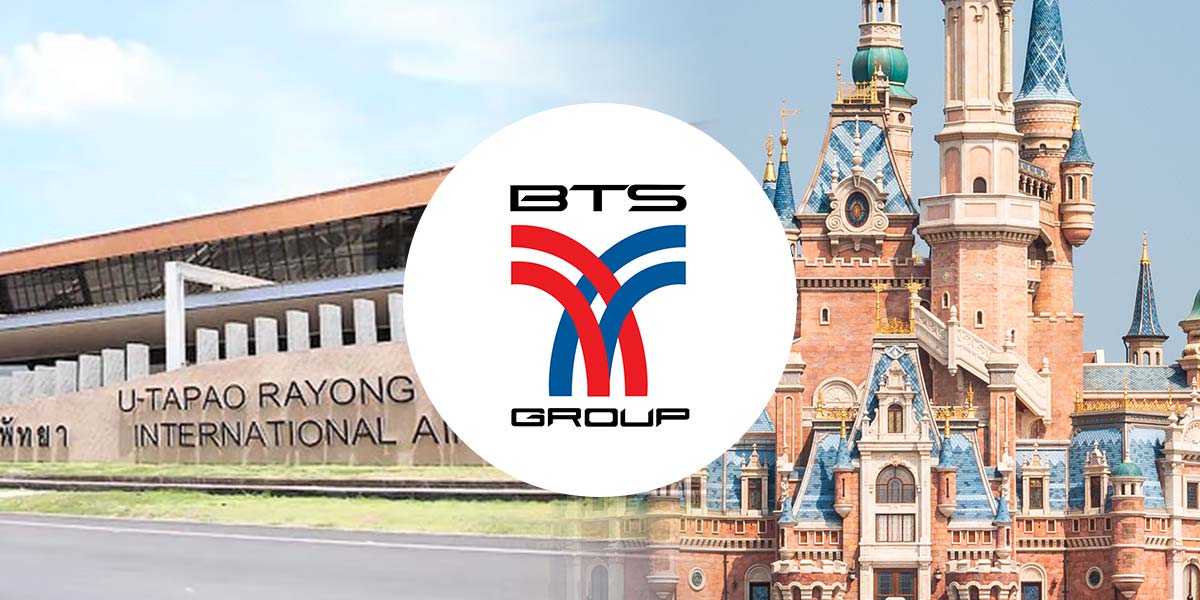
Mr. Surapong Laoha-Unya, Chief Executive Officer of MOVE Business Division and CEO of Bangkok Mass Transit System PCL (BTSC), a subsidiary of BTS Group Holdings (SET: BTS), stated that U-Tapao International Aviation Co., Ltd. (UTA), the concessionaire for the U-Tapao Airport and Eastern Aviation City Development Project, is expected to receive the Notice to Proceed (NTP) by the end of March this year. Thereafter, the project will move to the detailed design stage in preparation for actual construction this year.
BTS is also interested in bringing world-class projects to develop the U-Tapao Aviation City area, such as a Disneyland amusement park from The Walt Disney Company. If receiving government backing, similar to projects in Hong Kong and Shanghai, where authorities supported such developments to boost long-term tourism revenue, the park could potentially become a global landmark.
As Thailand is a tropical country with no winter, and U-Tapao offers a prime seaside location with landscape potential, the country could develop an amusement park model similar to Tokyo DisneySea in Japan. The Japanese park was built at a cost of around THB 100 billion and is the only Disney park in the world with a theme focused on “the ocean, exploration, and navigation,” located within the Oriental Land Company resort over an area of around 445 rai, and divided into eight main zones.
Regarding the operation status of the MRT Pink and Yellow Lines, Mr. Surapong stated there has been natural growth, driven by population migration into condominiums along the lines and expansion of shopping centers such as Seacon Square. Passenger numbers have increased by 7-8% year to date, but the company has targeted double-digit growth to reach a sustainable business level, even though both lines’ operations are not yet generating direct profits.
For the MRT Green Line extension, the Bangkok Metropolitan Administration has started using revenue from fare adjustments and subsidies for scheduled debt repayments, having passed the Bangkok Council and published in the Royal Gazette. The city targets a combined subsidy and fare revenue of around THB 600-700 million per month to avoid new debts and reduce interest burden. It is expected that by April this year, there will be no overdue debts in the regular system.
Furthermore, BTS has expanded its scope to managing the fare collection and operation & maintenance (O&M) systems for intercity expressways, including route M81 (Bang Yai–Kanchanaburi), which began partial operations on January 16, 2026, and route M6 (Bang Pa-in–Nakhon Ratchasima), nearly 300 kilometers, expected to commence operations in late this year or early next year. The business model is a 30-year gross cost management contract, with the business group holding a 40% stake. Main revenue comes from management fees, not direct revenue sharing.
While the Baan Phuea Khon Thai (Home for Thai People) project has received considerable booking interest from the public, it focuses on locations near railways, electric trains, and city centers. The target is to develop approximately 300,000 units nationwide. Installments start at around THB 4,000 per month, with long-term payments over 30-50 years. The supporting loan is provided by the Government Housing Bank. Currently, the project’s success is being evaluated.