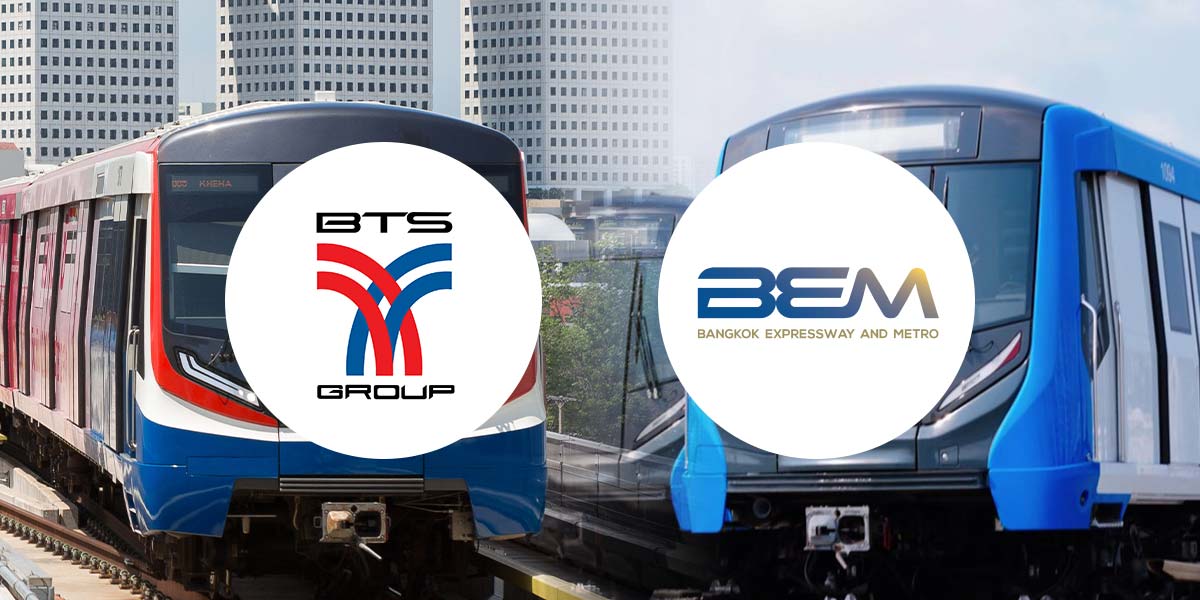
Mr. Pipat Ratchakitprakarn, Thailand’s Deputy Prime Minister and Minister of Transport, stated that from May 1, 2026, the Ministry of Transport will commence negotiations with two private entities holding mass transit concessions: BTS Group Holdings Public Company Limited (SET: BTS) and Bangkok Expressway and Metro Public Company Limited (SET: BEM).
These discussions will focus on the repurchase of mass transit concessions in line with the government’s ‘Single Ownership’ policy, which aims to centralize the management of all transit lines under the Mass Rapid Transit Authority of Thailand (MRTA). The objective is to bring all projects under a unified policy framework, promoting integrated management, the introduction of joint ticketing, and harmonized fares that would benefit the public.
The most appropriate method for collecting integrated fares is still under consideration. Proposals include a daily flat fare of 40 baht across all lines, or a zonal daily pass with three pricing tiers at 40, 50, and 60 baht. The MRTA and the Department of Rail Transport (DRT) are currently reviewing the alternatives to choose an approach that maximizes passenger benefits.
Relevant legislation includes the Rail Transport Act, B.E. 2568 (2025), published in the Royal Gazette on December 27, 2025, and the Joint Ticket System Act, B.E. 2568 (2025), published on December 28, 2025. Drafting of the implementing regulations is underway, after which the drafts will be submitted to the Cabinet for approval and enactment.
The Office of Transport and Traffic Policy and Planning (OTP) expects the drafting process for the regulations related to the Joint Ticket System Act to be completed by June this year. In total, there will be 21 supplementary regulations, including ministerial rules, official guidelines, and royal decrees, which will mandate all modes of transport to be included in the integrated ticketing system.
Related to the Rail Transport Act, there are 77 subordinate legislative instruments. The DRT reports that the first meeting of the Rail Transport Policy Committee will be held on April 23, with agendas that, once signed by the Minister of Transport, can be implemented immediately.
Key points to be discussed include prohibiting duplicate entry fees to help lower the cost of living, updating the exemption for child fares—from a height-based cutoff at 90 cm to an age-based cutoff under 7 years or height not exceeding 120 cm—granting half-price fares for senior citizens, free rides for people with disabilities, and mandating that operators provide passenger insurance of not less than 500,000 baht per person.
Mr. Pipat further stated that the legal process relating to the joint ticket system is expected to be completed by June 2026. Therefore, the Ministry of Transport, through the MRTA and cooperating agencies such as the Bangkok Metropolitan Administration (BMA), will begin parallel negotiations with BTS and BEM from this May to ensure timely progress. The aim is to implement EMV card technology as a unified ticketing method for all transit systems, extending from the rail network to buses and ferries—projected as a New Year’s gift for 2027.
Previously, Mr. Keeree Kanjanapas, Chairman of BTS, expressed support for a single flat fare, whether it be 20 baht per trip or a daily rate starting at 40 baht, noting that this would incentivize more people to use the public transit system. He emphasized that the state should support such fare approaches rather than continue fuel price subsidies, and confirmed BTS’ willingness to negotiate on the concession repurchase.
According to people familiar with the matter, the government plans to repurchase concession-based rail projects from the private sector, with a budget estimated at approximately 200 billion baht. This budget would cover the four main lines: Green, Pink, Yellow, and Blue; Airport Rail Link is excluded for now due to complex contractual connections with the high-speed rail linking three airports.
To raise the required funds, the government is considering two primary options: establishing an Infrastructure Fund to attract investment or booking the financial obligation as debt and making incremental repayments via operating revenue over time.
There is also consideration for the BMA to transfer Green Line assets to the MRTA, making the state the sole owner of infrastructure, thus strengthening the feasibility of implementing a unified single-fare policy. However, the government would need to compensate the BMA for previous investments. This transfer process had been reviewed by the Land Traffic System Arrangement Committee in a previous administration, but was halted due to the parliament dissolution.
Bualuang Securities (BLS) expects BTS to benefit most from the government’s concession repurchase policy, as this will ease operational losses for the Pink and Yellow Line projects, both of which are in their early phases and carry high costs. After the transfer, BTS will shift to being a pure O&M contractor for the state, gaining more stable, recurring income, reducing revenue volatility, and strengthening its long-term financial position.
BEM, while not facing the same income pressure as BTS, is also likely to benefit. Proceeds from selling back the concession could be reinvested into new railway projects or other infrastructure, boosting the company’s growth potential.
Plan B Media Public Company Limited (SET: PLANB) is expected to benefit indirectly from a unified ticketing system and better-integrated public transport management. Increased commuter numbers should positively impact its out-of-home media business, especially in mass transit networks.
Following these, Bualuang recommends ‘Buy’ ratings on BTS with a target price of THB 5.40 per share, BEM at THB 7.30 per share, and PLANB at THB 5.80 per share.
Asia Plus Securities further notes that the “40 baht all-line ticket” initiative will help reduce the cost of living, increase consumer purchasing power, and positively impact the retail sector, particularly CP All Public Company Limited (SET: CPALL) and Central Retail Corporation Public Company Limited (SET: CRC), both likely to benefit from increased consumer spending.
Krungsri Securities (KSS) stated that BTS would likely be the biggest beneficiary, as these measures will help reduce losses in the underperforming Yellow and Pink Lines and improve the overall financial outlook for the company going forward.