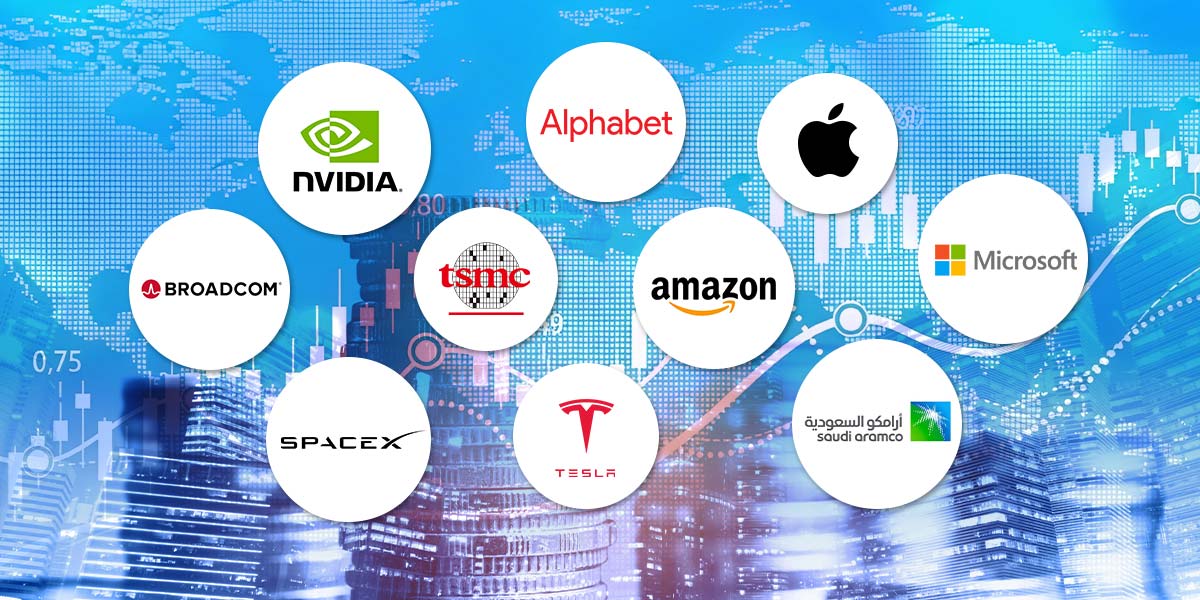
The concentration of wealth in the global equity markets has reached a historic, almost unfathomable milestone. Driven by the relentless momentum of artificial intelligence and breakthroughs in commercial aerospace, the world’s 10 largest companies now command a staggering combined market capitalization of $28.48 trillion.
To put this immense financial muscle into perspective, if these ten corporate giants were unified as a single nation, their economic value would comfortably dwarf almost every superpower on Earth. According to 2026 nominal GDP projections by Statista, this corporate behemoth would rank as the second-largest economy in the world—easily outpacing China ($20.85 trillion), tripling Germany ($5.45 trillion), and lagging only slightly behind the United States itself ($32.38 trillion).
The Elite Ten vs. Global Powers
A breakdown of the data highlights how individual corporate balance sheets now rival entire national outputs:
| Rank | Entity (Company / Country) | Market Cap / Nominal GDP |
| 1 | United States | $32.38 Trillion |
| — | Top 10 Global Stocks Combined | $28.48 Trillion |
| 2 | China | $20.85 Trillion |
| 3 | NVIDIA (NVDA) | $4.969 Trillion |
| 4 | Alphabet (GOOG) | $4.367 Trillion |
| 5 | Apple (AAPL) | $4.275 Trillion |
SpaceX’s Ascent Signals a New Era
While the podium remains dominated by the AI and hardware triumvirate of NVIDIA ($4.97T), Alphabet ($4.37T), and Apple ($4.28T), the defining catalyst for this latest market milestone is the spectacular ascent of SpaceX.
Now firmly entrenched as the world’s 7th largest stock with a valuation of $2.104 trillion, SpaceX’s entry into the top ten underscores a profound shift. Wall Street is no longer just pricing in terrestrial digital dominance; it is actively valuing the infrastructure of the burgeoning space economy.
Corporate Sovereigns
This massive valuation concentration raises crucial macroeconomic questions. Companies like Microsoft ($2.90T), Amazon ($2.57T), and TSMC ($2.20T) wield capital expenditures that rival the infrastructure budgets of mid-sized European nations. Meanwhile, the inclusion of enterprise networking giant Broadcom ($1.82T) further underscores the market’s aggressive betting on AI infrastructure.
Crucially, this corporate empire isn’t entirely tech-centric. Even as Silicon Valley dominates, Saudi Aramco ($1.75T) remains an absolute heavyweight anchoring global energy markets, while Tesla ($1.52T) bridges the gap between massive manufacturing footprint and future autonomous tech.
As these mega-caps continue to scale, the line between corporate influence and sovereign economic power continues to blur. Investors are no longer just buying equities; they are buying into corporate empires that outpace the economic output of entire continents.