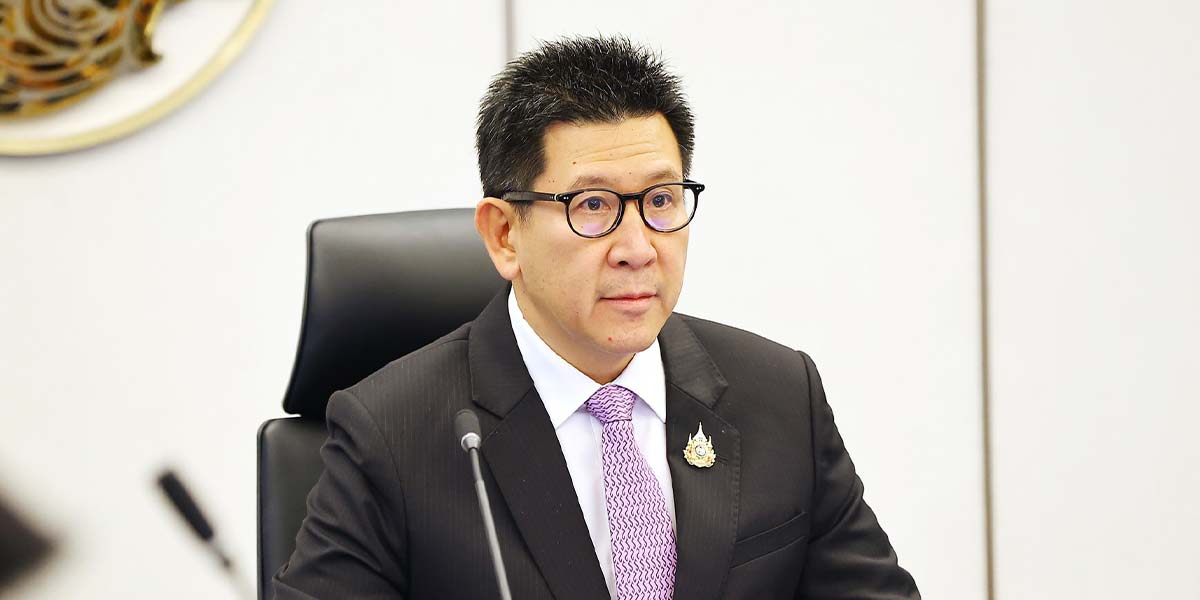
Mr. Ekniti Nitithanprapas, Thailand’s Deputy Prime Minister and Minister of Finance, stated that the agreement between the United States and Iran, scheduled to be signed on June 19, 2026, to end the conflict in the Middle East and restore the free passage through the Strait of Hormuz, marks a positive development for the global economy. This progress has already led to an uptick in global stock markets, reflecting growing investor confidence and easing concerns over energy risks.
However, the Deputy PM cautioned that significant risks and uncertainties remain on the global stage, and Thailand cannot afford to be complacent, given its high dependency on imported oil and natural gas. He emphasized the necessity of expediting the deployment of the country’s second tranche of emergency borrowing—200 billion baht—to advance renewable energy projects, reduce reliance on energy imports, and address structural challenges in the long term.
Following the anticipated end of the war, Mr. Ekniti expects the global economy and GDP to recover, yielding greater-than-expected benefits for Thailand’s economy. He noted that the Ministry of Finance would need to revise Thailand’s GDP projections and flagged cautions amid global volatility.
The main issues to monitor are inflationary pressures and rising living costs, particularly their effects on grassroots populations and small entrepreneurs. The government remains vigilant and is ready to implement support measures, including the ‘Thai Chuay Thai Plus’ initiative aimed at lowering costs and improving access to funding.
Mr. Ekniti also reaffirmed the importance of the 400 billion baht loan decree, especially the 200 billion baht allocation for infrastructure and energy transition projects. He highlighted that global oil prices are unlikely to return to pre-war levels in the near term, and Thailand may face elevated energy costs for another one or two years.
Meanwhile, the Ministry of Finance has begun assessing loan-funded projects, with the primary goal of alleviating living costs and accelerating the transition of the national energy structure to minimize risks from future energy crises.
Dr. Pipat Luengnaruemitchai, Chief Economist at Kiatnakin Phatra Financial Group (KKP), noted that while reopening the Strait of Hormuz is a positive sign for the Middle East and global energy markets, significant uncertainties remain. He identified three main unresolved issues in U.S.-Iran negotiations: Iran’s nuclear program, which still lacks clarity concerning mutual agreement; economic sanctions, with Iran seeking the release of frozen assets but the U.S. demanding nuclear capability reductions first; and ongoing Israeli-Lebanese tensions, which have disrupted negotiations in the past.
Dr. Pipat observed that the United States is particularly motivated to resolve the conflict due to the long-term impacts of the standoff and the country’s entrance into a politically sensitive period. This lessens any U.S. incentive to escalate the conflict or start a new war, as stability is now a priority.
On oil prices, Dr. Pipat said that before the latest tensions, crude oil traded around USD 60 per barrel, rising to USD 80-90 per barrel amid recent instability. He expects that, in the long term, oil prices may trend back toward USD 60 per barrel given the ample global supply, though the timeline for this adjustment remains unclear.
A resolution in the Middle East is anticipated to significantly benefit the Thai economy by reducing living costs, easing inflation and interest rate pressures, and boosting the recovery in tourism, a key economic driver for Thailand.
Commenting on the Thai stock market, Dr. Pipat cautioned that the recent rise in the SET Index was partly driven by heavyweight stocks like DELTA, and that the market’s strength may not be as broad-based as it suggests. As such, KKP maintains a cautious outlook on the overall market. While short-term optimism among investors may prevail, he recommended that investors focus on underlying fundamentals, especially the profitability outlook and valuations of listed companies, to guide prudent investment decisions.
Dr. Phacharaphot Nuntramas, Chief Economist at Krungthai Bank (KTB), remarked that although U.S.-Iran negotiations are underway, disruptions to oil production and supply chains will likely take at least three to six months to fully resolve. This means that energy costs will remain high throughout the year. Oil prices are expected to decline from their peak in 2Q26—estimated at an average of USD 90-95 per barrel—to around USD 70-80 per barrel in the second half of the year.
If the conflict ends, Dr. Phacharaphot expects increased mobility and a rebound in tourism, which had previously been impacted by reduced Middle Eastern airline routes. He projects annual inflation of 2.5-3%, which remains within target and is not a major macroeconomic concern. However, higher living costs and electricity expenses continue to impact real consumer spending. He expects the Bank of Thailand to maintain its benchmark interest rate for the time being.
Notably, data centers, AI, and smart technology are considered tangible megatrends. The investment in Thailand in such technologies has become increasingly visible, reflected in over 40% growth in technology exports and substantial imports of machinery for data centers and factories. “The current current account deficit is a quality deficit, driven by capital and technology imports for long-term investment, which will ultimately benefit the country’s economic structure,” Dr. Phacharaphot said.
On equity markets, Bualuang Securities (BLS) commented that a potential U.S.-Iran ceasefire would likely ease tensions in the Middle East, leading to lower global crude oil prices. This would pressure upstream energy and refinery stocks—such as PTTEP, TOP, SPRC, and IRPC—due to likely revenue and profit slowdowns. However, small power producers (SPP), especially GPSC and BGRIM, stand to benefit from lower natural gas and fuel costs, which would improve their margins.
The airline sector, including THAI, AAV, and BA, would also benefit from reduced jet fuel costs, enhancing profitability.
Krungsri Securities (KSS) further noted that the ceasefire is supportive for the Thai stock market, especially for companies that benefit from lower energy costs, such as those in the tourism and services sectors—including MINT, CENTEL, and AOT—as well as utilities like BGRIM, GPSC, and GULF. Domestic finance companies, led by MTC and SAWAD, may benefit from a revived investment climate and a more relaxed cost of funds environment.
Nonetheless, the rise in the Thai stock market may be limited by continued weakness in energy and petrochemical stocks, such as PTT, PTTEP, PTTGC, and TOP, stemming from lower oil prices.
Finansia Syrus Securities (FSS) anticipates that if a ceasefire proceeds, Thai equities will experience sector rotation from energy and commodities to domestic and consumption sectors. Yield-sensitive groups, such as finance, transport, SPP power plants, tourism, and retail, are seen as laggards and could outperform going forward.
The brokerage recommends stocks with strong earnings momentum for Q2 and the second half of 2026 that are either minimally affected or benefit positively from an easing war situation, citing BGRIM, CPALL, CRC, ERW, STA, BA, BDMS, CPF, CPN, GULF, KTB, TIDLOR, and WHAUP as examples.
DAOL Securities (Thailand) stated that progress in U.S.-Iran negotiations should facilitate a normalization of crude oil prices in the latter half of 2026, albeit with some volatility as negotiations continue. The brokerage maintains an assumption of average Dubai crude oil at USD 85 per barrel this year and notes Brent crude futures have declined to around USD 83-84 per barrel.
The SET Index is anticipated to be supported by positive investment sentiment and a recovery in Asian markets, which may drive recoveries in stocks previously hit by oil cost concerns. Highlighted as top rebound picks are CENTEL (target price: THB 37, Buy), OSP (THB 19, Buy), MINT (THB 26, Buy), SJWD (THB 10.50, Buy), and AAV (THB 1.12, Hold).
Industries benefiting from lower oil prices include the tourism sector—led by ERW (target THB 3.20), CENTEL (THB 37), MINT (THB 26), and SHR (THB 1.80)—and airlines: AOT (THB 60), SAV (THB 14.50), and AAV (THB 1.12).
Retailers BJC (THB 17), CPAXT (THB 19), and CPALL (THB 63) are expected to benefit from reduced logistics costs and rebounding consumer purchasing power.
Beverage firms OSP (THB 19), CBG (THB 40), and SAPPE (THB 30) will benefit from lower energy and packaging costs, and a positive outlook is also seen for construction companies such as CK.