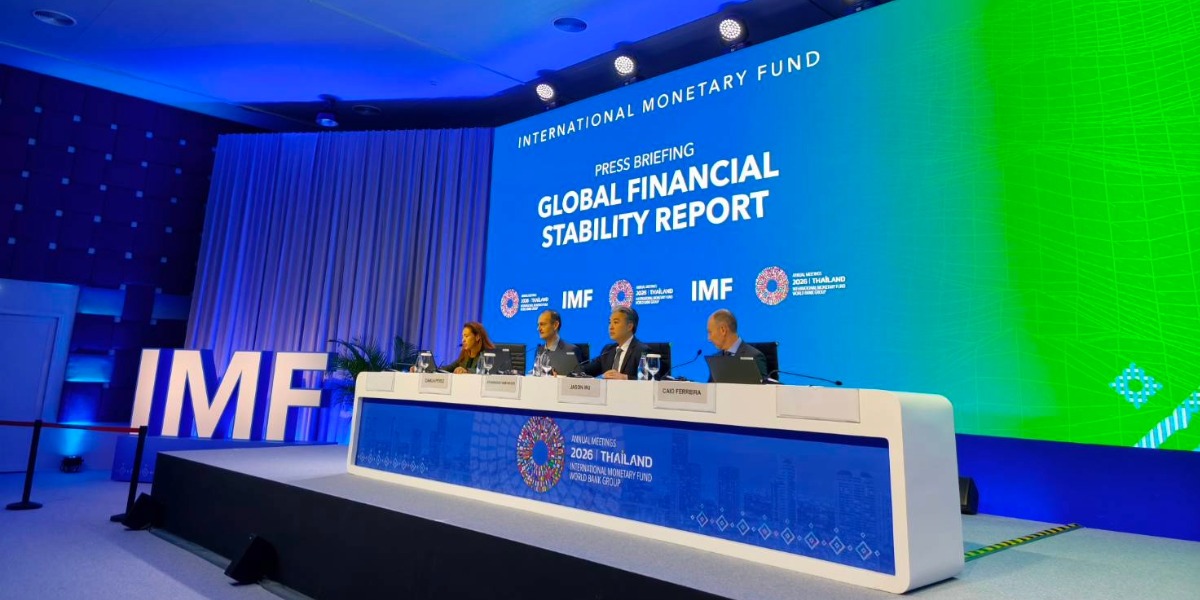
At the 2026 IMF-World Bank Annual Meetings in Bangkok, the IMF presented its latest Global Financial Stability Report, warning that while global financial markets currently display strong risk appetite, this resilience rests on fragile foundations.
Strong corporate earnings, upward growth surprises, and optimism surrounding artificial intelligence have buoyed global risk sentiment, but the IMF cautioned that this stability is vulnerable to three major systemic risks: a potential AI-related market correction, escalating sovereign bond yields, and growing cyber threats. The IMF urged global policymakers to act immediately to strengthen financial resilience and rebuild policy buffers before new economic shocks hit the global system.
The IMF highlighted the global financial system’s heavy reliance on the artificial intelligence sector, describing AI as the single most important engine driving both real economy growth and stock market performance. Addressing comparisons to historical tech bubbles, the IMF noted that current price-to-earnings ratios in the AI sector have not looked overly stretched because earnings have continually exceeded expectations. In recent quarters, markets have engaged in a positive feedback loop where analysts set ambitious earnings forecasts, tech companies beat those forecasts, analysts upgrade their expectations higher, and companies beat the new higher estimates once again.
However, this “beat-and-upgrade” cycle raises the bar with each quarter, making markets increasingly vulnerable if monetization delays or earnings disappointments occur. Vulnerabilities are further amplified by global exposure to the U.S. If AI revenue promises fail to materialize, equity values could deplete, debt service could falter, and promised revenues would vanish, triggering a severe market correction and global financial tightening.
This AI exposure carries direct implications for regional economies, particularly host nation Thailand. The IMF noted that Thailand’s role as a major net exporter of AI hardware has provided a crucial boost to its economy, helping offset energy price headwinds and maintaining current account buffers.
However, a global AI market correction would hit Thailand through a drop in tech export demand, while broader risk-off sentiment would trigger capital flight, tighter credit conditions, and currency depreciation across emerging markets. The IMF emphasized that countries like Thailand must build policy resilience beforehand and allow exchange rate flexibility to function as a primary shock absorber.
Turning to bond market volatility, the IMF stated that rising sovereign bond yields reflect fundamental shifts back to pre-Global Financial Crisis norms rather than an irrational market overshoot. Yields have been driven higher by persistent post-pandemic inflation, energy price shocks tied to Middle East conflicts, central bank rate repricing, and upside growth surprises.
As central banks shrink their balance sheets, governments and private issuers must rely increasingly on price-sensitive investors to absorb unprecedented volumes of sovereign and corporate debt issuance. The IMF noted that market discipline has returned, with investors actively penalizing countries with large fiscal imbalances and policy uncertainty. Because macroeconomic and fiscal policy space is far more restricted than during past crises, the IMF stressed that governments must prioritize fiscal consolidation to return sovereign debt to a sustainable trajectory.
Under a severe stress test scenario—combining an AI market correction with energy price shocks and bond market sell-offs—the IMF reported that the global banking sector as a whole remains resilient. However, the IMF identified a vulnerable tail of undercapitalized banks under stress, particularly those heavily exposed to Non-Bank Financial Intermediaries (NBFIs), where systemic risks have migrated following post-2008 banking regulations. Specific vulnerabilities include pension funds and insurers holding illiquid assets, growing leverage among private credit borrowers, and rapidly expanding hedge funds that could amplify market shocks.
Furthermore, the IMF classified cyber threats as an escalating systemic risk fueled by rapid digitalization, technology concentration, and AI-enabled attack tools. To counter these threats, the IMF urged authorities to maintain strict inflation mandates, preserve central bank independence, strengthen cyber hygiene, and enhance supervisory monitoring of non-bank financial institutions.