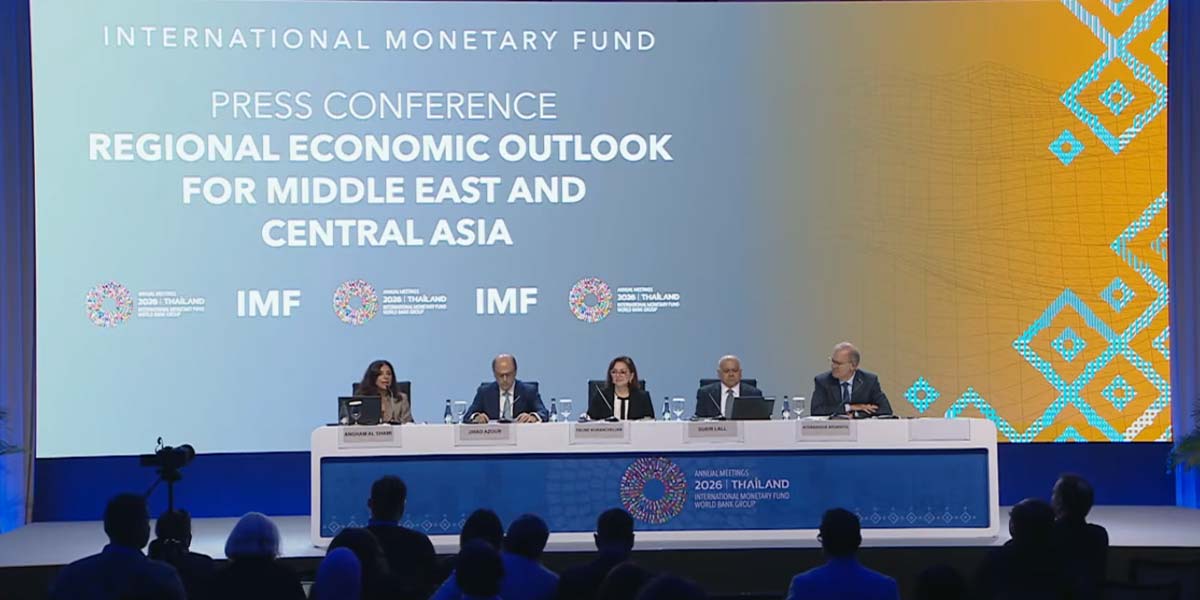
The International Monetary Fund (IMF) highlighted a divergent economic outlook for the Middle East, North Africa, and Pakistan (MENAP) and the Caucasus and Central Asia (CCA) regions during the 2026 IMF-World Bank Group Annual Meetings in Bangkok.
Jihad Azour, Director of the Middle East and Central Asia Department at the IMF, outlined that while pre-war surpluses, output from non-Gulf energy producers, alternative transport routes, demand adjustments, and inventory drawdowns buffered the initial impact of the Middle East conflict, significant risks remain.
For MENAP, the IMF projects a sharp contraction in 2026, with regional growth falling from 3.3% in 2025 to -1.3% in 2026, before rebounding strongly to 6.6% in 2027. This, however, conceals substantial differences within the region. Oil exporters directly hit by energy and trade disruptions will see significant contractions in 2026, although higher oil prices may provide some fiscal and external relief.
While a sharp recovery in GDP is expected as energy production and trade normalize, output in these economies is still likely to remain below pre-conflict forecasts.
MENAP’s oil-importing economies, on the other hand, have demonstrated resilience in 2026, thanks to remittances, tourism, supportive financial conditions, and government intervention. However, inflation is expected to rise moderately before gradually subsiding, and policy buffers are becoming increasingly thin.
Turning to CCA, the region has generally weathered the shock, supported by robust remittances and strong investment flows. Economic growth is forecast to moderate from 6.2% in 2025 to 5.2% in 2026 and 5% in 2027. Although higher imported energy and food prices have renewed inflationary pressure, the extent of its impact varies across countries.
Despite some signs of recovery, the IMF warns that the outlook is highly uncertain. A more prolonged conflict or further disruptions in energy and trade could worsen outcomes for Gulf exporters and increase inflation, placing strain on fiscal and external positions.
Tighter global financial conditions could also amplify vulnerabilities, especially in economies dependent on external financing or with high borrowing needs. Low-income and fragile states are seen as especially exposed due to their reliance on food imports and narrow fiscal space.
Following these, the IMF recommends that policymakers prioritize price stabilization while maintaining fiscal sustainability, rebuild fiscal buffers, and strengthen their capacity to absorb shocks. Targeted measures, such as budget-neutral cash transfers for the most affected, are preferred over broad-based subsidies.
Additionally, reinforcing institutional frameworks, promoting trade diversification, deepening regional integration, and supporting the adoption of new technologies like artificial intelligence are encouraged to improve resilience and support long-term growth.