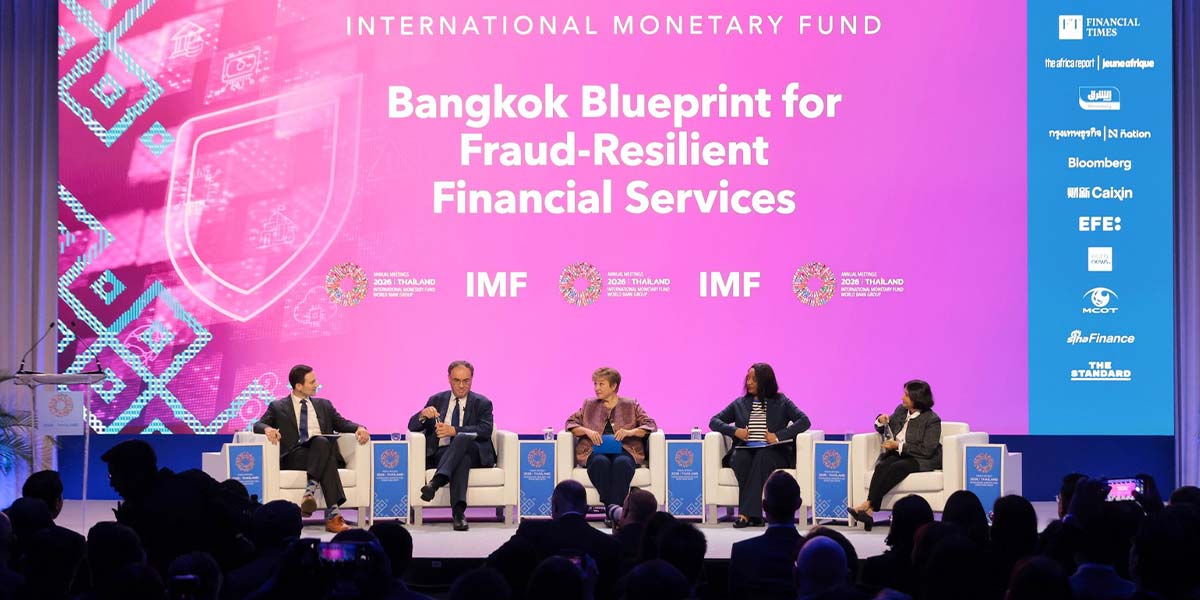
Thailand has unveiled the “Bangkok Blueprint for Fraud-Resilient Financial Services,” a framework comprising 12 key considerations across five pillars aimed at strengthening financial systems against fraud, improving cross-border cooperation and building public trust in digital financial services.
The framework was launched on Wednesday, October 14, during the 2026 Annual Meetings of the International Monetary Fund (IMF) and the World Bank Group at the Queen Sirikit National Convention Center in Bangkok.
Ekniti Nitithanprapas, Deputy Prime Minister and Finance Minister of Thailand, delivered the opening remarks, while Vitai Ratanakorn, Governor of the Bank of Thailand (BOT), outlined the framework developed in collaboration with the IMF and World Bank Group.
Ekniti said the launch came at a critical time for strengthening multilateral cooperation against financial fraud, which continues to impose substantial costs on economies and individuals worldwide. Global losses from fraud are estimated at approximately $1 trillion annually, equivalent to around 3% of global gross domestic product (GDP).
Financial fraud frequently crosses national borders, with victims in one country, perpetrators in another and stolen funds transferred to a third jurisdiction. Limited coordination among authorities across countries has made the problem difficult to address, requiring a collective international response.
Ekniti highlighted three core principles behind the Bangkok Blueprint: taking a systemic approach to fraud, strengthening international cooperation, and establishing a practical framework that countries can adapt to their respective legal systems and institutional capabilities.

The first principle recognizes that victims may have accounts across multiple financial institutions, making clear accountability and effective mechanisms for recovering funds essential. The second aims to sustain cross-border cooperation through international organizations, while the third emphasizes practical implementation and continuous improvement based on countries’ experiences.
Ekniti also pointed to lessons from Thailand, Malaysia, Singapore and Hong Kong in translating policy into action. Thailand has adopted a “connect the dots” approach by linking information across agencies, although extending such coordination across national borders remains a key challenge.
He called on participating countries to carry the initiative forward beyond the annual meetings, stressing that a problem that crosses borders requires a coordinated international response.
Five Pillars for Fraud-Resilient Financial Services
Vitai said the Bangkok Blueprint provides countries with a framework they can adapt to strengthen their financial services systems against fraud and scams as digital financial services become more accessible and affordable, but also expose users to new risks.
The framework comprises 12 key considerations organized under five pillars:
- Establish Strategic and Legal Foundations
- Strengthen the Fraud Mitigation Life Cycle
- Leverage Existing Risk and Enforcement Frameworks
- Expand Domestic and Cross-Border Coordination and Cooperation
- Promote Consumer Protection and Resilience
The framework covers national strategies and legal foundations, systems for preventing and detecting suspicious transactions, mechanisms for responding to fraud and assisting victims, cybersecurity, anti-money laundering and countering the financing of terrorism, and law enforcement.
It also emphasizes information-sharing and coordination among domestic agencies and across borders, alongside consumer protection and public awareness of financial fraud.

Vitai stressed that legislation alone would not be sufficient. Similarly, detecting suspicious transactions would have limited impact without rapid response mechanisms capable of preventing losses or stopping funds from being moved. Effective fraud prevention therefore requires coordinated measures throughout the entire process.
Following the launch, Vitai said Thailand’s financial fraud losses had reached approximately THB43 billion in 2024 before declining to more than THB30 billion in 2025 and around THB9 billion in the first half of 2026.
The decline suggests that the situation has improved, although continued efforts are needed, he said.
Vitai added that the Bangkok Blueprint would allow countries to build on an established framework rather than start from scratch. Thailand would also apply the principles to strengthen its existing measures.
Global Financial Leaders Call for Collective Action
The launch was followed by a discussion among global financial leaders on combating fraud, strengthening trust in digital financial services and improving international cooperation.
Kristalina Georgieva, Managing Director of the IMF, said digital financial services had become increasingly important for individuals, businesses and small entrepreneurs. Their continued adoption depends on trust that users’ identities and money will be protected.
However, cyber fraud and the use of artificial intelligence (AI) by criminals are undermining that trust, potentially discouraging people from using digital financial services and weakening business activity and the financial system.
Georgieva said countries needed clear national strategies supported by strong leadership and coordination across sectors. Prevention should be a priority because it can reduce the cost of mitigating losses, while coordinated response mechanisms and assistance or compensation for victims must also be in place. She emphasized that combating fraud should not be left to central banks alone.

The chief of IMF described the Bangkok Blueprint as an important legacy of the annual meetings, calling for its principles and practical lessons to be developed into a systematic approach. She also highlighted the importance of working with the Financial Stability Board and the World Bank Group, as well as monitoring and reporting progress to determine whether the measures were reducing fraud.
Andrew Bailey, Governor of the Bank of England, said responsibility for preventing financial fraud should extend beyond the banking sector to technology companies and major digital platforms.
He argued that technology and services should incorporate safeguards from the outset rather than relying primarily on compensation after fraud has occurred.
Anshula Kant, Managing Director and World Bank Group Chief Financial Officer, said banks should prioritize fraud prevention from the product-design stage and continuously monitor transactions for suspicious activity, rather than relying solely on know-your-customer (KYC) procedures. She also stressed the importance of compensation mechanisms that take into account differences in customers’ levels of financial literacy.
Soraya Munyana Hakuziyaremye, Governor of the National Bank of Rwanda, said the expansion of digital financial services had brought greater exposure to fraud, particularly for people with limited financial awareness. She called for stronger domestic and cross-border cooperation and information-sharing, alongside the use of AI to identify suspicious accounts and transactions.