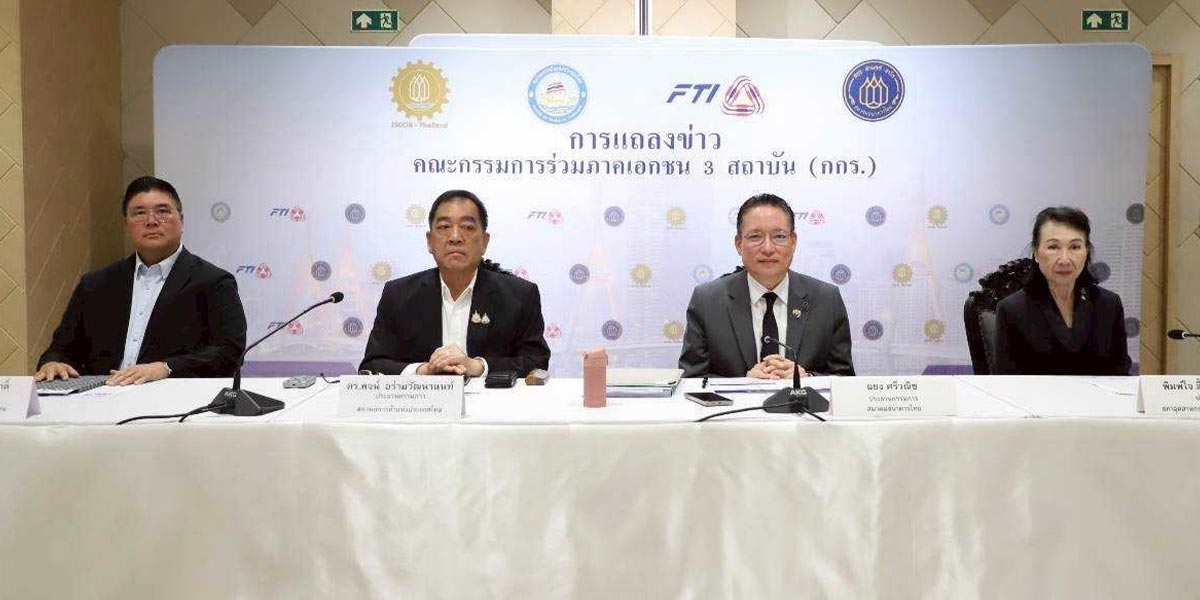
Payong Srivanich, President of Krung Thai Bank Public Company Limited (SET: KTB), as Chairman of the Joint Standing Committee on Commerce, Industry and Banking (JSCCIB) for June 2026, revealed that energy security remains a key risk factor for the global economy this year. Energy exports from the Middle East through the Strait of Hormuz have yet to return to normal, while OECD countries are likely to accelerate crude oil imports to replenish depleted reserves. This has resulted in persistently high global energy and production costs for goods and services.
The JSCCIB assessed that the Thai economy continues to experience K-shaped recovery. Although exports grew by 18.9% in the first four months of the year, especially technology products which surged by 48.4% following global growth in artificial intelligence (AI) investment and data centers, the benefits from technology exports have yet to fully realized in the Thai economy due to high import dependency for raw materials. Meanwhile, production and exports of other goods remain sluggish amid concerns over rising raw material costs and subdued domestic demand due to high living costs.
The committee also expressed concern for businesses and labor in the “lower K”—those not reaping the benefits of export expansion and foreign direct investment (FDI). Recent data from over 300 listed companies reflect that many businesses face rising costs while revenues decline. Accordingly, urgent structural reforms are needed so that new investments can generate added value, disperse fund flows into the real economy, and boost domestic employment.
According to Payong, the committee has forecasted that the “Thai Chuay Thai Plus” scheme, which injects about THB 170 billion to stimulate the economy, will support domestic spending, prompting an upward revision of the 2026 Thai GDP growth forecast to 1.6 – 2.0% (from the previous estimate of 1.2 – 1.6%). Inflation is expected at 2.5 – 3.0%, and the export growth forecast has been revised up to 8 – 10% from flat growth previously.
The JSCCIB viewed that Thailand should capitalize on the opportunity from the global megatrends, particularly AI, data centers, and cybersecurity, to elevate its smart electronics and advanced manufacturing industries. This could be achieved by promoting research and development, amending regulations that hinder investment, and preparing for OECD membership to attract FDI and enhance long-term competitiveness.
Regarding domestic energy, the JSCCIB reassures that Thailand’s energy security remains stable, with combined crude oil and refined petroleum reserves at approximately 13.384 billion liters—enough for around 109 days of national consumption—and no signs of shortages. The refining sector has lowered its dependence on Middle Eastern crude from 55% to 27%, increasing imports from other sources to 73% in order to mitigate geopolitical risks and maintain supply chain continuity.
Additionally, the JSCCIB expects the national Power Development Plan (PDP 2026) to be announced by August 2026 as a framework for long-term energy direction, covering energy security, the promotion of biofuels, electricity cost management, and the increasing share of renewable and clean energy. These measures will strengthen the competitiveness of Thailand’s industrial sector in the future.
At the same time, the JSCCIB believes Thailand should leverage its position as host of several major international forums in 2026—such as the 3rd ABAC 2026, Gastech 2026, Thailand-US Trade & Investment Forum 2026, and IMF-World Bank Annual Meetings—to showcase Thailand’s economic potential, build investor confidence, and promote a new economic model driven by innovation, investment, and future industries. These measures will attract investment funds and foster long-term, sustainable growth.