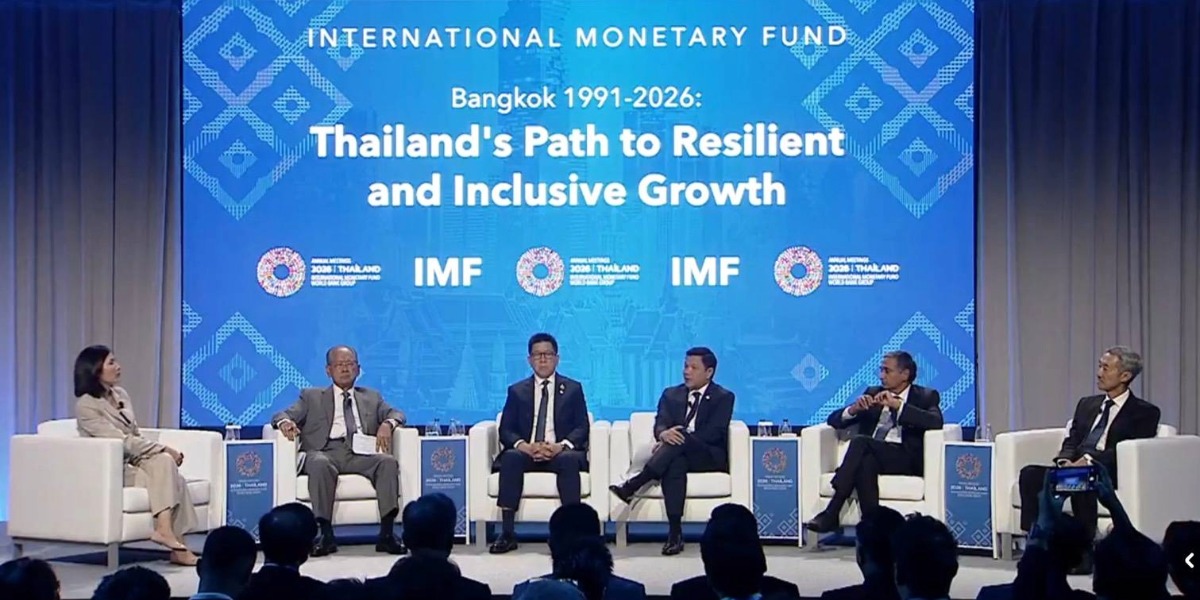
Thirty-five years after hosting the 1991 IMF-World Bank Annual Meetings, global financial leaders and top policymakers gathered in Bangkok during the 2026 IMF-World Bank Annual Meetings for a special seminar examining Thailand’s economic trajectory. The panel, titled “Thailand’s Path to Resilient and Inclusive Growth,” explored how the nation transformed over the past three decades, the structural headwinds currently slowing its momentum, and the strategic reforms required to propel its next phase of development.
Deputy Prime Minister and Minister of Finance Ekniti Nitithanprapas characterized 1991 as Thailand’s “first takeoff,” driven by major inflows of Japanese foreign direct investment (FDI) following late-1980s currency realignments. This shift allowed workers to migrate from low-yield agriculture into high-productivity manufacturing sectors such as automotive manufacturing in eastern provinces like Rayong.
However, the rapid eight to ten percent annual growth that followed bred overconfidence and led to excessive unhedged offshore borrowing through the Bangkok International Banking Facilities (BIBF), culminating in the 1997 Asian Financial Crisis. Ekniti stressed that the primary lesson from 1997 is that rapid expansion without stability inevitably creates severe societal disruption.
To prepare for Thailand’s “second takeoff,” Ekniti explained that the nation cannot rely on cheap labor due to its rapidly aging population. Instead, Thailand must pivot toward digital technology, productivity enhancements, and human capital development while welcoming a new wave of FDI aimed at global supply chain diversification. He likened this incoming investment to a high-speed train pulling up to a platform, emphasizing that the government’s duty is to open access points so local citizens, university students, and small businesses can upskill and integrate into global value chains.
To execute this transition, Ekniti outlined a public-private framework structured like a football team. In this strategy, private sector leaders act as the “strikers,” driving growth sectors including smart agriculture, food processing, smart electronics, electric vehicles, medical and wellness services, and the creative economy. The public sector acts as the “midfielders,” removing bureaucratic bottlenecks such as cumbersome work permits and launching the “Skillbridge” program to connect university training directly with FDI requirements in regional hubs like Lamphun, Nakhon Ratchasima, and Songkhla.
Finally, fiscal and monetary stability serve as the “defenders” at the back end. Ekniti noted that strict fiscal discipline has kept Thailand’s 10-year government bond yield at 2.4 percent—well below the 5 percent yield seen in the United States—and prompted rating agencies to restore Thailand’s credit outlook from negative to stable.
Krishna Srinivasan, Director of the IMF’s Asia and Pacific Department, highlighted the dramatic expansion of Asia’s role in the global economy over the past thirty years. While Asia contributed less than a quarter of global growth three decades ago, it now accounts for 68 percent of global economic expansion, underscoring the region’s central dynamism. Srinivasan pointed out that Thailand’s surge in per capita income reflects this broader regional transformation.
The IMF’s relationship with Asian economies has evolved substantially since the 1997 crisis. Srinivasan explained that lessons learned from 1997 led the IMF to modernize its surveillance toolkits, establishing Financial Sector Assessment Programs and developing the Integrated Policy Framework to help emerging markets manage volatile capital flows through coordinated monetary, exchange rate, and macroprudential measures.
In today’s high-interest-rate environment where capital can easily retreat to safe havens, Srinivasan emphasized that policy predictability, central bank independence, and strict fiscal discipline remain vital for attracting long-term FDI.
Addressing the impact of artificial intelligence on the workforce, Srinivasan presented findings from recent IMF research in Asia. In sectors highly exposed to AI, labor demand initially declined by 10 percent before stabilizing, as AI reshaped the nature of work rather than simply eliminating positions. When workers demonstrate the willingness and ability to adopt AI tools, firm productivity rises and hiring rebounds. Consequently, Srinivasan urged educational systems to transition toward continuous, lifelong learning to prevent technological disruptions from widening income inequality.
Bank of Thailand Governor Vitai Ratanakorn explained that while the 1997 crisis prompted crucial financial sector reforms—such as adopting flexible exchange rates, flexible inflation targeting, and building robust foreign reserves—the real economy has experienced a persistent structural deceleration.
Thailand’s average annual growth rate has stepped down after every major economic shock, slowing from over 7 percent prior to 1997, to 5.3 percent post-1997, 3.5 percent following the 2008 global financial crisis, and averaging 2.4 percent after the COVID-19 pandemic, with 2026 growth projected between 2.1 and 2.3 percent. Reversing this downward trajectory requires addressing deep structural constraints through tight monetary-fiscal policy coordination, central bank independence, and preserved fiscal buffers.
To address these real-economy bottlenecks, Governor Vitai outlined four targeted priority areas pursued by the central bank over the past year: managing household debt, improving credit access for small and medium-sized enterprises (SMEs), advancing financial sector infrastructure, and curbing illicit financial flows. Vitai highlighted a critical strain in the financial system, noting that total SME loan outstanding in Thailand has contracted for 16 consecutive quarters, falling 4.4 percent year-on-year in the latest quarter even as corporate loans expanded by 6 percent.
Furthermore, central bank research revealed that only the top 30 percent most efficient SMEs receive 21 percent of available bank credit. Vitai argued that broad liquidity injections cannot resolve structural deficiencies; financial support must be selectively directed toward competitive and productive SMEs in sectors such as agribusiness, smart electronics, and wellness services.
Regarding artificial intelligence, Governor Vitai offered a positive perspective on its potential in Thailand. In an aging society facing a shrinking domestic labor pool, AI provides an essential technological solution to raise workforce productivity. By aggressively upskilling and reskilling Thai workers to integrate AI tools into daily operations, Thailand can successfully counteract demographic drag and sustain long-term economic expansion.