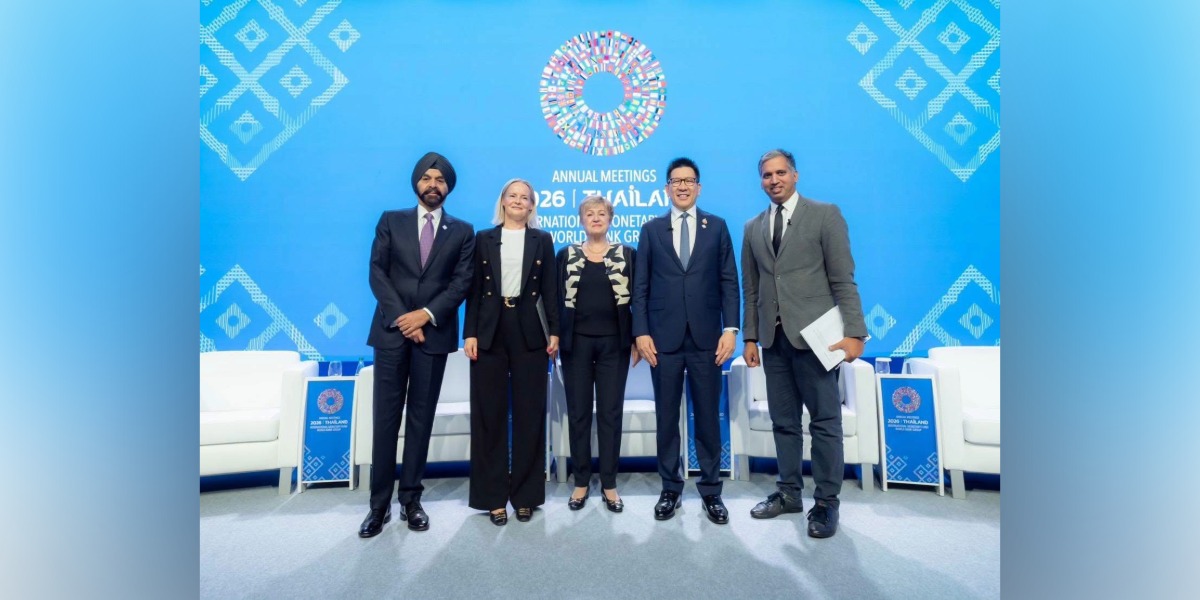
Thailand outlined its strategic approach to navigating global economic fragmentation during the IMF-World Bank Meetings in Bangkok panel titled: “Building Resilience in a Fragmented World” on October 13, 2026.
Speaking alongside leadership from the International Monetary Fund, the World Bank Group, and Finland’s Ministry of Finance, Deputy Prime Minister and Minister of Finance Dr. Ekniti Nitithanprapas explained that an increasingly divided global landscape is shifting economic priorities away from maximizing efficiency toward safeguarding security.
This global structural shift impacts economies through three primary channels: trade, finance, and investment. While trade routes adapt to rising obstacles and financial systems face elevated bond yields and high capital costs, global investment flows are actively redirecting toward safer bases.
Thailand has emerged as a major beneficiary of global supply chain restructuring, recording an 80% year-on-year surge in foreign direct investment (FDI) applications during the first half of 2026, totaling over 1.37 trillion baht. To convert this investor momentum into concrete economic activity, the Thai government is actively working to reduce administrative red tape and regulatory hurdles.
Rather than merely increasing financial liquidity, Thailand’s core priority is “Turning Capital into Capabilities” by ensuring foreign investments directly drive job creation, workforce upskilling, and business competitiveness. Dr. Ekniti emphasized that global fragmentation creates uneven, K-shaped economic impacts that disproportionately harm smaller nations. In response, Thailand and other mid-sized economies are stepping forward as “Trusted Connectors” to bridge global divides, foster a rules-based international order, and preserve cross-border trust.
To strengthen regional stability and economic agility, Thailand is championing deeper ASEAN integration through increased intra-regional trade, interconnected digital infrastructure, the development of the ASEAN Power Grid, and expanded strategic partnerships beyond the block.
Crucially, Thailand maintains that economic resilience requires trust built both internationally and domestically. Demonstrating this commitment to grassroots inclusion, the high-level conference hall featured sound-absorbing panels decorated with 37 traditional woven fabric patterns from 26 local Thai communities. By linking high-level international policy directly with local artisans, Thailand demonstrates that lasting economic resilience rests on trust connecting governments, citizens, and local communities alike.