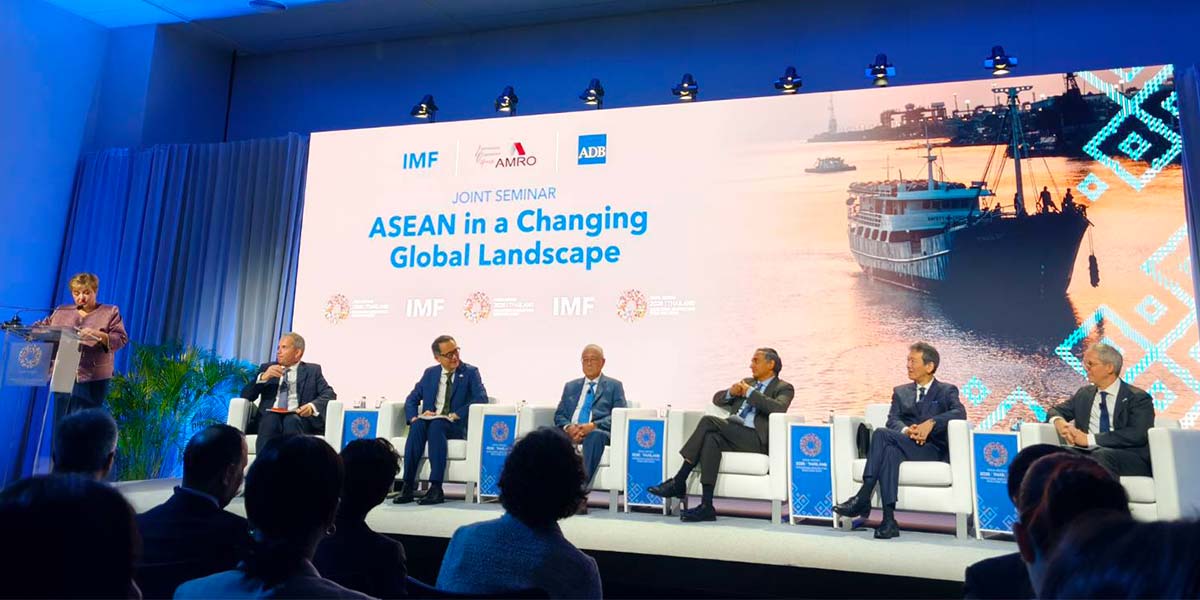
Senior economic policymakers and multilateral leaders gathered in Bangkok at the 2026 IMF-World Bank Annual Meetings to map out a strategy for Southeast Asia amid escalating geopolitical fragmentation, energy market volatility, and climate disruptions.
Addressing the panel titled “ASEAN in a Changing Global Landscape,” International Monetary Fund Managing Director Kristalina Georgieva framed Asia as the primary driver of global economic expansion, delivering 68% of global growth in 2026. Within the region, the 11-economy Association of Southeast Asian Nations (ASEAN) represents a $4.5 trillion economic bloc of roughly 700 million people, expanding at a 4.5% annual pace. However, speakers emphasized that preserving this dynamism requires decisive structural reforms and fiscal discipline as external shocks become more frequent and severe.
The panel outlined four immediate priorities to fortify regional resilience: safeguarding fiscal buffers, accelerating market-oriented structural reforms, expanding intra-regional trade, and deepening cross-border cooperation beyond traditional commerce.
Protecting Buffers and Targeting Support
A central theme across the discussion that the head of IMF pointed out was the need for governments to rebuild fiscal space following a series of global supply and commodity shocks. Georgieva urged policymakers to resist broad-based price subsidies during energy disruptions, stressing that governments must “protect people, not prices” by allowing market price signals to function while directing targeted fiscal aid to vulnerable households.
Reinforcing this warning, Krishna Srinivasan, Director of the IMF’s Asia and Pacific Department, pointed out a significant policy mismatch across the region. Energy consumption in ASEAN averages 7% of GDP, leaving member economies particularly exposed to global fuel volatility. Despite this vulnerability, more than 50% of the emergency fiscal support provided by regional governments during recent shocks was untargeted. Srinivasan noted that such broad-based price suppression is costly and inefficient, particularly given that ASEAN’s average revenue mobilization stands at just 10% of GDP, compared with over 15% in peer economies.
To overcome these fiscal constraints, Scott Morris, Vice-President at the Asian Development Bank (ADB), emphasized the role of digital infrastructure in enabling precise targeted aid. Citing social welfare frameworks in the Philippines and India as successful benchmarks, the panel noted that investing in digital identity and distribution systems allows states to deliver targeted support without eroding national balance sheets.
Central Bank Scenario Planning and Capital Market Reform
Monetary authorities are also adapting to an increasingly unpredictable environment. Eli M. Remolona Jr., Governor of the Central Bank of the Philippines, explained that central banks have fundamentally altered their operating frameworks to rely far more heavily on scenario analysis. Rather than relying on baseline forecasts, policymakers are modeling extreme outcomes, ranging from sustained oil price spikes to severe weather events such as El Niño disruptions.
Beyond interest rate policy, Remolona highlighted capital market development as a critical bottleneck for regional resilience. While equity and bond markets are relatively sophisticated in Singapore, Malaysia, and Thailand, capital markets across the rest of ASEAN remain thin. The panel called for deeper corporate bond markets, standardized cross-border listings, and integrated financial safety nets to ensure that growing regional savings can be efficiently channeled into domestic enterprise rather than relying solely on bank lending.
The Framework and Supply Chain Realignment
Addressing structural shifts, Atsushi Mimura, Japan’s Vice-Minister of Finance for International Affairs, introduced an “ABC&D” analytical framework detailing the structural challenges and opportunities facing the bloc:
- Aging Demographics: Divergent demographic trends require tailored policy responses, with rapidly aging societies like Thailand and Singapore building out social safety nets, while younger nations like the Philippines prioritize education and skills up-skilling.
- Beijing Competition and Supply Chain Realignment: Intense competitive pressures from China are driving global manufacturers to adopt “China+1” diversification strategies, positioning ASEAN economies such as Vietnam and Thailand as primary destinations for relocated supply chains. Meanwhile, resource-rich members like Brunei, Malaysia, and Indonesia are capitalizing on demand for critical minerals and energy transition inputs.
- Climate Risk and Disasters: Frequency and intensity of natural disasters necessitate massive infrastructure investments with disaster risk management built in. The ADB highlighted flagship projects, including a multi-billion-dollar initiative along Thailand’s Chao Phraya River Basin, as models for blending public policy with climate adaptation financing.
- Digitalization and AI Integration: ASEAN members are integrating into global high-tech supply chains, exemplified by Malaysia’s emergence as a global semiconductor manufacturing hub.
Mimura emphasized that Japan remains committed to acting as a strategic partner by combining its technology, financial capacity, and expertise in energy conservation with ASEAN’s labor, natural resources, and manufacturing strength.
Regional Integration and ASEAN Power Grid
While ASEAN’s global trade openness is exceptionally high—with a trade-to-GDP ratio of 110% compared to the global average of 44%—intra-regional trade accounts for only 22% of total trade, far below the European Union’s 60%.
The panel identified non-tariff barriers, such as local content requirements and administrative restrictions on services, as the primary impediment to deeper economic union. IMF analysis suggests that systematically reducing non-tariff barriers and harmonizing cross-border service regulations could boost ASEAN’s real GDP by 5% over the medium term.
In physical infrastructure, the ADB reaffirmed its $30 billion financing commitment to ASEAN, which includes $10 billion explicitly allocated to regional energy connectivity projects such as the ASEAN Power Grid. Morris argued that establishing a connected regional power market is essential to unlock economies of scale for large-scale renewable energy investments in solar, wind, and hydro power.
Concurrently, regional financial integration is advancing through digital payment linkage initiatives like Project Nexus, allowing seamless cross-border retail payments across member states. Yasuto Watanabe, Director of the ASEAN+3 Macroeconomic Research Office (AMRO), noted that enhanced multilateral surveillance and institutional coordination between AMRO, the ADB, and the IMF provide a robust regional financial safety net to mitigate contagion risks.
Five-Year Horizon
Looking ahead five years, the panel expressed shared optimism regarding ASEAN’s trajectory. Watanabe envisioned a more integrated regional manufacturing model evolving from “Made in a Specific Country” to a unified “Made in East Asia” production ecosystem. Remolona suggested that ongoing trade and financial integration could push ASEAN “halfway to the EU” benchmark in market integration.
Srinivasan concluded that as capital markets deepen and private sector participation expands beyond traditional banking, ASEAN’s share of global GDP will continue to rise. While demographic drags and external volatility remain persistent threats, the panel agreed that disciplined policy execution and regional solidarity will maintain ASEAN as a central pillar of global economic growth.