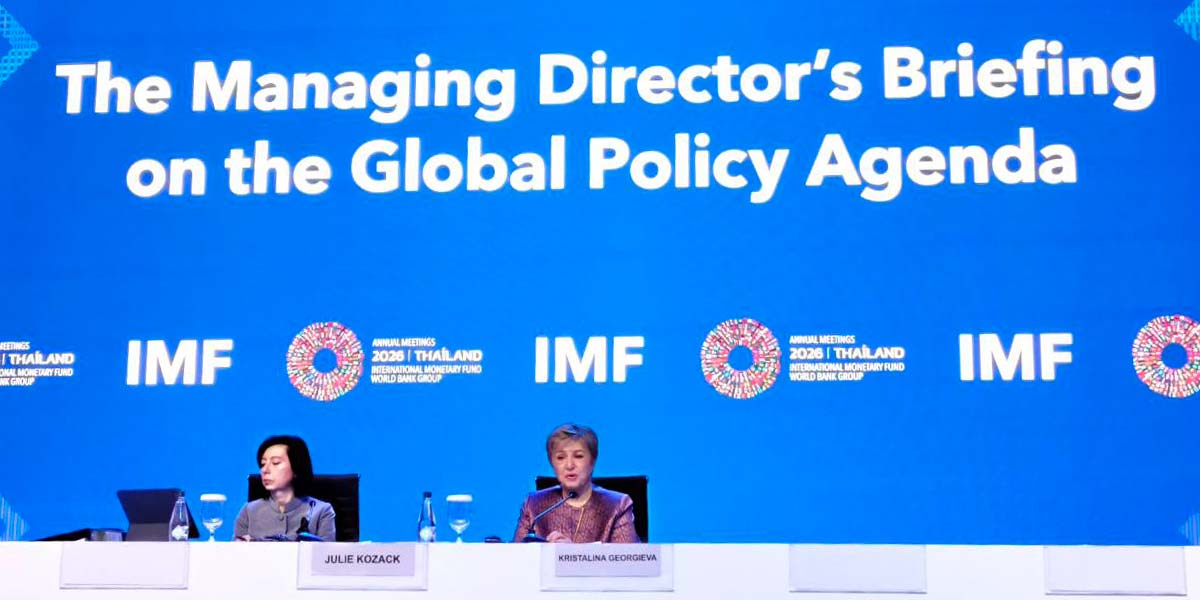
Speaking at the Global Policy Agenda press briefing during the 2026 IMF-World Bank Annual Meetings in Bangkok, the International Monetary Fund Managing Director Kristalina Georgieva addressed the room during the Q&A session, spanning from low-income debt distress to sovereign yield pressures, global trade imbalances, European budgetary strains, and Middle East conflict spillovers.
Responding to inquiries regarding low-income nations, Georgieva noted that while underlying debt volumes in developing countries have stabilized, debt-servicing costs have surged from 6% of government revenues a decade ago to 14% today due to elevated global interest rates. To assist vulnerable members, the IMF reformed its Poverty Reduction and Growth Trust to triple lending capacity and is actively seeking member commitments to replenish the Catastrophe Containment and Relief Trust.
On global trade and fiscal imbalances, Georgieva targeted the structural divergence between the world’s largest economies. She offered a clear tripartite prescription: China needs to spend more by shifting its growth model from export surpluses toward domestic consumption; the U.S. must save more by putting its fiscal deficit and debt accumulation on a downward trajectory over time; and Europe must invest more to boost productivity and regional competitiveness.
Addressing high borrowing costs in emerging markets and Southeast Asia, Georgieva noted that benchmark yields in advanced economies are establishing a higher structural floor for borrowing, driven by persistent inflation, energy costs, and AI investment demand. To mitigate these pressures, she urged ASEAN economies—such as Thailand—to deepen intra-regional trade integration, pointing out that trade within ASEAN stands at just 22%, compared to 60% within the European Union. She also clarified her warning that “winter is coming,” explaining that seasonal energy demand in the Northern Hemisphere combined with policy complacency poses a distinct risk to global economic stability.
Turning to European fiscal concerns, Georgieva addressed France’s elevated budget deficit—projected to remain above 5% of GDP—and rising gilt yields in the UK. While expressing confidence that market access remains functional, she stressed that structural deficit reductions are mandatory across the Eurozone to reassure investors and reduce sovereign borrowing premiums. She recommended UK policymakers to stay the course to maintain financial market confidence rather than taking decisive fiscal consolidation steps.
Concluding on the geopolitical crisis in the Middle East, Georgieva expressed sympathy over recent attacks targeting facilities in Saudi Arabia, noting that conflict spillovers pose broader risks to energy markets and regional stability. However, she praised the Gulf Cooperation Council member states for their proactive structural reforms—such as Saudi Arabia’s introduction of VAT during the pandemic and non-oil diversification efforts—which created robust fiscal buffers that continue to insulate regional balance sheets from external shocks.