The Thai government has announced a sweeping revision of its strategic plan for the Land Bridge project, which aims to connect the Gulf of Thailand to the Andaman Sea.
The new direction, under a committee led by Deputy Prime Minister and Finance Minister Ekniti Nitithanprapas, involves a comprehensive feasibility study reviewing prior plans and expanding the project’s scope. This study—set for completion within 90 days—will assess economic protection, technological advancement, and impacts on local communities. Upon confirmation of economic value, the findings will move to the Cabinet for consideration.
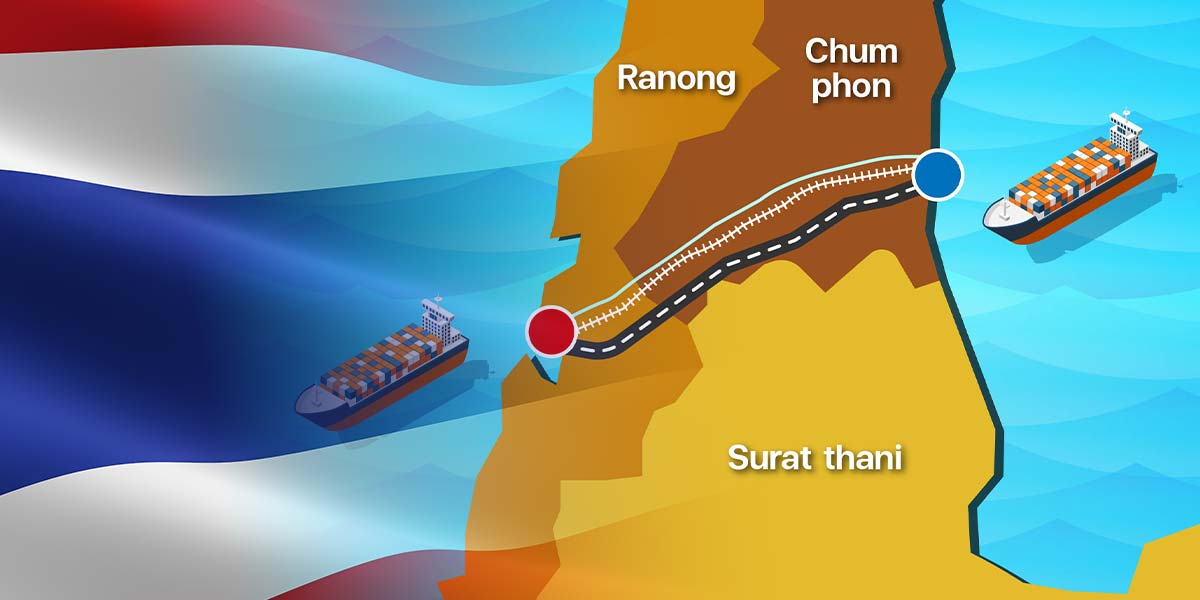
Previous Land Bridge studies lacked comprehensive logistics integration, prompting Prime Minister Anutin Charnvirakul to call for a broader review. This includes evaluating systems such as dual-track railway links and integrating the project with the Southern Economic Corridor (SEC). The SEC now covers Nakhon Si Thammarat, Surat Thani, Chumphon, and Ranong, expanding the project’s reach and addressing concerns such as land expropriation.
The project feasibility will now include new geopolitical factors—like possible tolls for the Strait of Malacca—reflecting evolving global challenges. Studies completed two years ago by the Office of Transport and Traffic Policy and Planning are considered outdated due to recent geopolitical developments.
If deemed viable, the government will promptly proceed. The project, championed since 2019 and further unified with the SEC, now only awaits solutions for funding. For oversight, the new committee features representatives from several ministries—including the Ministry of Natural Resources and Environment, the Ministry of Energy, and the Ministry of Industry—to ensure coordination and address environmental and community concerns.
On the technical side, the Land Bridge model will comprise four main components: a deep-sea port at Laem Riu (Chumphon), a deep-sea port at Laem Ao Ang (Ranong), a 90-km connector route with both motorway and dual-track railway, and oil and gas pipelines. Planned rail links will allow exports from Laem Chabang and the EEC directly to Ranong, strengthening export routes to Europe and China and bypassing Singapore. This infrastructure is positioned to support nearly 6 million containers exported annually.
Kamol Kamoltrakul, an independent scholar, noted that the project remains in the study phase but is expected to open for bidding in 2026 under a Public Private Partnership (PPP). The private sector is anticipated to handle 100% of construction and operations under a 50-year concession, with an estimated investment of THB 1 trillion. The government will cover land expropriation and key facilitation, requiring at least THB 10 billion in public funds.
Foreign investment groups could hold 50–70% stakes, with the government allowing majority foreign ownership in return for modern technology and capital. Interested parties include DP World (UAE), New World Development (Hong Kong), CHEC and COSCO (China), Mitsui (Japan), as well as funds from Singapore, Saudi Arabia, Europe, and the U.S. Major Thai contractors, including STECON, CK, ITD, UNIQ, PYLON, SEAFCO, and SCC, are expected to benefit from construction demand and boost their contract backlogs.
The project structure rewards foreign concessionaires with 50-year rights, logistics fees, and property development potential, while offering substantial construction opportunities to Thai partner firms and spurring industrial growth within the SEC.