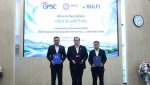
Sirimet Leepagorn, President and Acting Chief Operating Officer of Global Power Synergy Public Company Limited (SET: GPSC), revealed that this year, the Ministry of Energy is preparing to announce a new Power Development Plan (PDP 2026) for Thailand, covering the period from 2026 – 2050. This plan will have a significant impact on the development of additional power generation capacity, supporting economic growth and adapting to global energy transitions.
GPSC has assessed industry trends and developed strategies to guide future investments, aiming to play a key role in strengthening the country’s energy security over the long term. The company is planning to increase the clean energy proportion to as much as 70% of its total generation capacity, in line with the expansion of data centers, the electric vehicle sector, and the implementation of Direct Power Purchase Agreements (Direct PPA). These efforts will complement investment promotion within the Eastern Economic Corridor (EEC).
Given the country’s direction in energy development, GPSC expected that Thailand’s electricity demand could rise from the current level of approximately 30,000 – 33,000 megawatts to around 77,000 megawatts by 2050. Therefore, the new PDP must be designed to simultaneously address three key aspects: power system reliability, suitable pricing structures, and environmental friendliness.
Notably, the new PDP will incorporate the development plan for Small Modular Reactor (SMR) power plants as critical additional generation units to bridge the reliability gap caused by the intermittency of other renewable sources. Previously, SMR development was set at around 600 megawatts and scheduled for the end of the last PDP.
Under the revised plan, a total of 2,400 megawatts of SMR capacity is proposed to supply base load power using clean energy, enhancing energy security as a low-carbon, continuously operational source, and helping stabilize long-term fuel costs. This technology offers potential for boosting energy security, cost competitiveness, and propelling Thailand rapidly towards its Net Zero goal.
However, SMR technology is still in its early stages, requiring robust preparation in legislation, regulatory agencies, workforce development, and societal acceptance. The first SMR unit in Thailand may materialize after 2036, a timeline seen as appropriate for technology validation. Initial investment costs remain high—about $6–8 million per megawatt—meaning a 100 MW plant may require roughly $700 million, though development costs are expected to decline in the future.
For the initial phase, the Electricity Generating Authority of Thailand (EGAT) will lead the pilot project, with GPSC preparing studies on SMR technology and collaborating with Seaborg Technologies from Denmark to explore new-generation molten salt-cooled reactor technology, which boasts high boiling points and reduces internal system pressure.
The design emphasizes inherent safety—allowing for automatic shutdown during malfunctions to reduce dependence on external systems. Additional studies on other SMR technologies are also underway to compare their suitability.
Simultaneously, GPSC is reviewing asset management strategies, including extending power purchase agreements, improving plant efficiency, and repurposing aging plants to serve niche markets such as data centers. The company is also negotiating to import hydropower from Lao PDR, aiming to increase the share of competitively priced clean electricity and support Thailand’s role as the region’s clean energy hub.