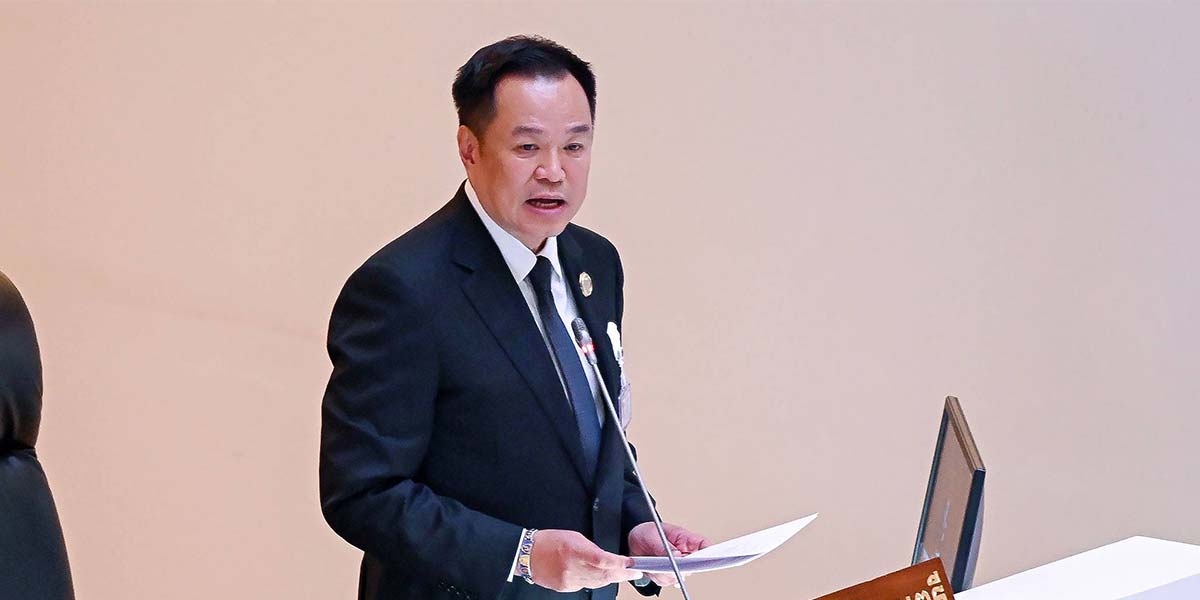
On April 9, 2026, at the first joint sitting of the National Assembly, Anutin Charnvirakul, Prime Minister and Minister of Interior, delivered the government’s policy statement to the Parliament covering key policies in all aspects of national administration.
The Prime Minister stated that the world is currently facing high uncertainty, particularly the ongoing conflict in the Middle East, which has disrupted crude oil and natural gas production and transportation, leading to volatile and increasing energy prices. This situation affects the economy and international trade, including Thailand.
The government is expediting energy management efforts to ensure sufficient domestic supply while managing production costs in both industry and agriculture sectors. The administration is also increasing the proportion of biofuel usage to reduce reliance on imports and mitigate the impact on citizens’ cost of living.
On the economic front, the government aims to restructure Thailand’s economy for sustainable growth, prioritizing holistic solutions to household debt with a debtor-centric approach alongside improving access to funding sources and reducing costs for farmers, small traders, and SMEs (Small and Medium-sized Enterprises).
At the same time, the government is committed to creating equal opportunities for business startups and growth across all groups, particularly for small entrepreneurs in the economic system, to generate jobs and careers. The government is also driving the digital economy and future technologies, especially artificial intelligence (AI), to enhance productivity and national competitiveness.
Meanwhile, the government emphasizes modernizing the financial and capital markets to ensure transparency and global competitiveness, making them sources of funding for businesses and promoting long-term investment and savings to boost financial security for citizens. These efforts aim to strengthen investor confidence and enhance the potential of Thailand’s capital market in the long term.
In the agricultural sector, the government targets the development of precision agriculture by utilizing AI and biotechnology to improve production efficiency and reduce costs, alongside implementing a co-interest payment scheme for farmers to support liquidity and increase income.
Regarding trade, the administration is progressing toward building trade alliances and elevating economic relations from trade partners to alliances to expand markets and strengthen the competitiveness of Thai entrepreneurs on the global stage, enhancing Thailand’s role in the global economic value chain.
To ensure effective policy implementation, the government has established an integrated administration mechanism under the “Cluster” approach, initially divided into five groups: Macroeconomics, Investment and Future Industries; Production, Trade, and Services; Infrastructure, Natural Resources and Environment, to promote a green economy and the transition to Net Zero; Social Welfare; and Foreign Affairs and Security, ensuring rapid and unified policy execution.
The government reaffirmed its commitment to implementing policies with tangible results, emphasizing the principle of “talking and doing” to effectively solve problems and concretely advance the nation.