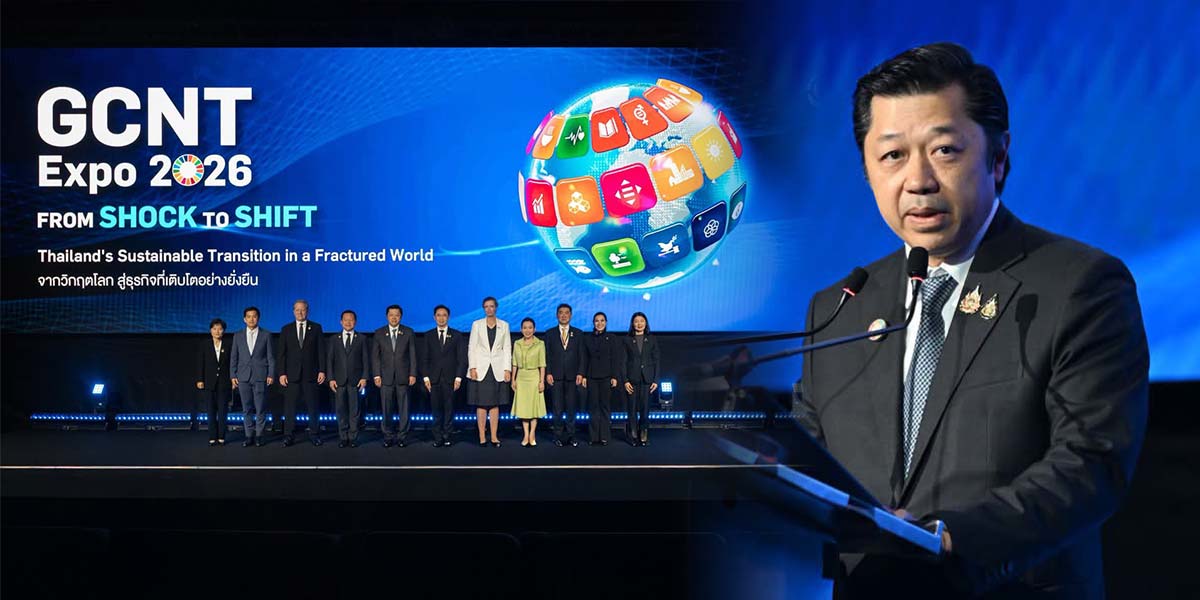
Suphachai Chearavanont, Senior Vice Chairman of Charoen Pokphand Group (CP Group) and President of the Global Compact Network Thailand (GCNT), and Michaela Friberg-Storey, the United Nations Resident Coordinator in Thailand, urged Thailand to move from a defensive response to global disruptions toward a proactive sustainability-driven transformation.
Speaking at the GCNT EXPO 2026 under the theme “From Shock to Shift: Thailand’s Sustainable Transition in a Fractured World – From Global Crisis to Sustainable Business Growth,” both leaders highlighted the need for cooperation among the private sector, the United Nations, academia, and civil society to turn the Sustainable Development Goals (SDGs) into concrete outcomes.
Suphachai said businesses can no longer treat sustainability as project-based activities or a response to external pressure. Instead, it must be integrated into business decisions and growth strategies, as investments, procurement, technology development, and innovation affect people, partners, communities, and the wider economy.
He stressed that businesses must shift their mindset from viewing sustainability as a “cost” to seeing it as an opportunity to strengthen competitiveness and support long-term growth. This is especially important amid geopolitical tensions, supply chain disruptions, rising costs, climate risks, and rapid technological change.
Suphachai also emphasized that large corporations cannot advance sustainability alone. The transition must extend across the entire value chain, including business partners, SMEs, workers, and communities, by improving access to technology, knowledge, capital, and business opportunities.
Friberg-Storey said global shocks do not automatically lead to change, but a “shift” occurs when leadership, investment, and cooperation move in the same direction. She noted that private sector decisions and investments play a key role in shaping industries, employment, supply chains, and national development.
She proposed three urgent transitions for Thailand: moving from ambition to accountability by turning sustainability commitments into measurable outcomes; shifting from commitment capital to capital at work by redirecting capital across the system; and moving from leading companies to leading ecosystems, where large companies help uplift SMEs, workers, and communities in their supply chains.
Friberg-Storey also pointed to a global funding gap of around $4 trillion per year to achieve the SDGs, saying the public sector alone cannot close this gap. She added that capital can drive change only when investable projects are supported by research, technology, innovation, and human skills development.
Both leaders’ remarks underscored the need for Thailand to transform global crises into opportunities by mobilizing business capability, capital, technology, innovation, and multi-sector cooperation to reinforce competitiveness and support long-term sustainable growth.