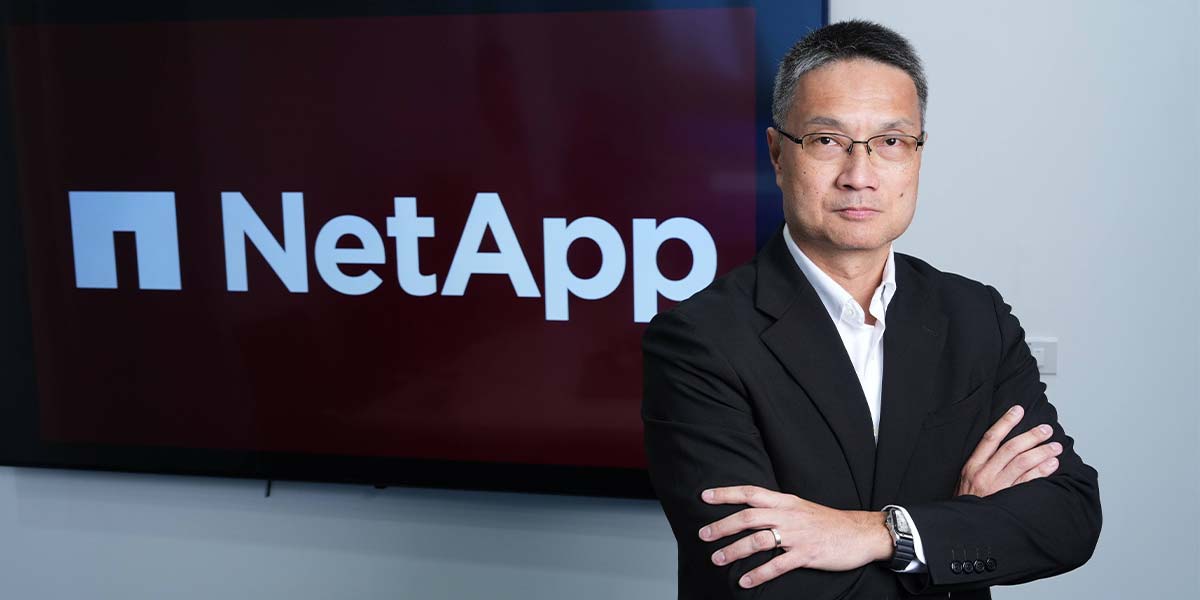
According to NetApp, a Intelligent Data Infrastructure company, Thailand is on the fast track to becoming a digital powerhouse, fueled by a strong focus on artificial intelligence (AI) and cloud adoption. The AI market in Thailand is projected to grow at a significant annual rate of 32.33%, resulting in a market volume of US$7.31 billion by 2031.
While AI adoption among Thai businesses is currently around 17.8%, a surge is imminent as organizations recognize the transformative power of Generative AI. This digital expansion is linked to the growing demand for data sovereignty and localized cloud services, with stricter regulations requiring locally generated data to be stored and processed within the country. Concurrently, the cybersecurity market is booming, estimated to reach USD 894.04 million by 2030, reflecting the increasing need for robust protection against evolving threats.
As AI, hybrid cloud, and cybersecurity converge, the world is entering a new phase of digital transformation—one defined by Intelligent Data Infrastructure, NetApp stated. For enterprises, data has become both a superpower and a source of complexity. The leaders of tomorrow will not be those who simply collect more data, but those who can harness, protect, and move it intelligently.
Below are NetApp’s predictions about how technology will evolve in 2026. These outline the transformations that will shape how organizations innovate, secure, and scale in 2026.
ARTIFICIAL INTELLIGENCE: FROM PILOT PROJECTS TO PERVASIVE INTELLIGENCE
Prediction 1: AI moves from pilots to production—made possible by Intelligent Data Infrastructure.
Enterprises will shift from experimentation to execution and scale AI across the business. The differentiator won’t be who has the biggest model or the most data, but who has the most unified, governed, and accessible data. Intelligent Data Infrastructure will underpin this shift, automating the curation, vectorization, and access to data needed to train, tune, and operationalize AI at scale.
Most AI initiatives fail not because of weak models, but weak data foundations. The next generation of AI success stories will fix that first.
Prediction 2: Agentic AI replaces the hype with real outcomes.
The next wave of AI will focus on systems that act and learn on their own, not just generate content. These systems will depend on fast, trusted access to well-governed enterprise data across hybrid environments. Unified data models, AI application integrations, and AI engines empower this wave both on-premises and in the cloud, including unique integrations with hyperscalers, sovereign clouds, and neoclouds. Architectures that enable independent scaling of performance and capacity will make this possible, ensuring flexibility and efficiency across AI environments.
CLOUD TRANSFORMATION: INTELLIGENT WORKLOAD PLACEMENT DRIVES THE NEXT WAVE
Prediction 1: Cloud strategies evolve to workload-optimized data platforms.
Enterprises have already moved past cloud mandates; the next evolution is intelligent workload placement. Organizations will increasingly rely on unified data platforms (not management consoles alone) to decide where workloads perform best across hybrid and multicloud environments. Intelligent Data Infrastructure enables this, providing consistent visibility, governance, and optimization for both enterprise and partner ecosystems.
Prediction 2: Data sovereignty reshapes global architectures.
Governments are tightening rules about where data can live. Companies and partners will respond by building local or sovereign environments that protect privacy without slowing innovation. Intelligent data platforms will automate encryption, policy management, and compliance so teams can focus on building value, not bureaucracy.
CYBER RESILIENCE: SECURITY BECOMES SELF-DEFENDING
Prediction 1: Breach detection and recovery speed become the new resilience benchmarks.
Cyberthreats are no longer isolated incidents. They’ve evolved into complex, multi-payout breaches where data is encrypted, ransomed, and resold. Exfiltration and data leakage will become equally damaging, demanding prevention and rapid response. Enterprises will demand faster breach detection, automated isolation, and near-instant recovery from confirmed clean data. Intelligent Data Infrastructure will integrate anomaly detection, breach analytics, and post-quantum cryptography standards to keep organizations secure even as threats evolve.
Prediction 2: Data governance and integrity will shape the future of trustworthy AI.
Looking ahead, organizations will prioritize comprehensive data governance, including access controls, security, privacy, and lineage tracking, across the entire data lifecycle. As AI-ready data becomes central to innovation, Intelligent Data Infrastructure will evolve to ensure these governance foundations are embedded from raw data through to advanced analytics, leading to reliable outcomes at every step.
THE ROAD AHEAD
The next era of digital leadership will not be defined by who has the most data—but by who uses it most intelligently. AI, cloud, cyber resilience, and modern infrastructure are no longer separate priorities; they are interconnected forces shaping the same future.
In 2026, enterprises that thrive will be those that embed intelligence into every layer of their data foundation—simplifying complexity, automating trust, and accelerating innovation. Intelligent Data Infrastructure is not just how the future runs—it’s what makes the future possible.