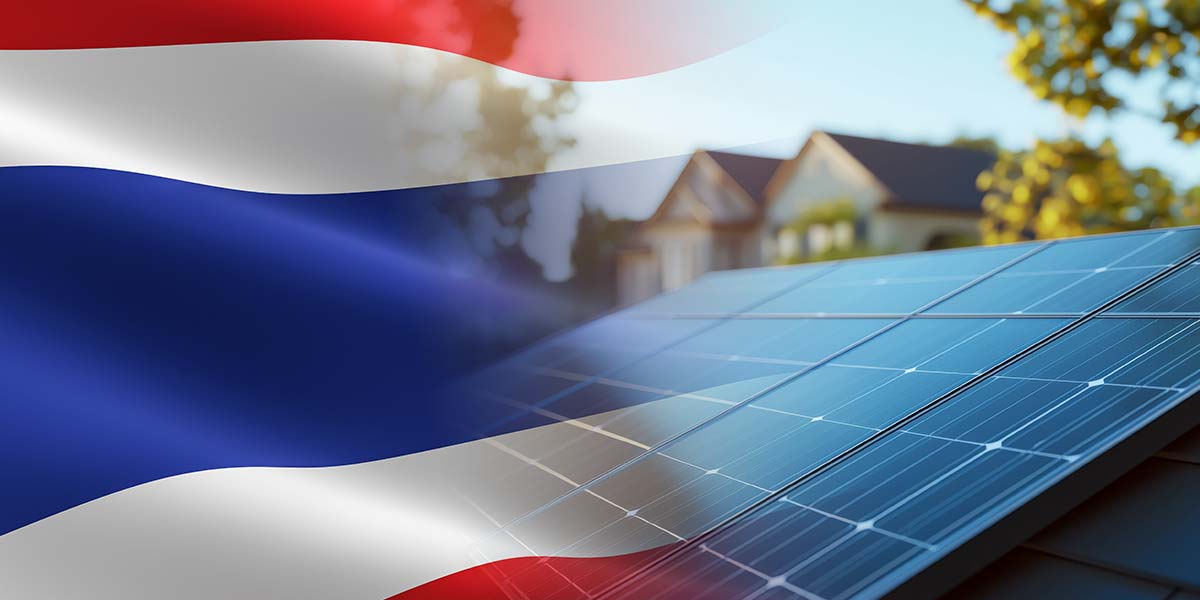
Ekniti Nitithanprapas, Deputy Prime Minister and Minister of Finance, disclosed that the Ministry of Finance is preparing to open registration for the household solar installation project—covering both rooftop solar and ground-mounted solar—offering an initial subsidy of THB 50,000 per right for 1 million rights, with a total budget of THB 50 billion, starting in mid-October 2026.
Currently, the Ministry of Interior is preparing additional project details and may consider expanding the allocation to 1.5 million rights. Preliminary details are scheduled for submission to the Finance Ministry by September 11, 2026, or the beginning of the following week at the latest, with full confidence that the project will succeed and budget disbursements for the energy transition will be completed by the end of 2027.
Ekniti stated that the household solar project will help citizens reduce electricity costs and generate revenue by selling excess electricity back to the Electricity Generating Authority of Thailand (EGAT) over a period of 25 to 30 years. He noted that this initiative requires less budget and yields better long-term outcomes than relying solely on the state welfare card scheme, which spent over THB 60 billion last year.
Additionally, the government plans to collaborate with state financial institutions—including the Government Savings Bank (GSB), the Government Housing Bank (GH Bank), and the Bank for Agriculture and Agricultural Cooperatives (BAAC)—to invest and install systems for low-income citizens. Revenue from selling electricity back to the power authorities will first be deducted to cover loan installment repayments to the banks, with a strict limit of one right per household.
To prevent fraud, state subsidies will only be disbursed after the electrical connection (Jump) is officially established. High electricity consumers will directly cut their utility bills, while low consumers can generate steady income over the 25 to 30-year lifespan of the solar panels. Initial calculations estimate that a 5-kilowatt system will generate approximately THB 1,000 per month in income for citizens.
Meanwhile, the electrical grid infrastructure is prepared to buy back power by replacing existing meters with smart meters and building a smart grid system, alongside expanding transmission lines and implementing battery energy storage systems (BESS). These infrastructure investments will be funded directly by the electricity utilities without taking on additional debt.
Furthermore, the Ministry of Finance is considering tax measures to support domestic solar panel manufacturers and encourage local production through Board of Investment (BOI) incentives. Thailand currently operates 7 to 8 solar panel manufacturing plants, most of which export to the United States to utilize tax privileges; domestic sales incur raw material import taxes, causing locals to import finished panels instead.
Ekniti added that the government will reduce tariffs on essential components that Thailand cannot yet produce domestically—such as solar cells—to lower costs for Thai manufacturers and build a domestic supply chain. This will enable local factories to sell domestically and compete on price against cheap Chinese imports. Finally, the government is partnering with the Ministry of Labor to conduct upskilling programs for installation and maintenance personnel to support long-term employment.