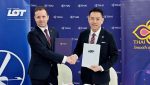
Bangkok Airways has reached an agreement with Thai Airways International Public Company Limited (SET: THAI) to jointly invest in the aircraft maintenance center (MRO) project at U-Tapao Airport.
Mr. Puttipong Prasarttong-Osoth, Chief Executive Officer of Bangkok Airways Public Company Limited (SET: BA), revealed the progress of the aircraft maintenance center project at U-Tapao Airport, in collaboration with THAI within the Eastern Economic Corridor (EEC).
Recently, an agreement has been reached with Thai Airways to jointly invest in the more than 200-rai land plot. However, the plan has been adjusted from establishing a joint venture (JV) company to separate investments, with each party managing its designated area, while still sharing some central areas and certain facilities. This adjustment allows Thai Airways to avoid the burden of investing in the entire 200-rai plot.
THAI will propose the project to its board of directors for approval, with signing of the lease agreement with the EEC expected within January this year. Initially, THAI has announced it will set up a subsidiary to run this project. Whether or not there will be more private sector partners is up to Thai Airways. The project is estimated to be worth 10 billion baht, with a 50-year lease term.
Bangkok Airways also benefits by not having to find a new location. The current clarity is awaiting official approval from the EEC. If granted, design work can begin immediately. The construction of the maintenance hangar is expected to take about 2 years and generate revenue immediately upon completion.
Regarding the progress of the U-Tapao Aviation City (UTA) project, which is a large-scale investment, Mr. Puttipong stated that negotiations with the Eastern Economic Corridor Policy Committee Office are underway to revise the investment plan. This is due to key issues regarding the high-speed rail project connecting the three airports, a main requirement in the government contract, not proceeding as planned. BA has proposed a new investment plan and assumptions based on the absence of the high-speed train. A timeline has been set for the government to address the issue, of about 1 year or until 3Q26. If no agreement is reached, the contract can be terminated. The company has already invested over 4 billion baht in consultancy and design fees.
Mr. Puttipong stated the company has a fleet development plan: it currently operates 22 aircraft. In 2026, it plans to add 2 Airbus A320 aircraft, and has signed to purchase 10-12 ATR72-600 aircraft to replace and expand its current ATR72-600 fleet. Two of these will be delivered in 4Q26 at a value of around 1 billion baht. There is also an ongoing Samui Airport development project, with planning and design focusing on passenger convenience and adherence to regulatory safety standards. Construction is expected to begin in mid-2026.
Samui Airport is BA’s main revenue route, accounting for 74% of total passenger income. It is also the only route with a notable 9% increase in advanced bookings. The company plans a major investment of 600-700 million baht next year to raise passenger capacity to 5-6 million people per year, and support the increased flight quota of 73 flights per day. A full redesign will separate domestic and international passenger check-in areas, doubling usable space, with the first phase of construction set for mid-next year, expected to take 2-3 years.
In 4Q25, Samui route continues strong with December advanced ticket bookings up 5% year-on-year, while 1Q26 advanced bookings are up 2%. Total annual revenue for 2025 is expected to remain steady from 2024’s approximately 23 billion baht, consistent with Samui ticket sales comprising about 70% of total group revenue, alongside stable low jet fuel (Jet A-1) prices.
The company is focused this year on enhancing route network, fleet, flight frequency management strategies, and airport development to improve profitability and passenger experience. Overseas ticket sales account for 82% of total passenger revenue, with 55% from Europe and the Middle East. Bangkok Airways is strengthening its alliance network, with ITA Airways, a member of the Lufthansa Group, being the latest interline partner, further expanding market opportunities in Europe.