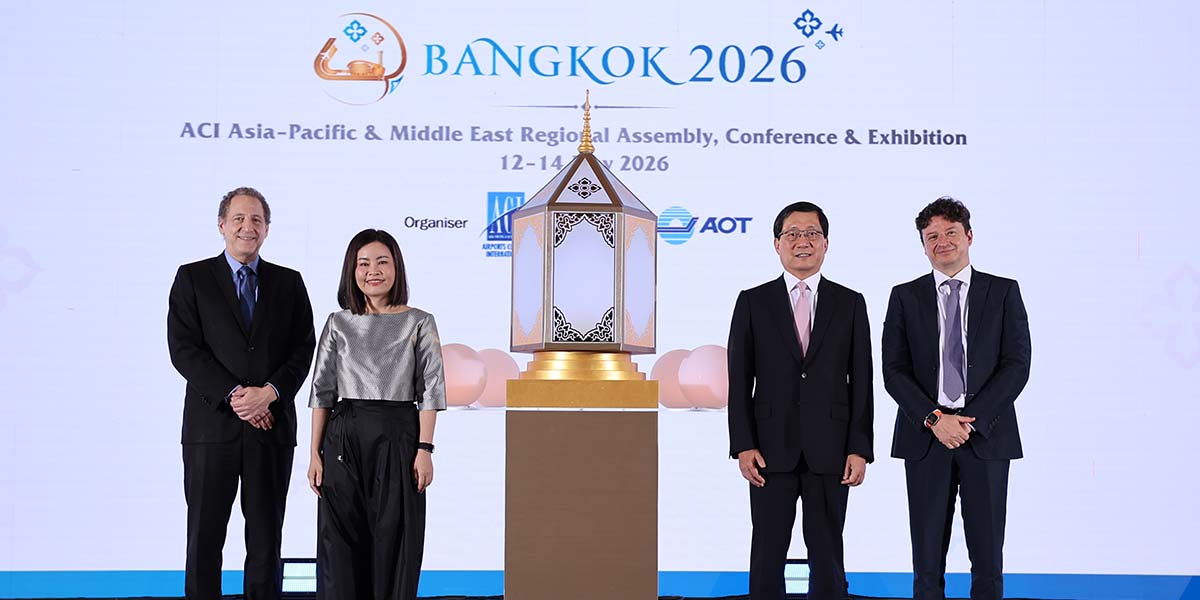
Ms. Paweena Jariyathitipong, President of Airports of Thailand Public Company Limited (SET: AOT), reiterated during the Airports Council International (ACI) Asia-Pacific & Middle East Regional Assembly, Conference and Exhibition 2026 (ACI APAC & MID RACE 2026), held in Bangkok from May 12 to 14, 2026, that AOT has a strategic goal to become a world-class aviation hub, prioritizing safety under international standards, excellent service, modernity, and sustainability.
The company also plays a role in driving the economy and strengthening national security, aiming to develop Thailand’s airports as destinations for global travelers and gateways connecting to neighboring countries.
This year, AOT is hosting the meeting under the main theme, “Airports as Engines of Shared Prosperity.” This annual conference is significant for the aviation industry in Asia-Pacific and the Middle East, gathering senior executives from leading airports, airlines, members of the ACI board, stakeholders, speakers, and experts to exchange best practices and explore the latest trends and technologies shaping the future of airports. It marks a pivotal step for Thailand in shaping global airport management direction and policies.
Ms. Paweena further stated that the ACI APAC & MID RACE 2026 comprises keynote speeches, panel discussions, workshops, and meetings for idea exchange, with representatives from all aviation and tourism industry sectors across Asia-Pacific and the Middle East participating. These include the Ministry of Transport, Tourism Authority of Thailand, Thai Airways, Changi Airport, Auckland Airport, Melbourne Airport, Hong Kong Airport, as well as regulatory bodies and ground handling and cargo service providers from various countries.
The conference activities are divided into subtopics such as airports in Southeast Asia and their socioeconomic impact, enhancing airport management systems to improve various capacities in both ground and air operations to deliver optimal user experiences, achieving net-zero greenhouse gas emissions for sustainable airport leadership, and choices between investing in new airports (Greenfield) or upgrading existing infrastructures (Brownfield).
In the first session titled “A Regulatory View on ASEAN Airports and Their Socio-Economic Impact”, Stefano Baronci, Director General of ACI APAC-MID, said that this year is a turning point characterized by intense change. He highlighted a historic shift: global economic centrality is reverting to Asia, with China and emerging markets now representing 40% of the global economy. While the digital era increasingly thrives on data rather than oil, current geopolitical conflicts in the Middle East have triggered severe disruptions.
Baronci emphasized that the Middle East conflict is effectively an “Asian crisis,” as the region relies on the Strait of Hormuz for 75% of its oil and 95% of gas. Aviation has been hit particularly hard; connectivity between Asia and the Gulf has plummeted by 40%, with flight disruptions at key hubs reaching 63% by late April 2026. Consequently, airfares have surged, with direct flights to the West costing double those routed via Middle East hubs. This instability is further compounded by environmental threats, such as rising sea levels sinking major Asian cities. Ultimately, Baronci frames this “morbid” transition as the difficult birth of a new, multipolar world order.