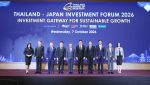
Ms. Naruechon Dhumrongpiyawut, Chief Executive Officer of Gunkul Engineering Public Company Limited (SET: GUNKUL), doubled down on the company’s major investment in the Philippines’ renewable energy sector, supported by a robust 6% economic growth rate and a population exceeding 113 million.
The CEO noted that the country’s increasing electricity demand and current power generation shortfall have opened lucrative opportunities for new investments, especially as the Philippine government seeks to boost its renewable energy capacity to 35% of the energy mix by 2030—an increase from 15 GW to 41 GW.
Earlier this week, GUNKUL announced its new venture, involving an investment in a 784 MW floating solar project at Laguna Lake, Luzon Island—the largest of its kind in the Philippines. The investment signifies GUNKUL’s strategic entry into the ASEAN clean energy arena.
There’s potential for an additional 200 MW expansion, as the main 784 MW project was developed in seven blocks. Each completed block will be able to commence commercial operations (COD) and recognize revenue immediately, expediting cash flow and enhancing overall project returns.
The project has secured the right to sell electricity under the Green Energy Auction Program (GEAP) through a 20-year Power Purchase Agreement (PPA) at a fixed tariff of PHP 6.53 per unit (approximately THB 3.53 per unit)—about 60% higher than the current feed-in tariff in Thailand. Its proximity to Manila, the nation’s economic center, ensures high demand and a stable power grid.
Moreover, the project has been awarded National Project of Significance status and Green Lane privileges, streamlining governmental approvals. Construction is slated to start in October 2026, with commercial operations beginning in late 2027 and full-year revenue anticipated for 2028.
The estimated investment is about $1 million per MW with a targeted Internal Rate of Return (IRR) of 14–16%. The main financial structure will be project finance, and EPC contractors from several Chinese companies are currently being selected.
GUNKUL has also partnered with two local firms: The original project developer and a transmission system specialist in the Philippines, to support construction, grid connection, and coordination with government agencies.
In the longer term, Ms. Naruechon added that the company aims for one-third of its portfolio to be international, complementing domestic growth from new power plant projects expected to come online in Thailand in 2026. The company highlights the stability and bankability of selling energy under the GEAP’s fixed tariff, compared to more volatile private contracts.
Krungsri Securities views the acquisition of a 40% stake in the project positively, citing the high feed-in tariff and the secure 20-year PPA as key strengths. If all blocks come online as scheduled by 4Q27, GUNKUL could see an annual profit share increase of around THB 1.2 billion, further strengthening its long-term outlook.
Bualuang Securities noted that this project is a major step into a high-potential ASEAN market and forecast a net profit of THB 1.6 million per MW for GUNKUL, adding approximately THB 792 million in profit from investments in 2028. With an upgraded target price of THB 5.50 per share—up from THB 4.30 —and a retained “Buy” recommendation, the analyst firm views GUNKUL as well-positioned for sustained growth, driven by both expanding capacity and regional diversification.